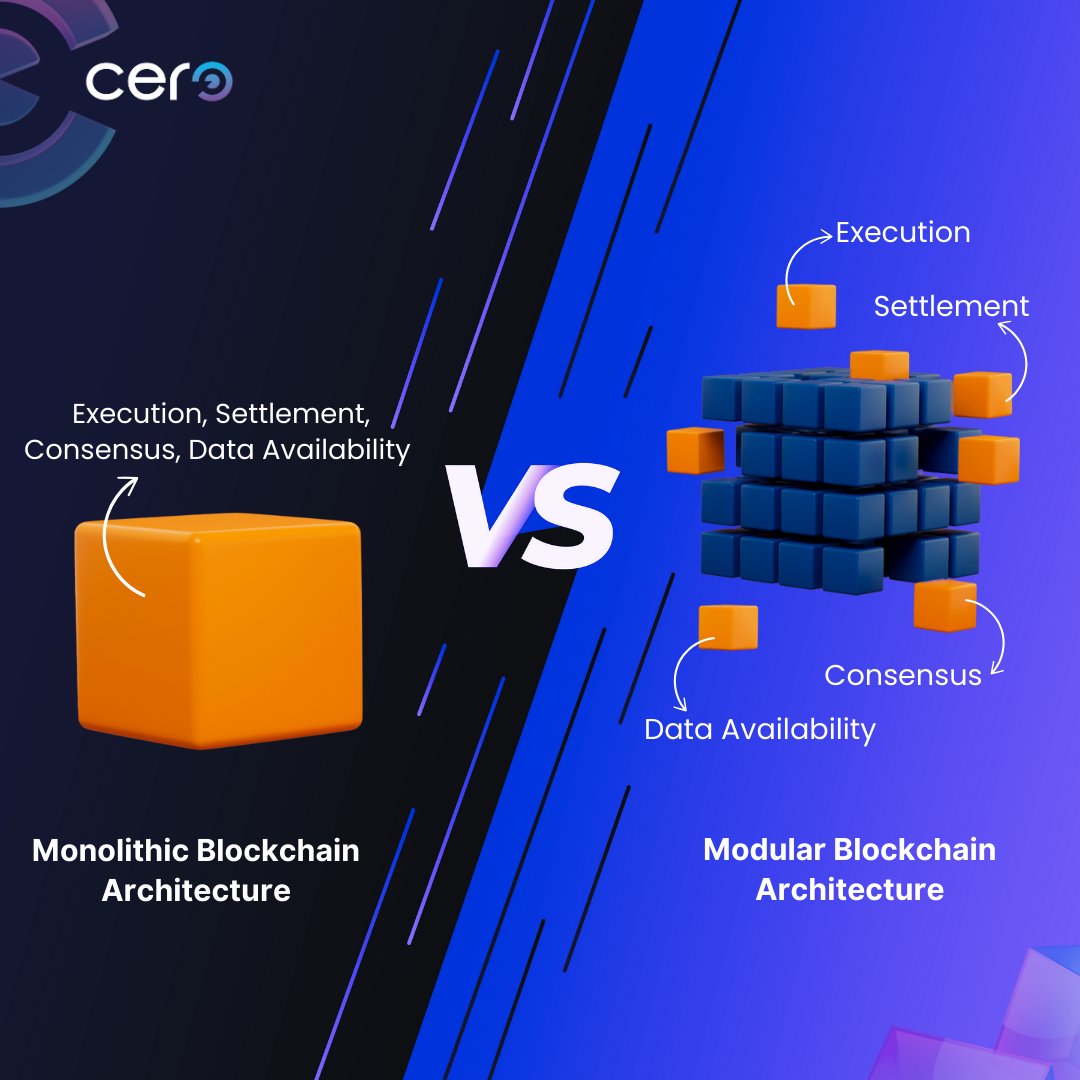
Monolithic chains = one machine doing it all.
Modular chains = specialized systems working in sync.
Here’s how the shift changes the roles of validators, sequencers & data layers, and why decentralized sequencing is a game-changer.
If you build or care about scalability, this thread's for you.👇
1) Monolithic VS Modular blockchain architecture
📃Understanding Their Roles – The distinction between validators and sequencers in different blockchain architectures.
The evolution of blockchain architecture is marked by a shift from monolithic to modular designs. This thread explores the technical nuances of this transition, with a focus on decentralized sequencing.
🟢Monolithic Blockchains: Integrated Design
Monolithic blockchains operate with a unified node network. This network handles:
- Consensus
- Transaction ordering
- Execution
- Data availability
This integration simplifies deployment but often leads to scalability bottlenecks as network demand increases.
How does modular differ? Find out below. 👇
Thread 🧵
🧱 Build your staking stack on solid ground.
With Zeeve's simplified, secure, and scalable staking node deployment ➡️ you can focus on Growth, knowing your Infrastructure is handled 🏗️
🔗 https://t.co/XdhFy4i4p7
#StakingNodes#Web3Infrastructure#Zeeve
When you trust one sequencer to run your rollup, you’re just one failure away from chaos.
What’s your take on relying on a centralized sequencer?
Let’s hear it!
🔺 Exclusively for Avalanche L1 builders
Traceye is offering zero-cost Consulting & Development for your Subgraph and SubQuery indexing needs.
No catch. No hidden fees. Just elite support to help you build faster, smarter, and better, only on @avax .
Let’s index the future.
The loudest conversations around MEV focus on the worst parts → frontrunning users, pushing up gas costs, gaming the system.
But the real story is more nuanced.
Some MEV strategies benefit users and protocols alike. If you’re building in DeFi or just curious about how this space really works, this thread will change how you think about MEV 👇🏻
#MEV #DeFi #CryptoThreads #Ethereum #Web3
#Blockchain #GasFees #OnchainAlpha #DeFiEducation #CryptoExplained
If you're building the next DeFi, Gaming, AI, Depin, and enterprise, this one’s for you 🫵🏻
Not just fast. Not just scalable. Trusted.
The next wave of builders won’t waste time on infrastructure.
They’ll launch, Iterate & Scale 🚀
That’s why we built https://t.co/xVMLrXqwyb, to simplify the launch of 🔺 @avax L1s for teams working on real innovation.
See how it works in our full walkthrough: https://t.co/bI2w5xblBW
#Cogitus #Avalanche #Web3Builders #DePIN #DeFi #Web3Gaming #BlockchainInfra #L1 #Zeeve
🏗️ Web3 innovation demands the best infrastructure.
Dedicated RPC Nodes deliver unmatched reliability, lightning-fast speed, and flawless consistency to keep your mission-critical systems running at peak performance.
No rate limits. No interruptions. Just seamless scaling.
Power your stack. Build without limits.
Come to Zeeve for enterprise-grade infrastructure 👉🏻https://t.co/xp6U5Fo15b
#Web3Infrastructure #RPCNodes #BlockchainInfra #Zeeve #BuildOnWeb3 #ScalableWeb3 #EnterpriseBlockchain #DecentralizedInfra #Web3Scaling
The future of blockchain doesn’t run on choke points. It runs on open paths and fair sequencing ✨
Decentralized sequencing isn’t a choice, it’s the foundation.
The power to choose what’s right is in your hands.
Choose Cero → https://t.co/vfJ3ZQGOx9
#FairTransactions #Ceronetwork #DecentralizedSequencing
Make querying blockchain data with @SubQueryNetwork easier than ever using @traceye_io !
💡 Benefit from rapid deployment and managed infrastructure, simplifying the setup and management of your SubQuery data retrieval pipelines.
Ready for the easy way?
Find the step-by-step guide on our blog! 👇 https://t.co/8zZRcyiu3m
#Web3Dev #Traceye #EasyDataRetrieval #SubQuery #GraphQLAPI
Cero isn’t just another sequencer.
It’s the one in the box.
📦 Protection from bad MEV – Included
📦 New revenue model – Included
📦 Centralized control – Not included
Shop now → https://t.co/0pXR9NzA5U
#CeroNetwork#CryptoRevolution#MEVProtection#DecentralizedControl #NewRevenueModel
5/5 Reality Check:
➡️ L2s are maturing, offering reliable and cost-effective scaling for a wide range of use cases.
➡️ L3s are cutting-edge, ideal for highly specialized applications demanding extreme customization.
➡️ 'Cheaper' is relative: L2s provide cost benefits for end-users, while L3s might be cost-effective for specific applications but carry higher development and infrastructure costs.
➡️ Data availability costs are a huge factor, and are currently in a state of rapid innovation.
In Summary:
✅ L2s offer scalable, secure, and generally cost-effective solutions for broad applications.
✅ L3s empower custom applications but require thorough cost-benefit analysis, especially regarding development and data availability.
✅ Always factor in development costs, security implications, and data availability strategies when making your scaling decisions.
#L2 #L3 #EthereumScaling #CryptoEcon #BlockchainEconomics #Web3Dev #SmartContracts #DecentralizedFinance #DeFi #Scalability #GasFees #Layer2Scaling #Layer3Scaling #Rollups
1/5 Decoding L2 vs. L3 costs ⬇️
It's not just about gas fees, it's about the entire economic architecture🏗️
Data availability, sequencer expenses, withdrawal complexities, development overhead, and security trade-offs all play a role. Which scaling solution truly optimizes your project's budget? 🛣️
Let's dive into the core financial considerations and uncover the hidden costs that can make or break your project.
Want to see the financial blind spots most developers miss when comparing L2s and L3s? 🤯 We're talking about the critical infrastructure and development costs that often outweigh transaction fees. This thread will reveal the true economic landscape of blockchain scaling. Prepare to be enlightened.
Thread below for a thorough analysis.
Thread 🧵
4/5. Critical Cost Considerations:
▪︎ Transaction Volume: L2s are optimized for high-volume general transactions; L3s are best for high-volume, application-specific transactions.
▪︎ Data Availability: A significant cost driver. Solutions like Celestia aim to reduce this.
▪︎ Security: L2s inherit security from L1; L3s rely on the security of the underlying L2.
▪︎ Customization: L3s offer maximum flexibility, but at a premium.
▪︎ Rollup Type: ZK-rollups (higher computation costs) vs. Optimistic rollups (potential withdrawal delays) also influence costs