Warsh's communications task force is co-led by three people with loads of expertise in how a central bank talks to markets:
• Peter Fisher (NY Fed from 1990-2001, the last half of that as the SOMA manager)
• Arminio Fraga (governor, Central Bank of Brazil, 1999-2002)
• Mervyn King (governor, Bank of England, 2003-2013)
This trio, compared to the other four, is probably the most markets-facing of the bunch. Fisher ran the desk that actually executes the Fed's operations and later worked at BlackRock; Fraga came out of Soros and later founded the hedge fund Gávea.
Fraga was parachuted into Brazil's central bank in early 1999, weeks after a currency crisis forced the real to float and sent it down more than 60% in a month. He stood up a full inflation-targeting regime in months, publishing explicit targets to give markets a new anchor after the old exchange-rate peg collapsed.
King ran the Bank of England for a decade, through the 2008–09 crisis. He's since become one of the sharpest critics of "forward guidance"—the practice of signaling where rates are headed. In a 2022 paper he argued it had become a liability. His point: the future is uncertain, so a central bank shouldn't pretend to know its own next moves. Instead of talking about the modal rate path, the Fed should explain how it reacts to a changing economy.
"The communications of a central bank need to focus on explaining its reaction function and developing a narrative about the state of the economy that changes over time meeting by meeting, report by report. The only forward guidance markets and economic agents need is an unswerving commitment to price stability." Link: https://t.co/vRvpbbDBWW
(It's worth noting, so far Warsh has sounded skeptical of spelling out that much, but it's early days.)
King is also known for his "Maradona theory" of interest rates—the idea that a credible central bank, like the soccer star who beat defenders by running straight while they braced for a swerve, can move markets through expectations alone.
Americans are leaving the U.S. in record numbers, drawn by a quality of life made easily affordable by the U.S.’s enviable salaries. https://t.co/UCpgTRtAWW
Federal Reserve Bank of Dallas President Lorie Logan says the Fed could shrink its balance sheet through regulatory changes that reduce banks’ demand for reserves during an event in Dallas https://t.co/PWBtUbAbO6
NEW ODD LOTS:
What War in Iran means for the 'teapot' oil refineries in China.
@tracyalloway and I talk to @Erica_Downs_ about what the closure of the Strait of Hormuz means for Chinese energy security. https://t.co/ZdGwLQJV8E
According to this excellent @WSJ story, Iran is today exporting more oil than before war broke out. That’s insane. First order of business for the US Navy is to stop any and all ship traffic out of Iran. That won’t spike oil prices. They’ll fall… https://t.co/C5wx98Hrfo
At its core, CBDC grants households and firms direct access to central bank liabilities in digital form. CBDC constitutes public money outright. If adopted at scale, it could displace deposits and alter the funding structure of banks.
https://t.co/GkCoVO3IoV
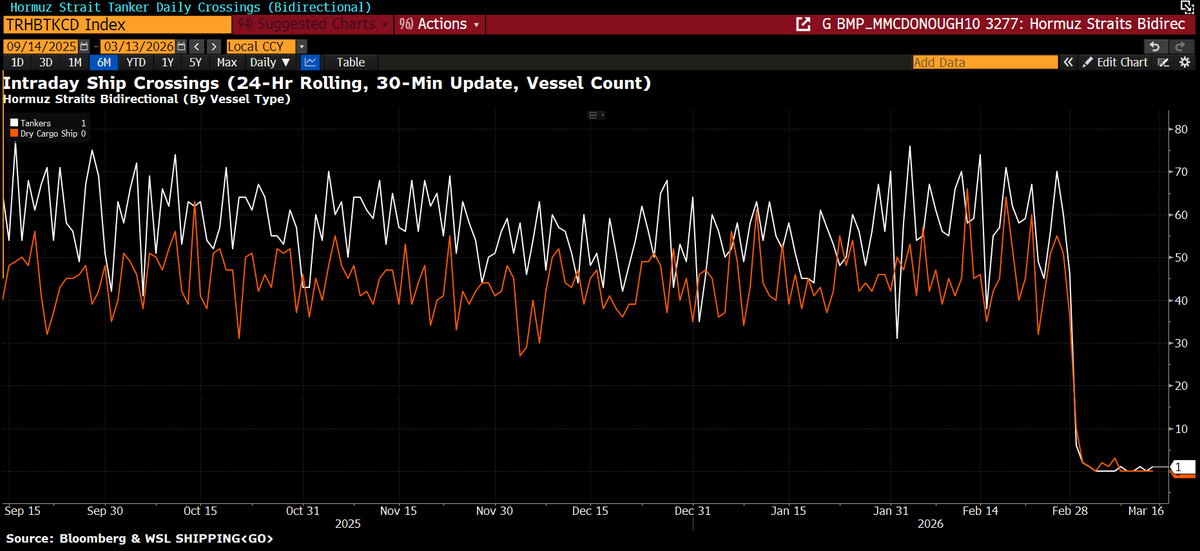
Data for Hormuz Strait vessel traffic, updated every 30 minutes
To monitor Hormuz Strait vessel traffic updated every 30 minutes, 24-hour rolling, type TRHBTKCD Index <Go> and WSL SHIPPING <Go> in Bloomberg.
(via Torsten Slok of Apollo)
Comptroller Jonathan V. Gould testified before the Senate on the OCC's supervisory approach of risk mitigation rather than risk elimination to empower banks to make sound decisions that support their communities and economic development.
HOW OIL COULD SURGE TO $200 AND BEYOND
@tracyalloway and I talk with @Rory_Johnston -- typically one of the least-alarmist people in oil -- about how the longer the Straight of Hormuz is shut, the greater the likelihood of an almost unimaginable disaster https://t.co/Qk7q5PZpk9
Subadra Rajappa, head of research at Societe Generale Americas, says US Treasuries “are not a good flight to quality hedge in this environment" https://t.co/pmz64D54t3
@Analystlearner Aw ok, so you’re talking about the long end of the curve specifically, in that case yea. But the fed is just using mbs proceed to buy 40b/month of tbills. My read was that asw tightening/flatening through January was mainly questioning around fed independance
A recent working paper from the Dallas Fed has modeled how the anticipation and realization of a closure of the Strait of Hormuz would affect the price of oil and the macroeconomy. https://t.co/edGNecdx1p
🚨 Five Functions to Follow 🚨
From faster bond pricing to smarter charting and securitized RV, here are five credit-friendly functions to add to your toolkit.
1️⃣ IBVL <GO>: AI-driven intraday bond pricing for a fast, trade-ready reference price.
2️⃣ CHRT <GO>: Find and filter credit-market charts, then refresh them with live data links.
3️⃣ NIA <GO>: Spot securitized RV with issuer curves, peer comps, and trade-driven spread trends.
4️⃣ ECST <GO>: Compare key econ indicators across countries and export your picks to Excel.
5️⃣ PF <GO>: Drag in Excel cash flows to solve PV/IRR and auto-calc metrics like duration.