One of the companies we have followed most closely at our Research.
$CGEO has been covered extensively by @Kamikazepartner and, since its addition to @albertrjf Model Portfolio, has delivered roughly +370%.
Another excepcional quarter from Georgia Capital 🇬🇪
Gideon Lewis-Kraus’s feature story “Sand Castles” in @NewYorker includes a remarkable statistic: in 2025, one in every 46 babies born in Taiwan was born to a family with a TSMC employee.
That sounded almost impossible, so I checked the math.
TSMC (VisEra included) had about 80,000 employees in Taiwan, roughly 0.54% of Taiwan’s population aged 20–64. Yet 2,331 of the 107,812 babies born in Taiwan, 2.16% of all births, were born to TSMC employee families.
So, mechanically, TSMC employees are overrepresented among the parents of newborns by a factor of 2.16/0.54, or about 4.
But this comparison is not quite right. TSMC has a very young workforce: the average employee is about 36, and almost 94% of employees are under 50. Comparing TSMC employees with everybody aged 20–64 is therefore not the right exercise.
Ideally, I would take the age and sex distribution of TSMC’s employees in Taiwan and apply Taiwan’s age- and sex-specific fertility rates. Unfortunately, the public corporate reports do not give me enough information to do this cleanly.
TSMC reports the sex composition of its Taiwan workforce, but the age-by-sex distribution I can find is for its worldwide workforce, not Taiwan alone. Moreover, the age categories are very coarse: 18–30, 31–50, and 51+. For fertility, whether an employee in the 31–50 group is 32 or 48 obviously matters enormously.
Thus, I do not think the data justify a precise age-adjusted estimate. But my best estimate is that TSMC employees in Taiwan have around 2.5 times more children than the average age-adjusted fertility, with a plausible range of roughly 2–3.5.
Of course, even a proper age adjustment would not identify a causal effect of working at TSMC. The selection problem is enormous. TSMC hires highly educated workers, pays them well, gives them unusually stable jobs, and provides generous family benefits. Finally, we have strong assortative mating in the marriage market.
In other words, the interesting exercise would condition not only on age and sex, but also on education, income, and marital status. My guess is that much of the remaining difference would disappear and that there is little causal effect of working for TSMC (in opposition to the large positive causal effect on fertility of having a high-income job with high education; yes, in most advanced economies those having more kids are the highly educated, high-income adults).
Still, the raw statistic is extraordinary: a company employing about half of one percent of Taiwan’s working-age population is connected to more than 2% of all the babies born in the country.
Fantástica tabla de @TorrasLuis.
Aquí la gracia es que estos sesgos no actúan de forma aislada, lo que en última instancia termina generando un efecto Lollapalooza o carambola.
La suma de las partes es mucho peor que cada uno de forma aislada.
Antes de que Adam Smith publicara "La riqueza de las naciones" en 1776, un puñado de frailes y profesores de la Universidad de Salamanca ya habían explicado buena parte de lo que hoy llamamos Economía, y casi nadie en España se acuerda de ellos.
En 1556 Martín de Azpilcueta explicaba que el dinero vale menos donde abunda, y por eso, la plata que llegaba de América disparaba los precios en Sevilla.
Es lo que hoy se conoce como teoría cuantitativa del dinero, y la formuló doce años antes de que el francés Jean Bodin se llevara la fama por decir lo mismo.
Ese mismo año Diego de Covarrubias defendía que el valor de las cosas no lo marca lo que cuesta producirlas sino lo que la gente las estima, y que el mismo trigo vale más en las Indias que en Castilla.
Luis de Molina sostenía que el precio justo es el que sale del mercado cuando no hay fraude ni monopolio, y que cuando la autoridad fija un precio por debajo, el trigo desaparece del mercado.
Juan de Mariana se atrevió a escribir que devaluar la moneda es un impuesto encubierto que nadie ha votado, y acabó procesado por ello.
Y Francisco de Vitoria, defendiendo que los indios eran dueños legítimos de sus tierras y que todos los pueblos, cristianos o no, estaban sujetos a un mismo derecho, sembró el germen del derecho internacional moderno.
Fue una inglesa, Marjorie Grice-Hutchinson, quien los rescató en 1952, y Schumpeter quien les dio el sitio que merecían en la historia del pensamiento económico, mientras aquí seguían prácticamente olvidados.
A partir de hoy iré contando sus historias, una a una, con datos, con fechas y con lo que tienen que decirnos sobre la inflación, los impuestos, los topes de precios o la pobreza.
Y de vez en cuando me tomaré la licencia de imaginar qué pensarían de nuestros problemas actuales, como la vivienda, porque muchos debates que hoy se venden como nuevos ya se discutieron en Salamanca hace casi 500 años.
#SalamancaLoDijoAntes
#EscuelaDeSalamanca
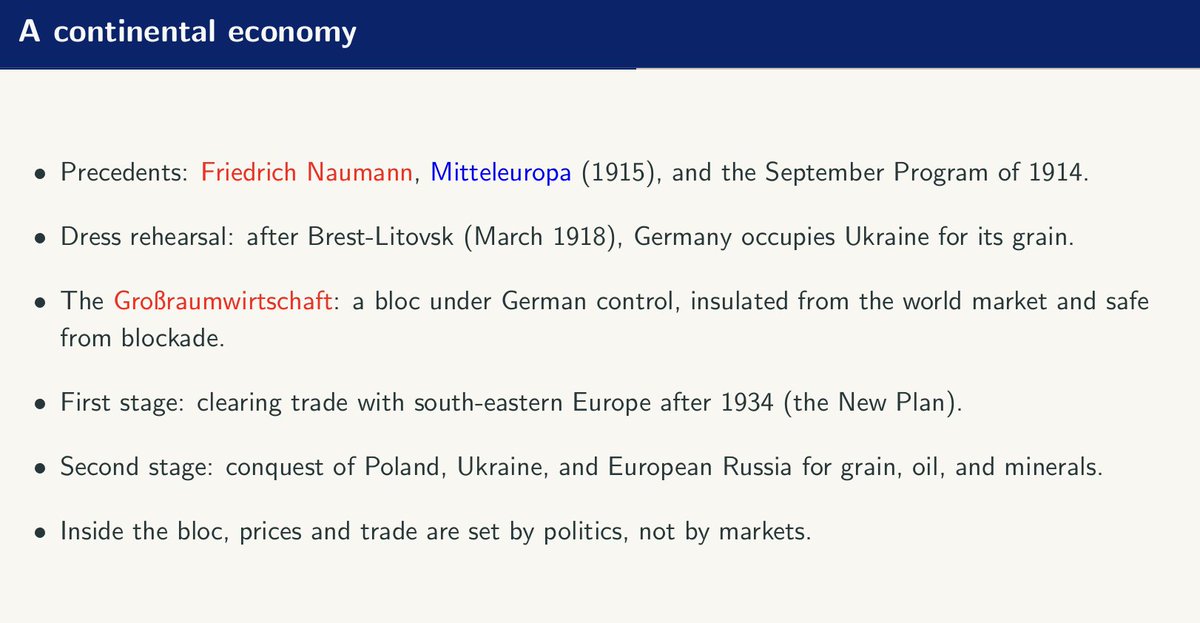
Today, I lectured on the economic history of fascism in my Global Economic History course. It is not a pleasant topic to discuss, but as I have mentioned before, I find it increasingly relevant. Tariffs as tools of statecraft, nationalist economic policies, the push for self-sufficiency in strategic goods, and the creation of closed economic blocs are back in the discussion.
The slides are here:
https://t.co/Aqo3tZb2mh
The situations are not equivalent (and far be it from me to make facile comparisons), but one cannot deny the parallels either. For example, is it a good idea for a regional hegemon to build an economic bloc and close it to trade with the rest of the world? Should a country seek to control the supply of critical inputs (oil and rubber in the 1930s, rare earths and advanced chips today) rather than buy them on world markets? What balance between power and rules should hegemons seek in international relations? How important are economies of scale in modern economic growth?
The last question is particularly salient. Many alternatives to the liberal international order, from the 1930s to today, argue that economies of scale are crucial for a developing state and that achieving them “playing by the rules” is hard. For example, AI is the ultimate increasing-returns-to-scale technology, and nations without control of frontier models will run their economies, culture, and knowledge production on an “operating system” someone else designed. In a world like that, what is the optimal economic strategy of a middle-sized nation?
As always, my goal in the lecture is not to provide answers, but to force students to think about these questions on their own.
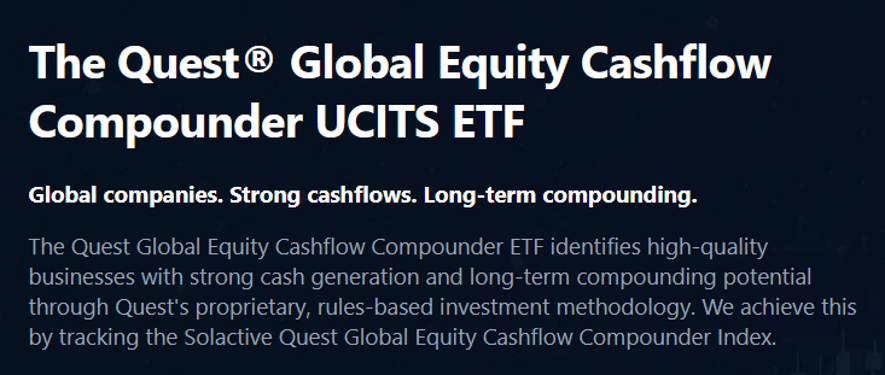
Mañana está previsto que empiece a cotizar en Londres un nuevo ETF que selecciona empresas por su CAPACIDAD DE GENERAR CAJA.
Se llama Quest Global Equity Cashflow Compounder UCITS ETF.
Aunque el producto es nuevo, su estrategia muestra un historial desde 2015.
¿Cómo es esto posible? Vamos a ver QUÉ COMPRA y cómo SELECIONA las empresas 🧵
En verde observamos el capital que ingresa a #bitcoin; motor propulsor de las tendencias alcistas
Desde agosto, viene siendo más el dinero entrando al activo vs el que sale (color gris)… pero nada sube en línea recta; hay momentos de “duda” como el que está experimentando $BTC
Esta semana el indicador mostrará debilidad “salidas”… manos débiles que venden el pánico del 3/noviembre; se hace lo contrario… COMPRAR
En mi último video lo expliqué… allí también cité: durante la siguiente tendencia alcista llegará 1 billón de dólares “nuevo” a $BTC, ese capital nos dejará arriba de $200k
Los inmigrantes (en especial los de baja cualificación, es decir casi todos los que vienen de fuera de la Unión Europea) EMPEORAN las cuentas de la seguridad social y el gasto público.
Eso de que los inmigrantes ayudan a "pagar las pensiones" es la mayor mentira económica que se ha contado en España en un siglo.
Aquí está bien explicado con números:
Yo también prefiero a Feijóo antes que a Pedro Sánchez de presidente del Gobierno mil veces.
Pero eso no quita para que mi predicción sea:
1) El gobierno PP-Vox no arreglará los problemas fundamentales de la economía española.
2) Las cosas irán empeorando de 2027 a 2030.
3) En 2030, año arriba, año abajo, tendremos un disgusto serio con alta probabilidad.
Creo que estoy de acuerdo. De toda la historia de la Humanidad, estamos viviendo el periodo más extraordinario, de mayor transformación, incertidumbre y -si no la jodemos por el camino- abundancia y progreso jamás vividos.
What a time to be alive…
¡Esto es todo amigos!
Gracias por acompañarme en este hilo
Si encontraste valor:
⚡ Sígueme para más contenido como este @SantiTorAI
🛎️ RT y Me Gusta para que más personas descubran estos consejos
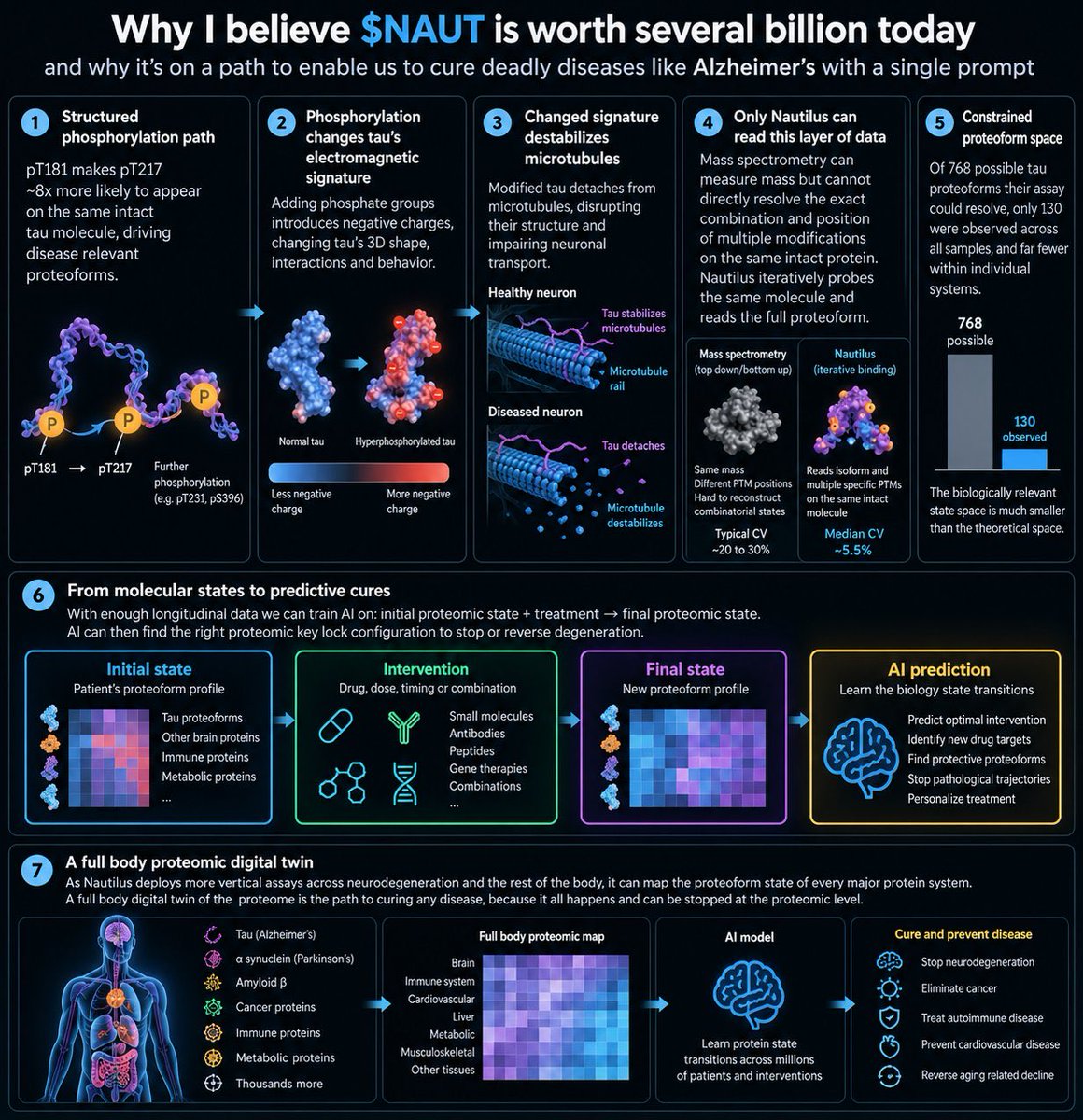
I believe $NAUT is worth several billion today, because it's on a path to enable us to cure deadly diseases like Alzheimer's with a single prompt by 2027-2028.
The breakthrough is not better protein measurement.
It is reading the state machine of human biology.
In Nautilus' tau paper, they found that phosphorylation is not random.
pT181 makes pT217 about 8x more likely to appear on the same intact tau molecule.
That matters because adding PO4 groups changes tau's charge distribution, which changes its conformation, which changes how tau binds microtubules.
Microtubules are the rails neurons use to move mitochondria, vesicles and proteins over enormous distances.
Tau helps stabilize those rails.
Change tau's molecular configuration enough and:
tau detaches → microtubules destabilize → transport breaks → neurons degenerate
Alzheimer's may therefore not be "too much phosphorylated tau."
It may be a progression through specific molecular states:
tau A → pT181 → pT217 → additional PTMs → pathological proteoform
And until now we largely could not read that combinatorial layer cleanly.
Mass spectrometry measures mass and charge extremely well, but two intact tau molecules can have the same mass while carrying the same phosphate at different positions.
Same atoms.
Same mass.
Very different biological behavior.
Fragmentation can help, but reconstructing the exact PTM configuration of millions of intact molecules becomes difficult.
Nautilus instead repeatedly interrogates the same intact protein with different probes.
Its tau assay currently reads isoform plus 7 phosphorylation sites, creating hundreds of potential molecular states, while reporting about 5.5% end to end CV versus about 25% cited by management as an industry benchmark.
And here is where this gets insane.
Biology does not appear to occupy every theoretically possible state.
Of 768 tau proteoforms their assay could resolve, they observed only 130 across all samples, and far fewer within individual biological systems.
That means the real state space may be highly constrained.
Now collect enough longitudinal data:
initial proteomic state + treatment → final proteomic state
Do that across millions of patients and interventions and AI stops being merely descriptive.
It becomes predictive.
Given molecular state X, what intervention moves the system toward healthy state Y?
That is effectively a biological key:lock search problem.
For tau alone, that could mean finding the intervention that prevents the proteoform trajectory that causes tau to abandon and damage the neuronal microtubule system.
But tau is just one vertical assay.
Add alpha synuclein.
Amyloid beta.
Cancer proteins.
Immune proteins.
Metabolic proteins.
Thousands more.
Eventually:
genome + proteoform state + treatment history → full body molecular state transition model
A genuine digital twin of human biology.
The endgame is not simply detecting disease earlier.
It is asking:
given this person's current molecular state, what intervention moves them back toward the healthy state?
And having an AI trained on billions of measured biological transitions produce the answer.
That is why I think $NAUT is building something much larger than a proteomics machine.
It is building the data layer required for AI to learn how to steer human biology.
ESTO ES ORO PURO
Anthropic recopiló todo lo que necesitas para dominar claude en una sola guía, y es GRATIS
Si esto hubiera existido hace un año, mi primera app me habría tomado un día, no 2 semanas
Guárdalo cuanto antes.
Enlace abajo👇
ÚLTIMA HORA 🚨: Claude ahora puede arreglar tu ordenador lento como un técnico informático que cobra 120 $ por hora.
Abre la aplicación de escritorio de Claude, dale acceso a tu ordenador y utiliza estos 7 prompts:
Mercedes sold its Tesla stake for $780 million. that same 4 percent is worth about $56 billion today.
in the clip below Musk explains how Mercedes ended up there. the US government gave Tesla almost $500 million, and he is asked directly whether that loan saved the company. he says no.
what saved it was a $50 million check from Daimler in May 2009. all of Tesla was worth $550 million then.
"they were the only ones. there was no other company, no other entity of any kind from which we could get investments."
Tesla repaid the government's $500 million with interest and a prepayment penalty, ten years early. he sent a thank you note with it.
"i don't like having a lot of debt. the taxpayers supported Tesla, we ought to repay them as soon as we can."
Mercedes turned $50 million into $780 million and walked away in 2014.
so was that a great investment - or the most expensive mistake in car industry history?