I guess the problem only becomes apparent to some people when companies accidentally lay off the person (in the name of AI) who is the single source of truth for some data.
This post neatly explains the rise of new AI roles. The execution phase of knowledge work was squeezed, so the other phases need to be staffed more heavily to compensate.
https://t.co/TtKh13qHnX
I'm a bit skeptical that "intelligence transformation" is a new issue introduced by AI. It has always been a major red flag when a single analyst effectively serves as your data catalog.
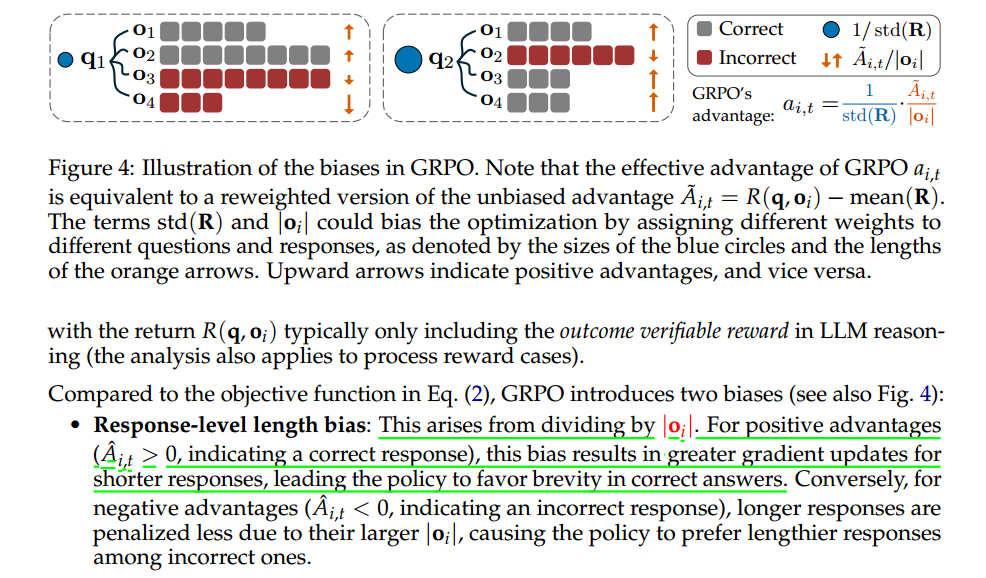
Using strong terms such as "length bias" and "biased optimization" repeatedly in the paper without a clear and accurate justification can make the paper confusing and frustrating to read.
The paper's interpretation of length bias is confusing and IMHO inaccurate. GRPO's normalization of the objective by length actually makes it length-neutral. The total advantage remains the same regardless of length. It does NOT create larger gradient updates for shorter outputs.
An interesting read! I really appreciate the detailed breakdown of how the training and eval data were prepared for Zeta2. I hope the team shares the datasets like they did for the first-gen model.
https://t.co/N0IBNY8fid
Instead, the main focus should be on figuring out how to effectively utilize coding agents in a way that is suitable for your organization and on advocating for that approach.
I fully agree that staff engineers should get hands-on experience with coding agents in 2026. However, I'd argue that learning and filtering emerging technologies have always been core functions of staff engineers.
https://t.co/rzEMxhbAxS
> I keep on seeing: the junior engineer, empowered by some class of LLM tool, who deposits giant, untested PRs on their coworkers—or open source maintainers—and expects the “code review” process to handle the rest.
This seems to be the norm these days.
https://t.co/sWnDSIJkel
Great points on ownership in this Oxide RFD. Using AI is fine, but blaming the model when a reviewer finds a bug is unacceptable. That abdication of responsibility should be Strike One for a junior engineer, and an immediate PIP for a senior one.
https://t.co/NHUHnR0t7y
But the worst part wasn't the code—it was her astonishing refusal to take ownership. We need to collectively draw a line in the sand: this behavior is professionally unacceptable.