Never played GTA. I've always been more of a strategy and FPS gamer, but Rockstar's launch campaign finally got me. FOMO is real!
$3.79B in launch-period sales, 32.5MM copies sold before release, and nearly half of estimated digital preorder revenue coming in the final week.
A remarkable example of product-led demand creation meeting growth-led execution. Years of customer loyalty, surprise and delight, amplified through a tightly coordinated GTM strategy.
Apparently, Rockstar acquired one more customer. I'll be checking it out between turkey comas! 🦃🎮
https://t.co/GxohADfvmA
@TaylorSicard@Seanfrank What exactly went wrong? AI is changing what SMBs will pay for. Retention can't fix a leaky acquisition funnel, and employees bear the cost too. https://t.co/MKt2M1TLHr
@FortuneMagazine I respect the exit, but what exactly went wrong? AI is changing what SMBs will pay for. Retention can't fix a leaky acquisition funnel, and employees bear the cost too. https://t.co/MKt2M1TLHr
I'm torn about Intuit selling Mailchimp for $3.68B, five years after buying it for $12B. I respect the discipline to exit, but I'm far more interested in the "how." Was it changing demand, product complexity, or an organization that couldn't adapt quickly enough?
AI is changing the price/value equation for micro-businesses and SMBs. Higher ARPU and better retention won't fix a new-customer funnel that's deteriorating. And we shouldn't overlook the employees who lived through this.
As an Evernote customer, I've seen Bending Spoons improve an established product. I hope Mailchimp gets the same attention.
https://t.co/KTacm7DAZT
I've been in politics for a quarter century. It's hard to express how staggering it is to see a conversation like this on corporate US media. The Morning Joe panel gobsmacked by the directness of @AbdulElSayed's points.
(clip via @DropSiteNews)
NEW: Mamdani’s message to Democrats after their election victories: lower living costs, “build, not bomb,” and put working people first. “It is not enough for us as Democrats to win power.
We have to use that power to deliver change that Americans can feel in their wallets.” Affordable housing.
Childcare. Results people can feel. That’s the mandate.
Zohran Mamdani on Iran:
I have to say that I find it quite ironic to read a post from the vice president as if he's describing the actions of a different administration.
He's the vice president of the United States of America. He is not just some commentator online.
And there has to be a reckoning of the fact that this is a war that they started. It's a war that they can end.
If they think it was a part of their political demise, then why don't they actually start to take some action to reflect that?
Microsoft's 60K buyout offer raises a bigger question than payroll savings. Azure was growing before generative AI. Can more AI infrastructure strengthen the cloud flywheel if the people who build and support it leave?
https://t.co/q1pEZP6riq
Apollo argues AI's payoff is largely confined to the Magnificent Seven. But how much of their growth comes from AI versus control of distribution? And after infrastructure and operating costs, who's earning a return? My take: https://t.co/b9jrfDOlJZ
Getty Images is preparing for Chapter 11. Getty. The company has the kind of publisher, sports, and entertainment relationships most CEOs would love to have.
So how does a business with that much of a head start end up here?
I went down a Michael Porter rabbit hole, and the question I came out with goes well beyond stock photos. And no, "AI did it" isn't much of an answer. 😄
https://t.co/93mqmQna08
In the future, understanding LLMs, machine learning and agentic systems will become basic operating literacy. Not everyone will need to build them, but understanding how they work, where they fail and how to apply them will become increasingly important across industries and professions. Ben Affleck is a great example of what it means to stay curious and keep learning.
Amazon analyzed 2MM+ campaigns and says ~20% of brand value shows up after the typical 7 - 30 day attribution window closes.
That’s not a small measurement error. That can completely change budget, CAC, LTV and growth decisions.
The bigger issue: if Amazon, Meta or Google are telling you what worked, what the customer is worth and where to spend the next dollar, they’re not just running media.
They’re increasingly owning the decision system.
Measurement isn’t a marketing analytics function anymore. It’s business infrastructure.
https://t.co/MHyOovg2y2
Meta is becoming our growth team, so the question is whether it’s making us smarter about the customer, or just making itself smarter?
Since ITP started changing the signal environment in 2018, it ushered in tighter privacy, loss of deterministic signals, and the ability for Meta and Google to reimagine the feedback loop through modeling, CAPI, Enhanced Conversions, and increasingly sophisticated AI.
That’s good technology; it's great, and we should want all of it.
The problem starts when better optimization gets confused with better customer understanding. If Meta can find my next customer better than I can, great. If Meta understands how my prospect’s needs are changing better than my company does, that’s a strategic problem.
CAPI gives the platforms better commercial truth, in relative terms, of course, e.g. ok to better fidelity. Their own data adds behavioral context. Consolidation gives their models more freedom. Agentic AI will eventually let those systems act on the intelligence themselves.
Brands need to do the opposite of retreating from the technology. Give the platforms better signals, but build stronger segmentation, creative hypotheses, cohort analysis, LTV, incrementality, qualitative research, and internal analytics alongside it.
Then train your own agents on that knowledge. The competitive advantage won’t be having AI. Everyone will have AI.
It’ll be knowing your customer better than anyone else, including the platforms you pay to find them. Here's my rant on my website, tell me what you think.
https://t.co/8L6wCeXhxZ
Oura is IPO’ing, so I spent some time in the S-1. Then my feed got flooded with charts, interesting artifacts, hot takes, and a healthy amount of AI slop explaining the business. Figured I’d throw in my two cents.
The underlying signals are good. 94%+ of ring activations convert to paid membership, ~85% 12-month paid-member retention, ~40% of new members come organically, and Oura now has 5MM paid members.
But I think the next leg of growth comes down to three things:
Segments. The averages are going to become less useful from here. 72% of members are women, 31% are Gen Z or younger, more than half report a chronic condition and members cite six reasons on average for buying Oura. That is a lot of very different customer journeys hiding inside one blended business. The growth team needs to understand acquisition source → reason for buying → engagement → renewal → upgrade → referral → lifetime contribution. Otherwise segmentation eventually becomes a growth ceiling.
Health. This is the part I think people may still be underestimating. In practical terms Oura makes the invisible visible. Sleep, recovery, stress, heart health, metabolic signals and increasingly more of what is happening inside our bodies becomes understandable and actionable. The ring is the entry point. The bigger opportunity is becoming one of the ways people actually understand and manage their health.
Integrations. Oura already supports 1,200+ partners. That can be a massive accelerant if those integrations actually connect insight to action: healthcare, women’s health, metabolic health, employers, care providers, etc. But 1,200 integrations can also just become 1,200 logos. I’d want to know which ones materially change engagement, retention, referrals and LTV.
There are watch-outs. Hardware margins aren’t amazing, warranty costs can bite and operating margins are still relatively thin. But I think Oura may be getting evaluated too much against what the product is today.
The ring itself is still evolving. The much bigger question is how much of the health journey can ultimately run through it.
Reuters: Oura reveals revenue surge in U.S. IPO filing (https://t.co/FgBJywjXe3)
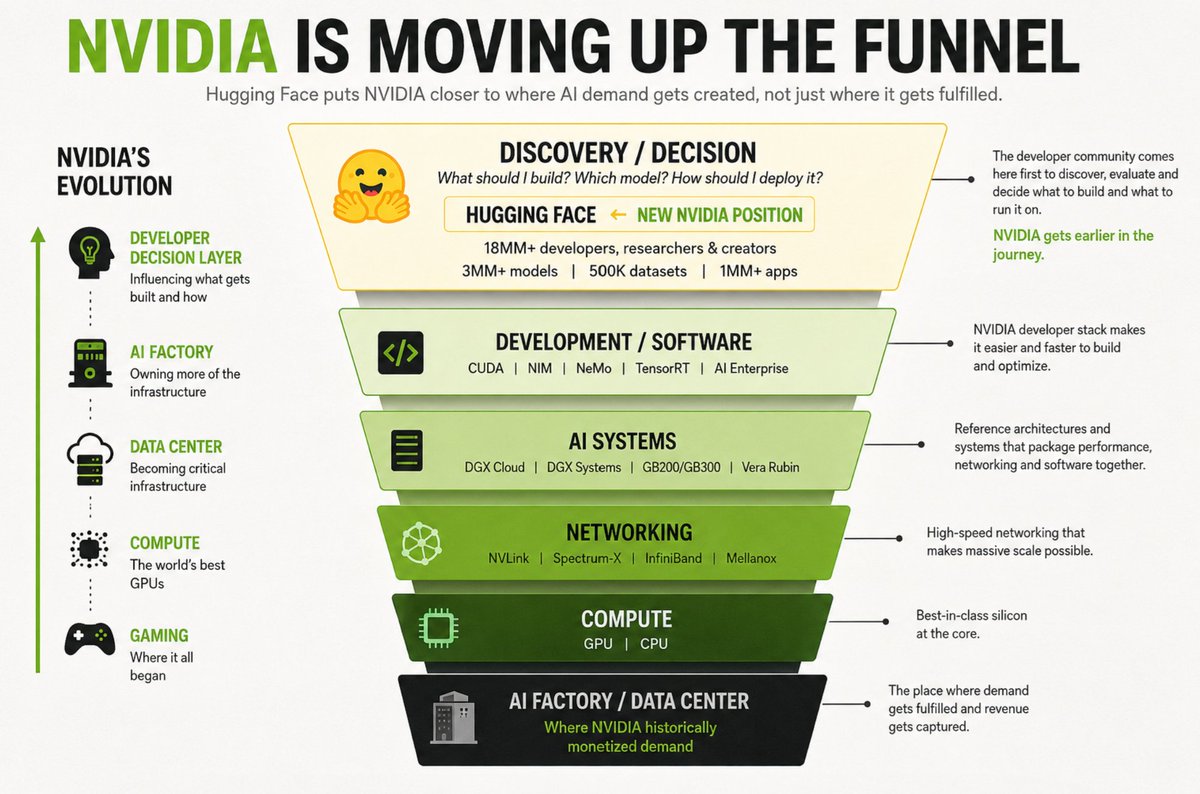
Paying ~86x revenue for anything is obscene. Yet NVIDIA is spending nearly $13B on Hugging Face.
This isn’t about buying $150MM of revenue. It’s about buying the network, distribution and a place much further up the AI decision funnel.
Gaming → data centers → AI infrastructure → developer ecosystem.
NVIDIA keeps growing up.
https://t.co/XOYxIEWAF0
I’ve spent years with Salesforce somewhere near the center of my growth operating system. Claudeforce is a smart move, but I think the bigger story is what happens when AI becomes the front end and CRM becomes infrastructure.
Phase 3 is where it gets really interesting: context may become more valuable than the record itself.
https://t.co/etIndte4cC
Decades spent optimizing websites around the assumption that consumers would navigate them to make a decision.
AI inverts that. Research → compare → evaluate → decide increasingly happens with AI. The website becomes less of the pathway...
My take: https://t.co/eW3ePBu236
Alibaba's Wan3.0 can turn a spreadsheet into a 30-second video.
We're rapidly solving the cost of producing content. The problem is attention isn't becoming any less scarce.
If creative becomes infinite, intent becomes a lot more valuable.
My take: https://t.co/VI9xTKj3KA