Norman Jackson climbed out of a Lancaster bomber onto the wing, in the freezing slipstream, four miles above Germany, to put out an engine fire with a hand extinguisher while the aircraft flew on through the night. It is one of the most physically unbelievable acts of courage in the history of the air war, and the fact that he survived it at all is a miracle.
Jackson was a flight engineer, and by April 1944 he had already finished his tour of 30 missions. He did not have to fly again. But his crew still had sorties to complete, and he would not let them go without him, so he volunteered for one more, a raid on Schweinfurt. On the way home a German night fighter tore into them, ripped open the wing, and set the fuel tank ablaze. A wing fire on a bomber full of fuel meant the aircraft would explode within minutes. Everyone aboard knew it.
Jackson, already wounded by shell splinters, did the only thing that might save them. He got a fire extinguisher, strapped on his parachute, and had his crewmates feed the rip cord out slowly so his canopy would billow behind him as an anchor. Then he pushed himself out through the hatch into a 200 mile an hour wind and hauled himself out onto the wing of the flying bomber, in the dark, at 20,000 feet, and started fighting the fire by hand.
He nearly did it. He got the extinguisher onto the flames and had the fire coming under control. Then the night fighter swung back for another pass and raked the aircraft again. Jackson was hit in the legs, the fire flared back up and burned his hands and face, and he was swept off the wing into the night. His parachute, already burned by the fire, streamed out only partly open and smouldering.
And he lived. He fell four miles with a half-burned parachute and hit the ground with a broken ankle, a shattered leg, and terrible burns, but alive. The Germans found him and he spent ten months in hospital before a POW camp, from which he later escaped. His own crew, who bailed out and assumed he was dead, survived to tell what he had done, and that is the only reason the story is known.
They gave Norman Jackson the Victoria Cross. He climbed onto the wing of a burning aircraft in flight to save his friends, and then fell out of the sky on fire, and got up and walked away from it.
My name is Justin and I have a Disability today is my Birthday and I am officially 30 Years Old all I want is millions of birthday wishes with the hashtag #HappyBirthdayJustin This is all I want for my birthday it make my day
Actor William Fichtner explains how the lowest point of his career, long before his success, became the turning point that kept him going:
He shares a moment from his early days in New York when everything he'd worked for felt like it was slipping away.
"I think I was 30 years old and I was in New York and I hit the end of the road. I ran out of money. I had no commercial residual. I had nothing."
After a few years of scraping by, a little money in theater and a few residuals from commercials, he had to go back to waiting tables. And it crushed him to compare himself to everyone he'd come up with:
"I felt like I was falling backwards and I was 30 now. Everybody that I knew I graduated college with [had] a company car and I was just... it was depressing."
He describes the morning he went to ask for a brunch shift at the White Horse Tavern in the West Village, a place he knew people went to:
"I woke up. I was brushing my teeth. I started crying. I really was. I was walking that street going, 'Just, it's all right, man. It's all right. You're not falling backwards. You're not going off the end of the earth.'"
On the walk, it got worse before it got better. He passed someone from his past:
"I passed a guy that I hadn't seen in a couple of years that was like kind of like an old friend. And I said hi to him and he walked by and he just kind of looked at me like he didn't recognize me. It was horrible. It was just horrible."
Then he walked into the restaurant, and the manager met him with hostility, telling him he was on the schedule the day before, hadn't even started, and was already fired.
But instead of breaking him, it freed him:
"I said, 'Thank you.' I walked out of there. I said, 'I have absolutely nothing right now and I'm feeling so good and I'm not working at your f****** restaurant today, buddy.'"
He went home to find a place to re-energize. Looking back, that brutal day became a great one:
"Just great, great day."
The lowest point can feel like proof you're failing, but sometimes it's just part of the process. Years before his success, that morning could have ended his career. Instead it became the turning point that kept him going.
Completely unacceptable performance by Chelsea. Embarrassing. No organisation, no heart, no fight, no pride, no leadership, no goal threat. It’s like they’ve given up at Brighton. Just because they’re near the beach doesn’t mean they’re allowed to be on it. Shameless performance. No wonder the fans are furious. These aren’t useless players, they’re internationals, which makes their abject showing at the Amex even worse. Overpaid underperformers.
Liam Rosenior will probably pay the price for this string of shameful displays and results, he’s out of his depth, but he’s the symptom of the malaise at Chelsea, not the cause. Club needs some grown-ups, experienced football people in the boardroom, in the recruitment department and in the dressing-room. Chelsea are such a contrast to Brighton & Hove Albion, who are so well-run on and off the field. BlueCo has to look, listen and learn. Because Boehly and Eghbali are currently overseeing a self-inflicted shambles. #CFC
What a brilliant , moving post match interview from Frank Lampard after Coventry City’s promotion. Paying tribute to some who are not regulars was typical and thoughtful. In my few exchanges with him, I always felt I was talking to a top human being. And I was right.
In Medellín, Colombia, there is a corner of the Manrique neighborhood where, every night at exactly 3 a.m., sandwiches used to appear.
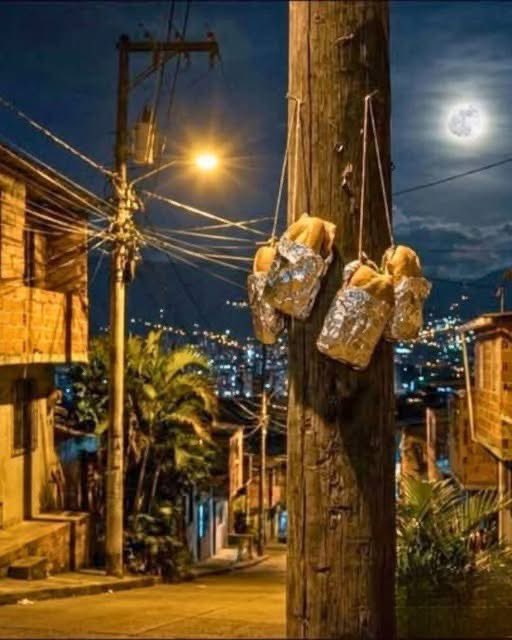
Always the same way: wrapped in aluminum foil, inside a plastic bag, hanging from a lamppost.
No one knew who left them.
The unhoused people in the area waited for them. If you arrived at 3:15, there were none left.
It happened every single night. For six years. From 2016 to 2022.
Never a single absence. Not in the rain. Not on Christmas. Not on New Year’s Eve.
Then, in 2022, suddenly, the sandwiches stopped appearing.
“What happened to the sandwich man?” people asked.
A social worker named Carolina began to investigate. After weeks of asking around, a night security guard told her, “I saw him. He was an elderly man, came on a motorcycle. He hung up the bag and left. Without saying a word.”
Carolina posted an appeal on Facebook, looking for the man who, for six years, had left sandwiches every night for those who had nothing. In two days, it was shared more than 8,000 times.
Then a comment appeared:
“I think it was my father. But he died five months ago.”
The woman was named Lucía. Her father, Hernán, was 68 years old. He worked in construction. He didn’t have much money. But every night he prepared eight sandwiches. And he left them on that corner.
Why?
In 2015, Hernán lost his son, Sebastián, who died on the street, right there in Manrique. He was 19 years old. A fragile boy, struggling with addiction. Hernán had searched for him for years. But he hadn’t been able to save him.
“If someone had given him food… maybe he’d still be alive today.”
So, two weeks after the funeral, Hernán began. Every night. Without ever missing one. Sometimes with just bread and butter, when the money wasn’t enough.
In six years, he made 17,520 sandwiches.
He never wanted to know who ate them. He used to say, “If I know them, I’ll start choosing who to give them to. This way, they’re for anyone who needs them.”
When the story went viral, many people wrote:
“I ate those sandwiches for four years. They saved me.”
“They were the only thing I ate on some days.”
“Today I have a home, a job. But I might not be here without those sandwiches.”
One month later, at dawn, 43 people gathered at that corner. All of them had eaten Hernán’s sandwiches. They lit candles. Brought flowers. Lucía was there, in tears.
“My father couldn’t save my brother. But he saved so many others.”
One of them said, “Those sandwiches kept me alive. Waiting for them every night gave me a reason to hold on. Today I’ve been clean for two years. I exist because of him.”
That’s how a group was born: “Hernán’s Sandwiches.”
Forty-seven people take turns. Each one prepares sandwiches one night a month. They leave them in the same place. At the same hour.
Two years have passed. And the sandwiches have never stopped appearing.
On the lamppost there is a plaque: “Here, for six years, a father left 17,520 sandwiches for children who were not his. Because he could not save his own. Hernán, your son would be proud of you.”
Lucía comes back every month. Always at 3 a.m. To check. And she always finds a bag.
Because true love, even in silence, leaves a trace that never disappears.
And you… what would you be willing to do, every night for six years, to honor someone you couldn’t save?