I always believe that the core of judging a successful meme lies in whether it can accurately capture and amplify a widespread, easily relatable collective emotion, thereby sparking the community's spontaneous spread and remix culture.
I think ethereum:0x163f8c2467924be0ae7b5347228cabf260318753 needs attention for the following reasons:
Under optimistic conditions, OpenAI's IPO could happen in September of this year. A conservative estimate might be Q4 of this year
Although Sam Altman's direct benefit may be limited, indirect benefits are still possible, such as increased personal influence, profits through his personal fund or investment portfolio, and everything related to the Sam Altman narrative. He himself will become a super IP in the AI field. This includes WLD, where any major positive news about OpenAI often triggers a narrative-driven short-term price increase. WLD is a project developed and operated by Tools for Humanity, providing World ID through iris scanning
The sentiment and capital spillover from an OpenAI IPO will definitely seek out targets related to Sam Altman, just like when Elon announced the SpaceX IPO, related meme coins emerged like crazy
Therefore, I believe WLD is already experiencing sentiment-driven speculation during this news development period. The overall driving factors include: AI sector popularity, strong connection with Sam Altman, the OpenAI IPO, and the possibility that World ID may coordinate with OpenAI's future products
The official OpenAI IPO news will serve as the main catalyst for WLD's price increase. Those who like to trade based on news flow should pay attention
However, WLD's unlocking pressure is quite large, which is an obvious risk point
The above content is entirely my personal understanding and analysis (dyor). If you have other opinions, feel free to discuss them in the comments
solana:J4x1EMmQjF6WEzXq2tUtzY89x5aMhYz5CzfevcJEpump 786m dyor
CA:J4x1EMmQjF6WEzXq2tUtzY89x5aMhYz5CzfevcJEpump
okx wallet:https://t.co/EZ2Y85J5q2
A token on Pump's new platform, pump fun GO
Completing missions on the official website allows you to earn bounties. These missions involve doing incredible or challenging things, such as: live streaming to snipe famous streamers, capturing video clips, going to crowded places to get 10 people to buy, or putting up billboards
In the past, when people bought coins, only the holders would share the token with others. Now, many people who want to earn bounties will do these missions, and the essence of these missions is to continuously generate traffic and attention for the token
When any of these missions is completed and gains huge exposure, the true effect will become apparent
I just went out and did not buy in immediately. I will wait and see what new mechanisms come next
The above content is entirely my personal understanding and analysis (dyor). If you have other opinions, feel free to discuss them in the comments
solana:SV151D5pjygAKA8aJJcKzm4wFnRX5G92Fye94jQJk7g 2.56m dyor
CA:SV151D5pjygAKA8aJJcKzm4wFnRX5G92Fye94jQJk7g
okx wallet:https://t.co/G56bwnuzg5
MeteoraAG, a liquidity infrastructure protocol developed by the original team behind Jupiter Exchange, has launched its first Dynamic Asset in collaboration with Sunrise DeFi. This represents another attempt by Solana in the RWA space, bringing real-world collectibles onto the chain. It is a tokenized version of sealed Pokémon SV151 series booster packs
Each token is 1:1 backed by a physical booster pack. These packs are securely stored in a custodial warehouse of the Bedrock Foundation and have been audited
In a few hours, could we see news about Moonshot?(But I feel that the current market cap is not a good entry opportunity)
The above content is entirely my personal understanding and analysis (dyor). If you have other opinions, feel free to discuss them in the comments.
The $gWEMBY mentioned in the quoted tweet represents Victor Wembanyama's 2023 Panini Prizm Silver Rookie Card PSA 10. This is one of the most representative and highest market value Rookie cards, also regarded as one of the "blue-chip" assets in modern basketball collecting
$gSPEED 1.23m dyor
CA:0xa0dd634a9d3c91829081fc66b90103a3e5c6aeec
okx wallet:https://t.co/y2ZhzLlFiF
Grail is a project that fractionalizes real-world collectibles onto the blockchain, primarily focusing on physical items such as trading cards and sports memorabilia. It operates essentially as a launchpad
In simple terms, the projects operational rules are as follows:
1- High-value physical collectibles are stored in a vault
2- Corresponding g tokens are issued, with each g token representing a small fraction of ownership of the underlying physical item
Users can buy these tokens with a small amount of money, achieving fractional ownership. They can trade them 24/7 on-chain or redeem them for the physical item at any time
Compared to the traditional collectibles market, this offers several obvious advantages:
1- Higher liquidity: previously, selling a collectible might require waiting months to find a buyer. On-chain, tokens can be traded directly
2- Lower barrier: previously, ordinary people could not participate in high-value collectibles. After fractionalization, small capital can also participate
3- More transparent pricing: all transaction records are on-chain and traceable
Regarding the project's background: 1confirmation is the core supporter and actual driver of the project. This is a well-known crypto VC fund founded by former Coinbase employee Nick Tomaino. They bought approximately a 1% share of Victor Wembanyama's most expensive rookie card, a Prizm Silver PSA 10, and fractionalized it on-chain as the gWEMBY token
gSPEED is a token representing a signed card of iShowSpeed, with a PSA 10 grade, and only 2 such cards are known to exist worldwide. Grail placed both of these rare cards into its vault and issued 20,000 gSPEED tokens
In simple terms, Grail transforms high-end physical collectibles, which were previously only accessible to the wealthy or professional collectors, into on-chain assets that ordinary people can trade and fractionally own at any time
The above content is entirely my personal understanding and analysis (dyor). If you have other opinions, feel free to discuss them in the comments
solana:9UuLsJ3jf8ViBNeRcwXD53re5G3ypgfKK3s2EiMMpump 314k dyor
CA:9UuLsJ3jf8ViBNeRcwXD53re5G3ypgfKK3s2EiMMpump
okx wallet:https://t.co/0LcojLGcro
Magpie is a permissionless lending protocol
By staking meme coins or tokenized stocks as collateral, you can obtain SOL tokens within seconds. All operations can be completed within a Telegram chat. Each repayment increases your on-chain credit score
The on-chain credit score is also an innovative feature: the credit score is publicly recorded on-chain. Anyone who repays on time can increase their score, unlocking better terms in the future
Besides borrowing, there are other ways to participate and earn money:
1- Provide liquidity. Deposit SOL into the liquidity pool and automatically earn 80% of all loan fees
2- Hold MAGPIE tokens. Earn 10% of each loan fee. Every MAGPIE in your wallet generates passive income. The platform takes regular snapshots, and the earnings are automatically deposited into your wallet in SOL
3- Refer friends. Earn a 5% lifetime commission on the loan fees of the people you refer
The project's "permissionless" nature is reflected in the aspects mentioned above. "Anyone, anytime, without permission" can participate as a borrower, lender, keeper, or MAGPIE holder. All operations are driven by publicly auditable smart contracts, not platform approval or intervention. This is typical of DeFi permissionless lending, which is completely different from traditional centralized lending
The reason I am editing this post is that, while looking at the token holding addresses, I saw some wallets with good past profits that have not even taken out their principal, nor have they closed their positions on gake. (This is not investment advice.)
The above content is entirely my personal understanding and analysis (dyor). If you have other opinions, feel free to discuss them in the comments
solana:C3fawupKrXdn3X7KPTmmnkwzJQ9qycMNag55ZzQ8pump 776k dyor
CA:C3fawupKrXdn3X7KPTmmnkwzJQ9qycMNag55ZzQ8pump
okx wallet:https://t.co/qMTzeZHDqJ
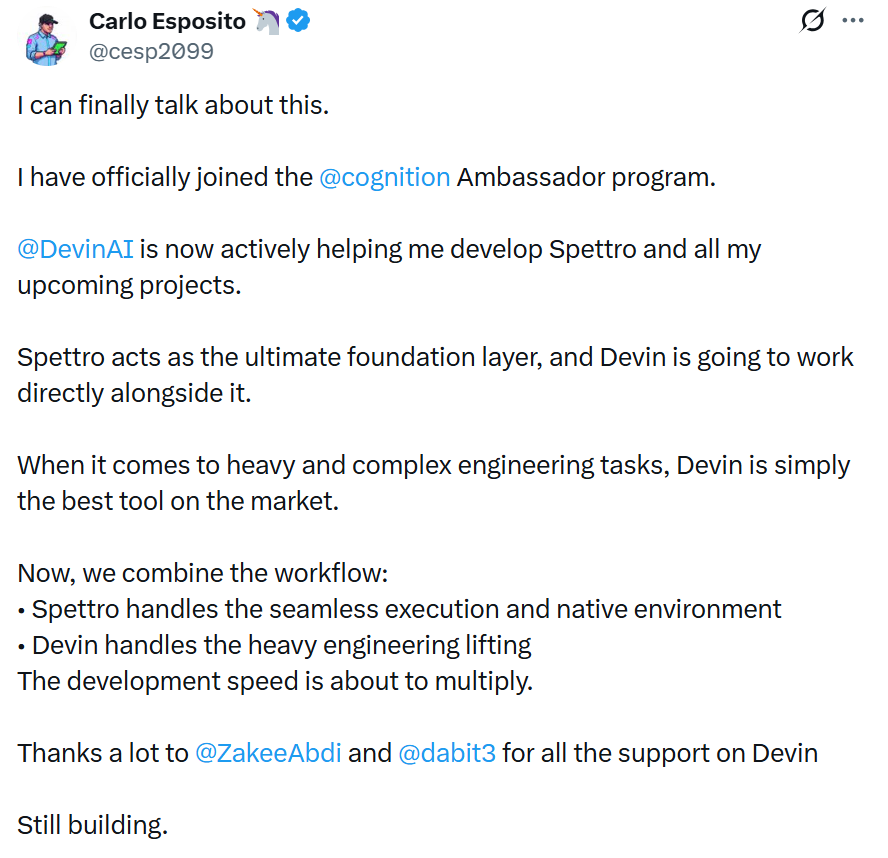
Spettro is a fully open-source, lightweight, terminal-first multi-agent AI coding assistant project designed for developers, enabling efficient operation of local AI agents with very low resources
Project core highlights:
1- Built with Go + Bubble Tea TUI: a terminal-native interface that supports explicit multi-agent role division, with clear handoffs between agents rather than a single prompt covering everything
2- Extremely lightweight + security control: supports parallel multi-instance, persistent sessions, explicit project trust handshake, approval processes, and encrypted storage of API keys
3- No vendor lock-in: compatible with Anthropic, OpenAI interfaces, and local models
4- Core workflow: Trust a project → Connect a model → Plan → Approve execution → Resume. Suitable for real repository-level development
Last year, the overall AI agents market was approximately 7 to 8 billion USD, with the AI coding sub-market around 3 to 10 billion USD. Spettro, as a lightweight open-source terminal multi-agent tool, is still small in size. However, it has precise positioning, capturing the CLI + multi-agent + low-resource trend, and has significant entry space within a billion-dollar market
The reason is that AI has evolved from "code completion" to "autonomous agents executing complete tasks." Recent years have marked the beginning of the Agentic Coding era. Developers need multi-agent division of labor, persistent sessions, secure approval processes, and terminal-native execution, rather than cloud-based black-box IDEs
Spettro perfectly aligns with this trend, through its extreme lightness, high controllability, and open-source transparency, becoming a genuine "terminal tool" in developers' hands
The SPETTRO token is used for paying for AI inference, subscriptions, Marketplace transactions, etc., within the platform. However, most revenue is directed toward continuous open-source development
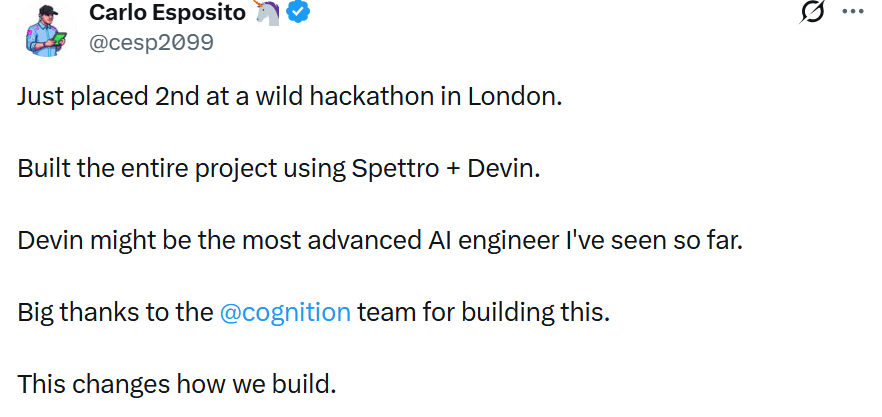
The developer is Carlo Esposito, who has joined the Cognition ambassador program and won second place in a hackathon sponsored by Cognition. Currently, Spettro is being actively assisted in development by DevinAI, with Spettro handling seamless execution and the native terminal environment, while Devin handles heavy engineering tasks
Since DevinAI is an autonomous AI software engineer launched by Cognition, "Devin actively helping with development" is seen as a strong technical endorsement
In summary, Spettro, despite its small starting size in the tens-of-billion-dollar and rapidly growing AI coding market, through its correct technical direction, clear positioning, and the Cognition ambassador program, has enormous future growth potential. It not only has product competitiveness but also a clear token utility scenario supporting an ecosystem closed loop
The above content is entirely my personal understanding and analysis (dyor). If you have other opinions, feel free to discuss them in the comments
solana:69LjZUUzxj3Cb3Fxeo1X4QpYEQTboApkhXTysPpbpump 3.1m dyor
CA:69LjZUUzxj3Cb3Fxeo1X4QpYEQTboApkhXTysPpbpump
okx wallet:https://t.co/n4LSTLyzlA
CodecFlow is a one-stop platform for robot development. Its goal is to make robot development as easy as developing a webpage, connecting the entire process of simulation, training, deployment, and financing, allowing users to get started quickly from a browser
They use large AI models as the "brain" and act as the execution engine, allowing AI to actually control physical or digital systems through "Operators." This is not limited to robots but also supports desktop automation, web operations, and more, greatly lowering the barrier to entry, achieving deployment in weeks rather than months, and providing a unified execution layer from digital automation to physical robots
The advantages of this approach include eliminating the problems of the traditional robot manufacturing industry, such as fragmented tools, high barriers, slow iteration, strong hardware dependencies, difficulty transferring from simulation to real-world, and challenges in AI execution implementation, as well as ecosystem issues
Coupled with the fact that demand for intelligent robots is high and growing rapidly, as they move from laboratories to manufacturing, logistics, healthcare, service, and home applications, the demand for robot software platforms, simulators, and automation tools is exploding. Browser-based or cloud-based low-barrier tools are particularly suitable for education, startups, and research labs. Therefore, CodecFlow's prospects are very broad
The project token is CODEC. The distribution is: 65% public market, 15% ecosystem, 10% team, etc., with some vesting
It provides a shared economic layer for CodecFlow, used for access, staking, reputation, market incentives, and contributor rewards. It helps coordinate creators and users in this market. Creators should be rewarded if their work is useful. Users should be able to discover trustworthy workflows. The ecosystem should allow good tools to spread more easily
As the CodecFlow product generates usage, the ecosystem can channel value back to CODEC through buybacks, rewards, and other value accrual mechanisms. This officially starts the economic flywheel: usage increases → executing workloads generates revenue → a portion of revenue is used for CODEC buybacks + rewarding developers. When someone uses a robot or AI component published by a developer to complete a task, the developer automatically receives money. This makes the platform better and the token stronger → attracting more developers and users → more operators, data, and usage → a positive cycle
The above content is entirely my personal understanding and analysis (dyor). If you have other opinions, feel free to discuss them in the comments
Next time you encounter a situation similar to solana:FeMbDoX7R1Psc4GEcvJdsbNbZA3bfztcyDCatJVJpump you can use this line of thinking:
A reliable and actually working product plus an active development team makes the news of the IBM partnership a huge call machine. It brings exposure, attracts new capital, becomes a powerful catalyst for price increases, and leads to token repricing
Can it be understood this way? Large companies usually have strict due diligence processes, which act as a "high-quality filter." They do not partner casually. A partnership often implies that the project has actual technology or product, compliance potential, and the ability to solve enterprise pain points. Buying the related token is like betting on this "early-stage asset that has been initially recognized by a major corporation."🤔
Next time you encounter a situation similar to solana:FeMbDoX7R1Psc4GEcvJdsbNbZA3bfztcyDCatJVJpump you can use this line of thinking:
A reliable and actually working product plus an active development team makes the news of the IBM partnership a huge call machine. It brings exposure, attracts new capital, becomes a powerful catalyst for price increases, and leads to token repricing
Can it be understood this way? Large companies usually have strict due diligence processes, which act as a "high-quality filter." They do not partner casually. A partnership often implies that the project has actual technology or product, compliance potential, and the ability to solve enterprise pain points. Buying the related token is like betting on this "early-stage asset that has been initially recognized by a major corporation."🤔
The $gWEMBY mentioned in the quoted tweet represents Victor Wembanyama's 2023 Panini Prizm Silver Rookie Card PSA 10. This is one of the most representative and highest market value Rookie cards, also regarded as one of the "blue-chip" assets in modern basketball collecting
$gSPEED 1.23m dyor
CA:0xa0dd634a9d3c91829081fc66b90103a3e5c6aeec
okx wallet:https://t.co/y2ZhzLlFiF
Grail is a project that fractionalizes real-world collectibles onto the blockchain, primarily focusing on physical items such as trading cards and sports memorabilia. It operates essentially as a launchpad
In simple terms, the projects operational rules are as follows:
1- High-value physical collectibles are stored in a vault
2- Corresponding g tokens are issued, with each g token representing a small fraction of ownership of the underlying physical item
Users can buy these tokens with a small amount of money, achieving fractional ownership. They can trade them 24/7 on-chain or redeem them for the physical item at any time
Compared to the traditional collectibles market, this offers several obvious advantages:
1- Higher liquidity: previously, selling a collectible might require waiting months to find a buyer. On-chain, tokens can be traded directly
2- Lower barrier: previously, ordinary people could not participate in high-value collectibles. After fractionalization, small capital can also participate
3- More transparent pricing: all transaction records are on-chain and traceable
Regarding the project's background: 1confirmation is the core supporter and actual driver of the project. This is a well-known crypto VC fund founded by former Coinbase employee Nick Tomaino. They bought approximately a 1% share of Victor Wembanyama's most expensive rookie card, a Prizm Silver PSA 10, and fractionalized it on-chain as the gWEMBY token
gSPEED is a token representing a signed card of iShowSpeed, with a PSA 10 grade, and only 2 such cards are known to exist worldwide. Grail placed both of these rare cards into its vault and issued 20,000 gSPEED tokens
In simple terms, Grail transforms high-end physical collectibles, which were previously only accessible to the wealthy or professional collectors, into on-chain assets that ordinary people can trade and fractionally own at any time
The above content is entirely my personal understanding and analysis (dyor). If you have other opinions, feel free to discuss them in the comments