100% local — no cloud, no telemetry, no token proxying. It runs on the subscriptions you already pay for. GPL-3.0, open source.
→ Site: https://t.co/G7U8EGzLur
→ Install: https://t.co/hf0QKS7iiV
→ Code: https://t.co/5GSoBr9uln
This is early and I'm building it in the open — I'd love your help. Bugs, rough edges, feature ideas, runtime requests (which agent CLI next?) → https://t.co/xYSbMTHLWH ⚡ RTs appreciated 🙏
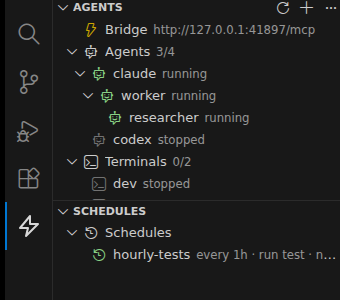
Meet Tachyon ⚡ — run a fleet of AI coding agents inside VS Code: each one a real terminal, all coordinating through an embedded MCP server. Bring your own CLIs (Claude Code, Codex, Gemini, OpenCode…). 100% local. Free & open source. 🧵
The problem: running 3–4 agents today means alt-tabbing between terminals, babysitting which one stopped to ask you something, and losing the whole fleet on a reboot.
Mini-tutorial:
1. Install "Tachyon" from the VS Code Marketplace (needs tmux — Linux/WSL/macOS)
2. Open a folder and declare your agents in a tachyon.yml:
agents: { claude: { cmd: claude, autostart: true }, codex: { cmd: codex } }
3. Hit ▶ in the ⚡ sidebar — each agent opens as a native editor terminal. The real TUI, not a wrapper.
Config-as-code: your comments survive UI edits. And agents survive VS Code restarts — tmux owns the processes, Tachyon re-attaches.
The core trick: an embedded MCP Bridge. One agent spawns sub-agents, reads their output, writes to them — spawn_agent, write_input, read_output, notify. Agents that orchestrate agents.
Tachyon also watches every pane and tells you — and your other agents — who needs you (prompt detection), who's idle (CPU-aware, so a thinking agent is never flagged as stuck), who crashed (exit code + frozen postmortem). No more babysitting.
And new this week: session resume. A reboot, wsl --shutdown, or an OOM kill takes your agents down? Reopen the folder and they come back WITH their conversation — claude --resume, codex resume… Your fleet survives the machine, not just the editor.
Plus: human-gated schedules (cron for agents), curated commands & runbooks, shared human↔agent pins, multi-root workspaces, and a tmux server inspector.
@VivendodeSaas So nao tá compensando fazer em rust + tauri , claude code alucina muito ainda mesmo cercando o agente de todas formas e provavelmente vai precisar de um sidecar rodando node, dai vai de electron mesmo
● Análise completa salva em .spock/research/2026-03-02-anthropic-prompt-eng-tutorial.md.
Resumo das melhorias identificadas
O tutorial revela 3 gaps principais no nosso processo:
Alta prioridade
1. Few-shot examples nos skills — O tutorial diz que exemplos são "the single most effective tool" e nós temos quase zero. Skills como
spock-task-create e spock-prd-create deveriam ter 1-2 exemplos concretos de input/output.
2. XML tags no https://t.co/7DtrJWTotU — Nosso pipeline de prompt monta tudo em markdown concatenado. Envolver dados injetados (task spec,
arquivos pre-lidos) em XML tags previne confusão instrução/dado — exatamente o que o capítulo 4 ensina.
Média prioridade
3. "Give an out" — Padrão barato: dizer "only answer if certain" reduz alucinações. Temos o Uncertainty Protocol no https://t.co/UoitiNoG86 mas não
reforçamos dentro dos skills individuais.
4. Evidence-first scratchpad nos audits — Antes de emitir veredicto, extrair evidências em tags <evidence>. Mapeia direto pros nossos
audit skills.
5. Task restatement no final — O tutorial nota que colocar a pergunta/tarefa no final do prompt dá melhores resultados. Nosso
https://t.co/7DtrJWTotU deveria repetir o objetivo após o contexto pré-lido.
Baixa prioridade
6. Prefilling no claude -p e stop_sequences para reduzir tokens desperdiçados.
Quer que eu implemente alguma dessas melhorias agora?
✻ Brewed for 3m 16s
thanks