Claude Fable 5 will be available again globally tomorrow.
After a series of productive conversations with the US government, we're redeploying the model with a new set of classifiers to target and block more cybersecurity tasks. In the near term, some routine tasks like coding and debugging will fall back to Opus 4.8. We’ll continue to refine these classifiers over the coming weeks to reduce false positives and better distinguish genuine misuse from legitimate requests.
We’ve also begun drafting a consensus framework—with Amazon, Microsoft, Google, and other Glasswing partners—for assessing the severity of AI jailbreaks and how AI developers should respond to them. We invite other industry partners and model providers to join us in this effort.
Finally, we’re scaling up our collaboration with the US government on model testing and safeguards. This will include pre-release access to models and safeguards for evaluation, information sharing on jailbreaks and misuse, and dedicated resources for joint research.
Thank you to our users for your patience, and to our partners across the government, industry, and the research community who worked alongside us to make Fable 5 available again.
Read our full blog: https://t.co/VHyum831ri
Claude Fable 5 will be available again globally tomorrow.
After a series of productive conversations with the US government, we're redeploying the model with a new set of classifiers to target and block more cybersecurity tasks. In the near term, some routine tasks like coding and debugging will fall back to Opus 4.8. We’ll continue to refine these classifiers over the coming weeks to reduce false positives and better distinguish genuine misuse from legitimate requests.
We’ve also begun drafting a consensus framework—with Amazon, Microsoft, Google, and other Glasswing partners—for assessing the severity of AI jailbreaks and how AI developers should respond to them. We invite other industry partners and model providers to join us in this effort.
Finally, we’re scaling up our collaboration with the US government on model testing and safeguards. This will include pre-release access to models and safeguards for evaluation, information sharing on jailbreaks and misuse, and dedicated resources for joint research.
Thank you to our users for your patience, and to our partners across the government, industry, and the research community who worked alongside us to make Fable 5 available again.
Read our full blog: https://t.co/VHyum831ri
The founders who build lasting products usually do three things themselves:
-They decide what problem is worth solving.
-They decide why it matters.
-They decide when to change direction.
AI can help with the how, but those three decisions are still yours.
#developers
❌User → LLM → Ans
vs
✅User →Research Agent → Verification Agent → LLM → Ans
Same model. Completely different outcome.
Most startups spend months chasing the newest model while ignoring system design.
The future of AI isn't just bigger models.
It's better orchestration
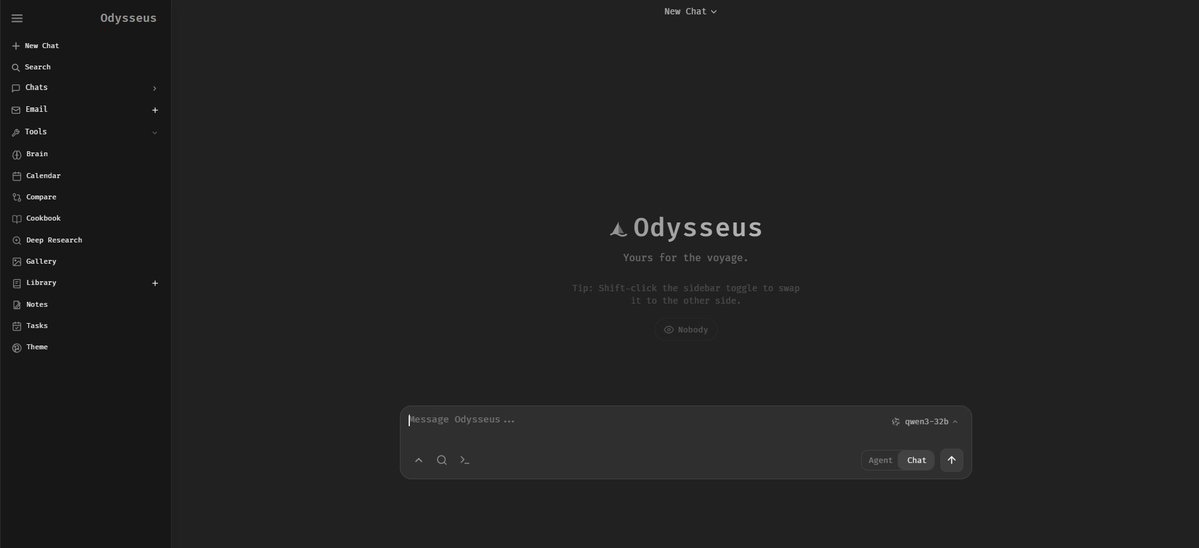
8/ Whether Odysseus succeeds or not isn't the most interesting question.
The interesting question is:
How many software workflows will eventually be handled by agents instead of humans?
My guess: far more than most people expect.
What AI projects have impressed you recently?
I spent the last few days exploring Odysseus and got it running locally with Docker Compose.
My biggest takeaway:
We're entering an era where AI agents are becoming software users, not just chatbots.
🧵
7/ My current learning strategy is unusual:
Rather than mastering every concept first, I'm exploring advanced projects and then filling in knowledge gaps as they appear.
It's messier.
But it creates stronger motivation to learn.
#LearningJourney
Japan's latest model, Sakana Fugu, delivers a full multi-agent orchestration system as a single foundation model. It dynamically orchestrates the world’s best models to tackle complex, multi-step tasks, accessible through a single model API.
#sakana
Combining the best of OpenAI models and Codex with a singular mission: to secure software continuously. Daybreak is the force multiplier cyber defense has been waiting for.
Introducing Daybreak: frontier AI for cyber defenders.
Daybreak brings together the most capable OpenAI models, Codex, and our security partners to accelerate cyber defense and continuously secure software.
A step toward a future where security teams can move at the speed defense demands.
I'm delighted that @coursera and @udemy have come together as one company to serve learners.
Both Coursera and Udemy were founded with the belief that access to high-quality education changes lives. Over the years, both companies have advanced this goal, creating opportunities for individuals, organizations, and communities around the world.
That role is even more important now, as AI is changing the nature of work and increasing the need for continuous learning. Helping people build job-relevant skills will be critical to how we create a better world.
By combining the strengths of both companies, we can better serve this need. We bring together a broader range of learning content, trusted instructors and educators, and engaging learning experiences. This creates new opportunities to make learning more personalized, more applied, and more accessible at scale.
I’m excited to serve as Chairman of the combined company, working alongside Greg Hart and the leadership team. There is a strong foundation in both organizations, and I look forward to what the teams will build together to expand access opportunity globally.
Learn more: https://t.co/QpCwBmqWTJ
we should really need to reform laboratories and tech communities....not just confined to the universities but also outside ...
People should have common room with common interests and that will be one way to bring change in tech....
#cscommunity
DeepSeek-R1's breakthroughs in LLM reasoning are impressive, but their failed attempts offer an even deeper lesson. They struggled defining per-step rubrics for Process Reward Models (PRMs) due to reward hacking, and Monte Carlo Tree Search (MCTS) proved unfeasible given LLM's vast token search space, with value model training too challenging. These aren't just dead ends; they're critical signposts for where the limits currently lie.
What practical hurdles are you seeing?