Professor at Northwestern University. Teach finance at UC-Booth. Former Economist and Senior Policy Advisor at Federal Reserve and Professor at UMich and Yale.
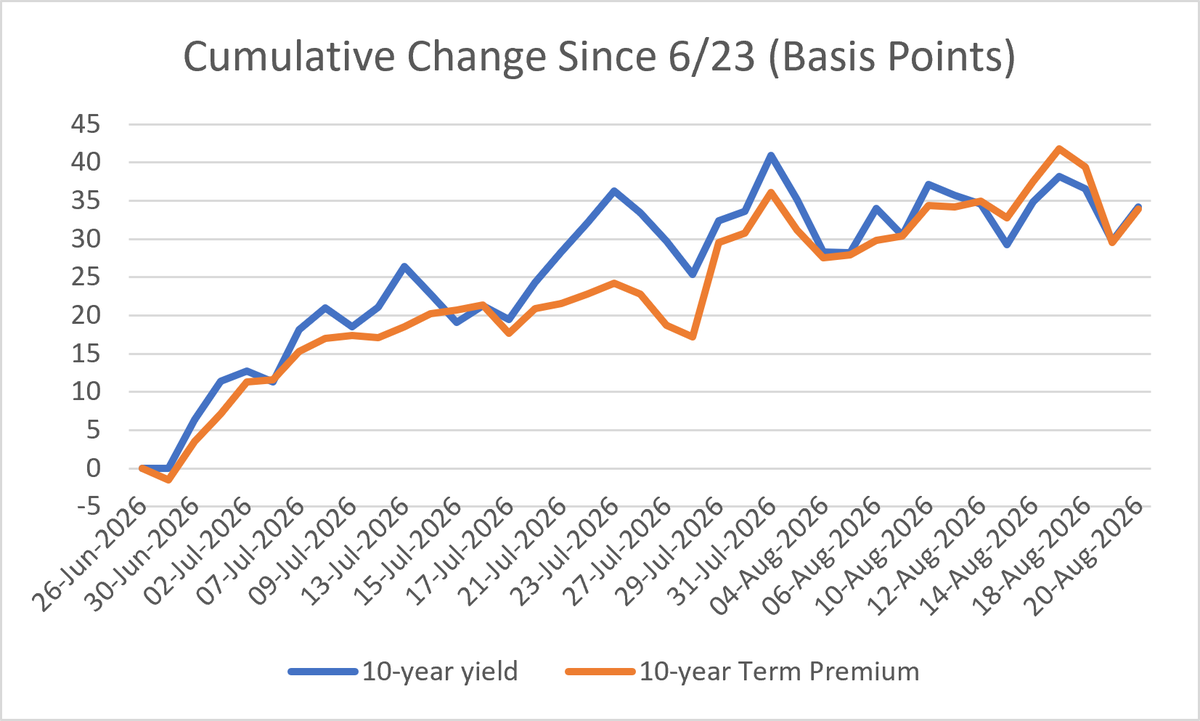
Yields are rising in other G7 nations too. The rise in the US 10-year yield is almost entirely due to risk averse investors demanding a higher term-premium to compensate for holding interest sensitive assets.
Uncertainty about the policy path or issuance are two of the biggest drivers of the term premium, but neither can explain the increase in yields since the June lows. Instead, the run-up in yields is best explained by models of contagions runs...
https://t.co/WlnygubFw3
What's driving the increase in bond yields?
A new post on the blog: https://t.co/5yagcKIfDd
Neither the increase in issuance nor changes in uncertainty can explain the increase in bond yields over the past 8 week. Fear of future issuance and models of contagious runs do fit the data, however.
I talk about what these models predict can happen to bond yields and what datapoints I'm looking for from Jackson Hole and the economy.
I’m not sure it’s hedge funds stepping away. Most hedge funds in basis trades prefer to fund through London banks so the Treasuries end up being collateral in euroclear repo rather than FICC (which is SOFR statistics). This is also why the UK has skyrocketed up the list of nations holding US treasuries. That’s all HFs entering the basis trade and funding in euroclear.
@ekwufinance We are above the 95th percentile in almost any valuation metric. What does that mean? Chances of a large (20%+) decline are greater and expected return going forward is lower. Does that mean you should exit the market? Probably not...
https://t.co/wihhVWer4G
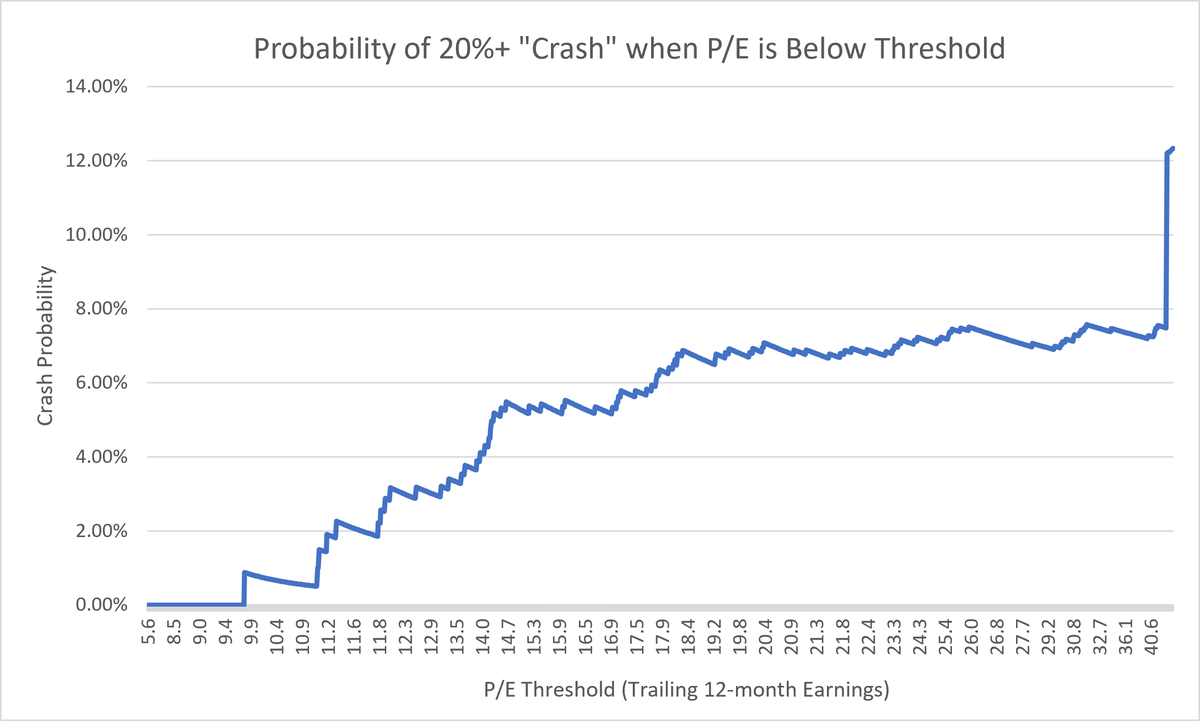
The S&P500 trailing 12-month P/E is above its historical 95% percentile. Do elevated valuations coincide with elevated crash risk? Yes!
Using Mishkin and White's (2002) definition of a "crash" as a 20% decline in the next month, quarter or year, crashes have occurred about 7% of the times that P/E has been this elevated over the past 100 years.
Elevated P/E has predictive power for crash risk. Does that mean an investor should get out of the market when P/E is this elevated? Not necessarily!
Even with the more frequent severe drawdowns, the equity premium has been so large that an investor who stayed in the market regardless of P/E earned higher returns than an investor who exited when P/E was this high. The false positives (high P/E but no crash) were frequent enough to outweigh the losses during a crash.
Those high returns come with more volatility, however, so the decision to stay in the market depends on the risk aversion of the investor.
Agree but with aging population we won't run even a primary surplus for the foreseeable future. Long interest rates are only 4.5-5% so if we can get 6% nominal GDP growth (big if) without blowing up interest rates we can be the anaconda swallowing the pig of baby boom retirement and maybe make it. But there's a lot of implausible ifs in that plan.
Is this 4-deminsional chess?...
Trump says cut rates --> fed raises rates instead--> enhances market belief in Fed independence --> bond market is relieved and lowers term premium and inflation expectations --> and Fed requires fewer rate hikes than they would otherwise need and financial conditions ease
Or
Blind rage at an independent agency?
it's a Rorschach Test!
@NickTimiraos That's a fair reading of the academic debate about what is the appropriate policy response by the central bank faced with an energy shock...
https://t.co/od2WJ7FwBG
A thread on oil and FOMC...
With the FOMC watching inflation and oil spiking on renewed hostilities with Iran, now would be a good time for an ambitious reporter to ask FOMC members what they think of the arguments made by Bernanke, Gertler and Watson (1997) that the 1970s recessions were caused by the Fed overreacting to oil shocks rather than the shocks themselves.
Interest rate decisions at the FOMC are a very academic exercise. Each voter has a staff and comes to the meeting armed with studies supporting their position (IMO - it would be most accurate to say each voter is presented with studies and forms their opinion based upon them and then brings the studies as evidence in support of their decision).
Bernanke, Gertler and Watson (BGW) wrote a very influential paper that speaks exactly to the present circumstances..
1/5
@coinbureau Is this 4-dimensional chess?
Trump says lower --> fed raises --> enhances Fed independence --> bond market lowers term premium --> Fed requires fewer rate hikes than they would otherwise
Or
Blind rage
@Kalshi This seems unlikely to happen. Trump calling for it probably lowers the probability of a rate cut. The Fed rightfully recognizes that it's easier to hit their targets if they are perceived as independent and can credibly signal.
@unusual_whales He's correct. There was a long debate in academic and policy circles during the 1990s and early 2000s about whether the Fed should have raise rates in response to a 1970s-style energy shock...
https://t.co/od2WJ7FwBG
A thread on oil and FOMC...
With the FOMC watching inflation and oil spiking on renewed hostilities with Iran, now would be a good time for an ambitious reporter to ask FOMC members what they think of the arguments made by Bernanke, Gertler and Watson (1997) that the 1970s recessions were caused by the Fed overreacting to oil shocks rather than the shocks themselves.
Interest rate decisions at the FOMC are a very academic exercise. Each voter has a staff and comes to the meeting armed with studies supporting their position (IMO - it would be most accurate to say each voter is presented with studies and forms their opinion based upon them and then brings the studies as evidence in support of their decision).
Bernanke, Gertler and Watson (BGW) wrote a very influential paper that speaks exactly to the present circumstances..
1/5