✨ New paper at #FAccT2023 next week ✨
Machine Explanations and Human Understanding
https://t.co/ZcdvsKLyr3
Explanations are hypothesized to improve human understanding of machine learning models. However, empirical studies have found mixed and even negative results.
Brilliant idea! Next up: Apple randomly reboots your Mac if you're building competing tech, Gmail silently edits your email if you mention rival platforms, and Tesla Autopilot swerves if it detects you're working on self-driving cars.
All in the name of safety, of course. Because malicious actors controlling the world’s operating systems, inboxes and cars would be extremely dangerous!
🚨Why can’t Transformers learn multiplication?🧮
Even with billions of params, models struggle with multi-digit multiplication.
In our new work, we reverse-engineer two models: a standard fine-tuned (SFT), and an implicit chain-of-thought (ICoT) model to see why. Read on!
1/n 🧵
1/n You may know that large language models (LLMs) can be biased in their decision-making, but ever wondered how those biases are encoded internally and whether we can surgically remove them?
🚨 New paper alert 🚨
Ever asked an LLM-as-Marilyn Monroe who the US president was in 2000? 🤔 Should the LLM answer at all? We call these clashes Concept Incongruence. Read on! ⬇️
1/n 🧵
CaseSumm is publicly available on HuggingFace! We hope this dataset enables:
- Better evaluation of long-context summarization
- Research on legal language understanding
- Development of more accurate & reliable legal AI tools
Dataset: https://t.co/VddZO3WJTw
I'll be presenting this work at 2pm and will be around until Sunday. Please reach out if you're interested in this line of work - would love to connect in person or virtually!
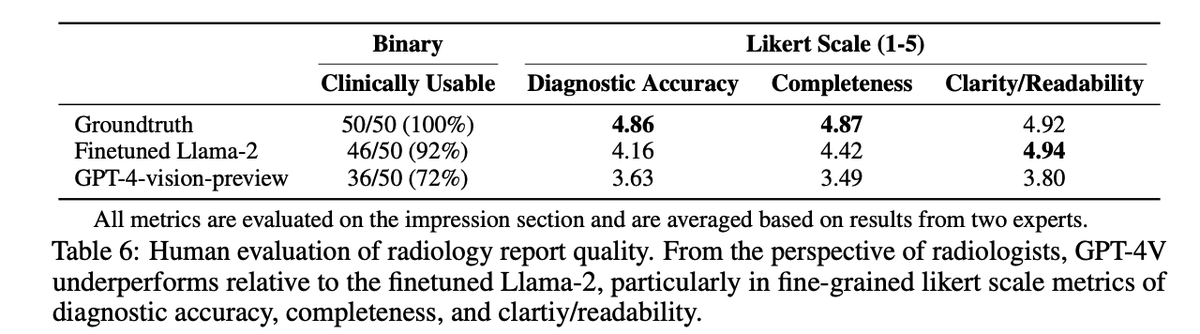
and I especially like the human evaluation we did. The ground truth reports are 100% clinically usable, although they slightly fall behind the fine-tuned Llama in terms of clarity and readability.
5/ We also conducted a human reader study to compare the quality and readability of AI-generated and human written reports.
Paper: https://t.co/6TiQGvEPgI
Code:https://t.co/cKAwhqIL5c
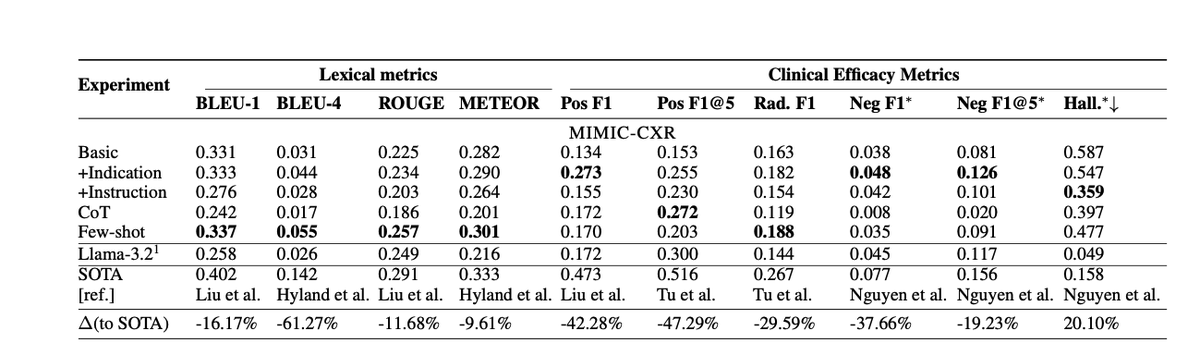
Altogether, our findings cast doubt on the viability of using GPT-4V in a radiology workflow.
4/ Our Evaluation Overview:
We started with direct report generation using different prompting strategies, but found the model failed terribly. To understand the low performance, we decomposed the task into two steps: image reasoning and report synthesis.