Building trust in blockchains among people, businesses, and governments. Our crypto compliance and investigation software powers hundreds of top institutions.
🚨 PSA: We continue to receive reports of third parties impersonating Chainalysis on various platforms. These scammers often use similar tactics and offer everything from help recovering lost funds to fake jobs usually in exchange for information or a fee. Our team works hard to detect and take these scams and impersonations down as soon as they are discovered, however if you get any of these messages, or believe you may be the victim of a scam, contact local law enforcement. You can also let us know via [email protected] so we can continue to track and manage these scams proactively.
𝐖𝐞 𝐰𝐢𝐥𝐥 𝐍𝐄𝐕𝐄𝐑 𝐫𝐞𝐚𝐜𝐡 𝐨𝐮𝐭 𝐭𝐨 𝐲𝐨𝐮 𝐅𝐈𝐑𝐒𝐓. We also won’t:
💰Ask you for funds
💸Promise you recovery of lost funds from scams or hacks
📋Offer you a job in exchange for any type of “fee”
💻Ask you to provide your information via a link on text, messaging services or unverified email
📵Send you unsolicited phone calls, emails, WhatsApp, Signal, Telegram or text/SMS
🔗Reminder: Chainalysis primarily provides its products and services to public and private sector businesses, and does not engage in investigation assistance for individual victims
We have more tips you can use to verify if the contact is legitimate on our website: https://t.co/YsGKL4NQaJ
China's crypto ban is still active. Its crypto economy is too.
China's stablecoin activity added roughly $240 million in March 2025. A year later, it added nearly $5 billion.
Exchanges are banned in the country, so the money moves peer-to-peer. That's now 59.1% of its all-in crypto economy, a 3.5x growth in share over the prior year.
Our data shows a clear shift in stablecoin adoption for domestic payments around March 2025.
But why?
One clue could be China's social credit policy.
In March 2025, state officials pushed the social credit system into finance and the internet. It uses behavioral scores and blacklists to restrict access to credit, travel, jobs and financial services.
Today, HSBC began rolling out a Hong Kong dollar stabelcoin to 3.3 million PayMe users. HSBC says it will soon expand into wholesale corporate and institutional cases.
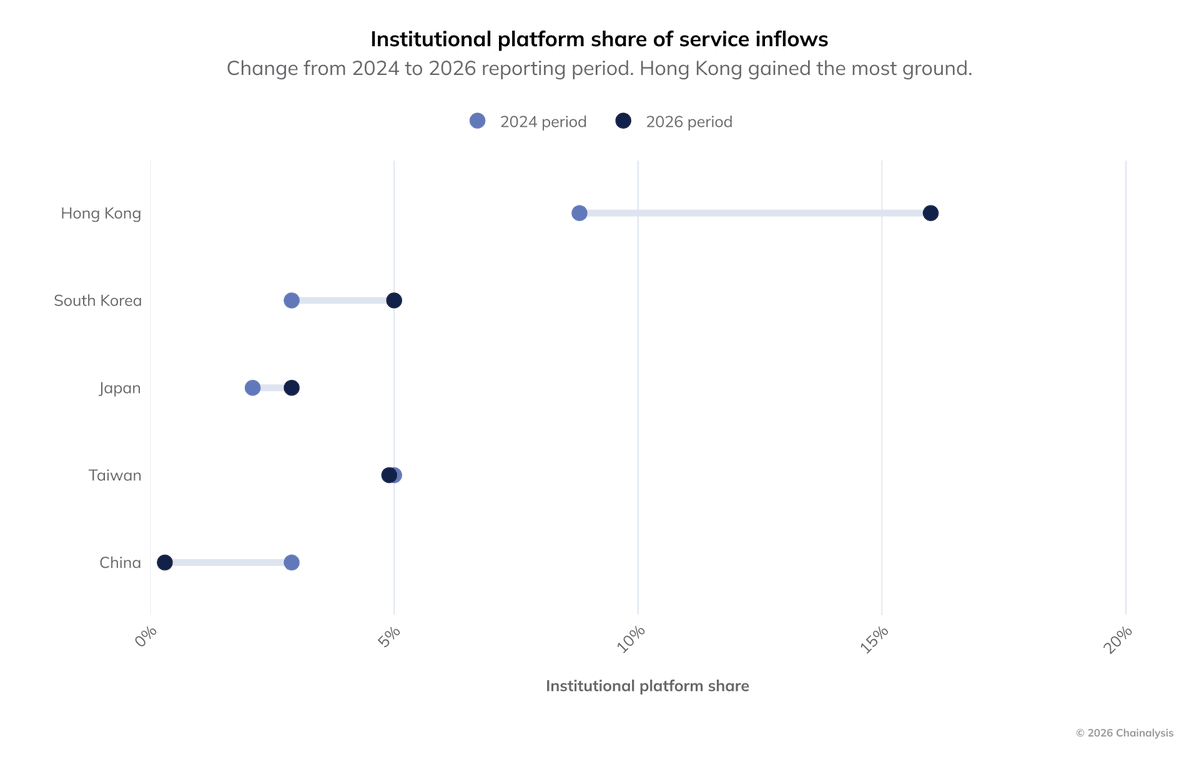
Those institutions are already in Hong Kong. Nearly $24B in service-to-service transfers came in the last year.
Institutional platforms made up 16% of service inflows, up from about 9% two years earlier. No other East Asian market tops 6%.
Experts we spoke with describe regulatory clarity as the primary driver of participation in Hong Kong. HSBC's licensed stablecoin launches into that.
1,462 suspects arrested. 10,909 malicious networks disrupted. More than $105M in illicit funds recovered in Operation Serengeti III.
Congratulations to @INTERPOL_HQ and agencies in 21 countries. Chainalysis is proud to have supported it through @wef Cybercrime Atlas.
The biggest growth rates in RWAs aren't where the most dollars went.
Corporate credit grew 3,156%. Private equity grew 1,340%. But both went from tens of millions to a couple of billion.
Treasuries grew "just" 125%. But $6.86B became $15.42B. That's $8.56B in new dollars, more growth than the next three categories combined.
Tokenized assets are now usable in lending, collateral and trading markets. More asset classes are coming on-chain.
The market is diversifying around US debt, not away from it.
Nearly one in five dollars of cross-border stablecoin value leaving Canada now goes to India, the Philippines and China.
Meanwhile, AI agents are paying pennies for services, led by the US.
See how the two fit together. https://t.co/UanIQsn9tg
Canada's peer-to-peer crypto activity rises and falls with one population: temporary visa holders.
We tracked study permit holders from India, China, and the Philippines since mid-2021. Three of Canada's busiest remittance corridors. As that group grew, P2P volume grew with it.
Monthly transactions peaked near 650k in spring 2024. Then policy changes cut permits. Issuance fell by more than half and P2P volume followed.
The link is associational, not causal. But it held in both directions.
Canadians are sending more money abroad on crypto rails, ranking first for cross-border flows in our big money index.
Stablecoin and bitcoin transfers from Canada to India, the Philippines and China rose 141% YoY to $2.36B. Nearly one in five dollars of Canada's outbound cross-border stablecoin value now goes to those three countries. The average remittance size was $663.
The World Bank puts the average cost of sending money from Canada near 6.7%, with banks above 7%. A stablecoin transfer settles for a cent or less, which makes using those rails for regular payments a much cheaper option.
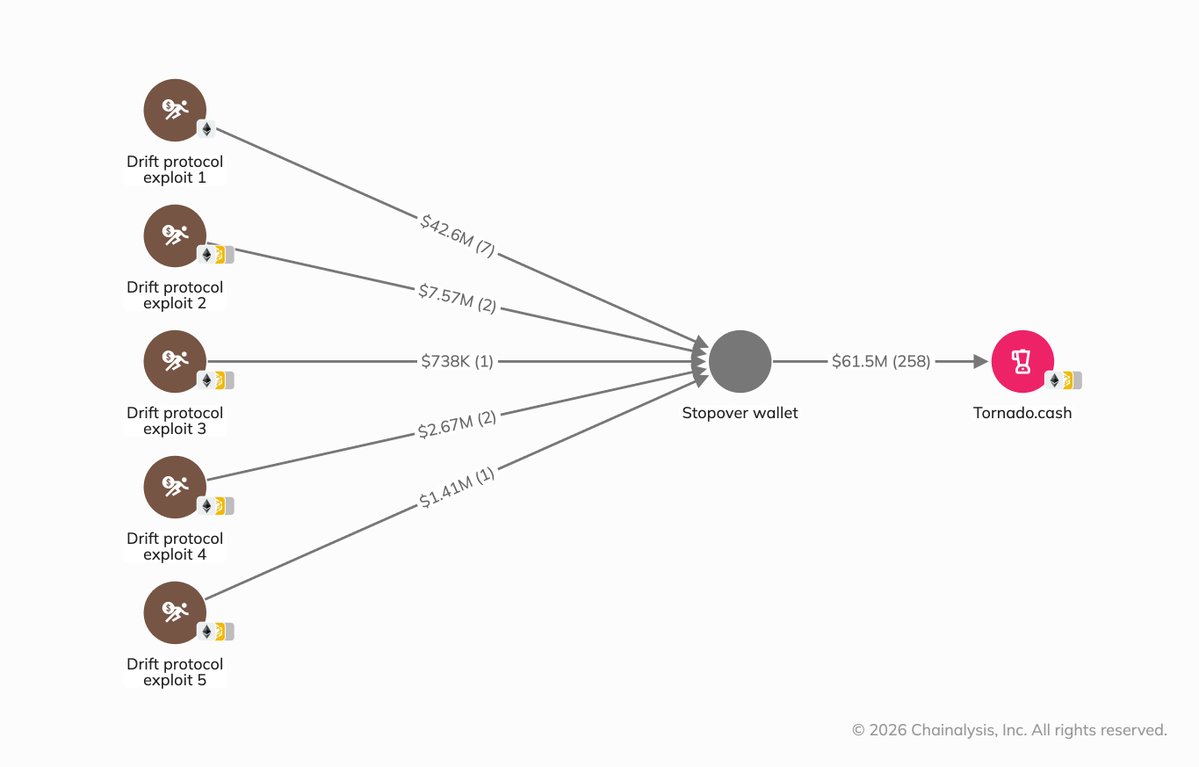
On April 1, 2026, the Drift exploiter sent funds from five exploit wallets into a stopover wallet across 13 transactions. The wallet then sat dormant until today.
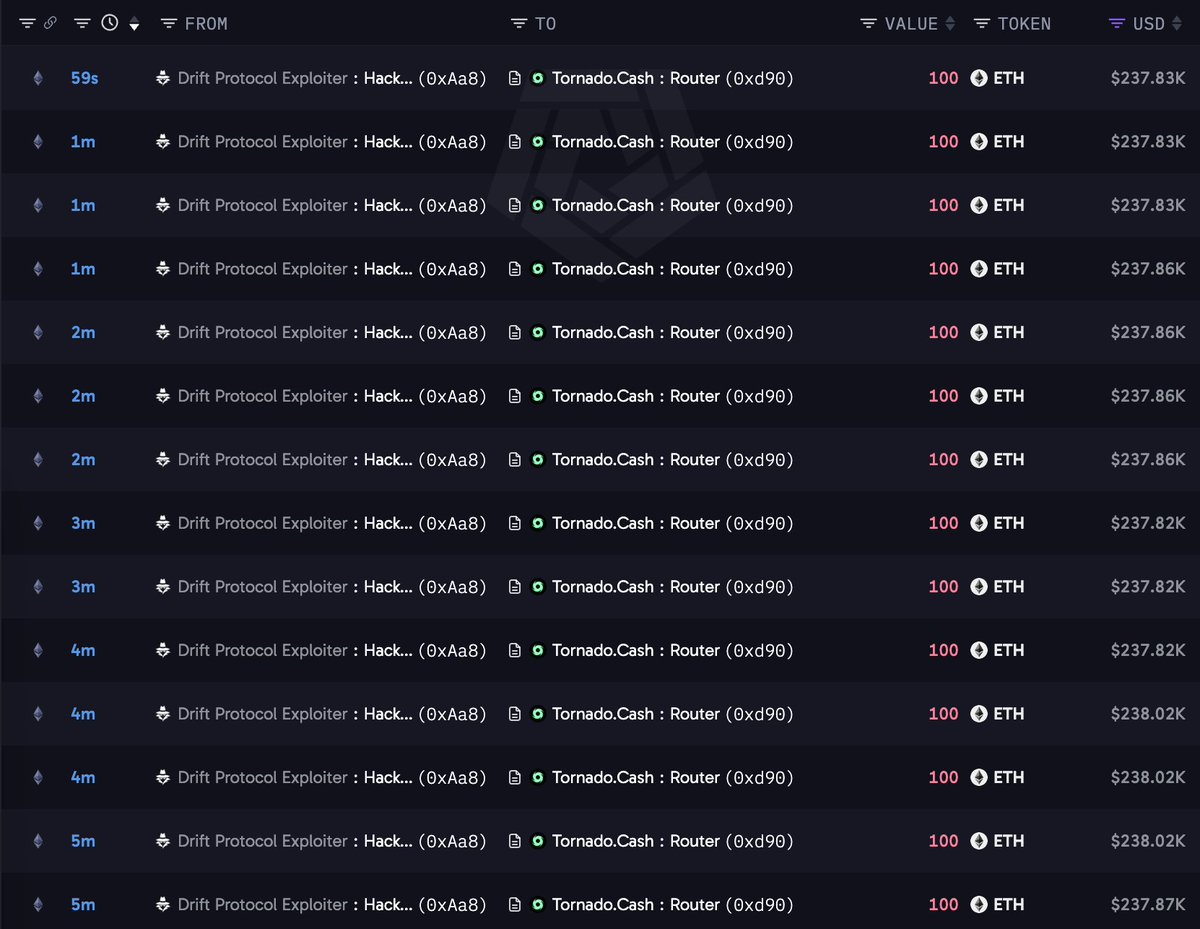
Today, $61.5M moved from that wallet into Tornado Cash in 100 ETH tranches.
We are continuing to monitor the situation.
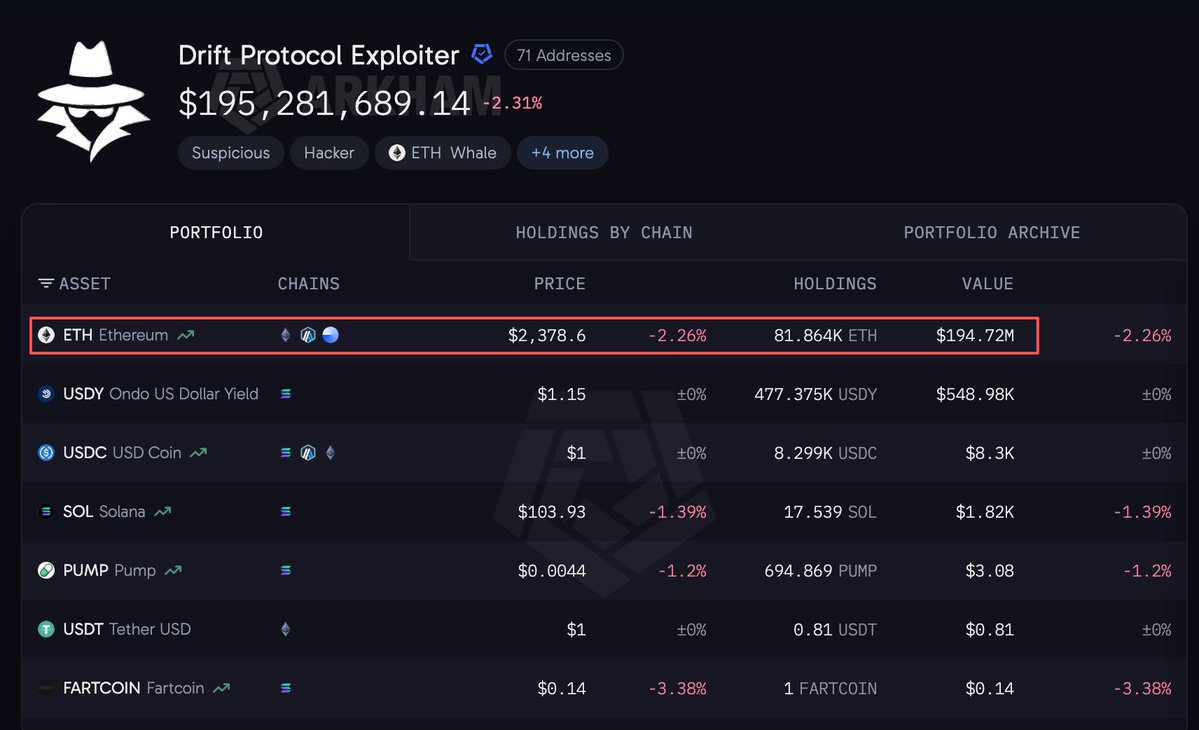
The Drift Protocol exploiter, who stole over $270M, is moving $ETH to #TornadoCash after 2 months of inactivity.
Over the past 2 hours, the exploiter has deposited 25,700 $ETH ($61.56M) into #TornadoCash and still holds 81,864 $ETH ($195M).
https://t.co/FRtFrS7rew
The global crypto economy shrank 1.6% in the year to June 2026. The US's shrank 2.2%. Canada's grew 2.3%, to $247.7 billion.
Canada is far smaller than its southern neighbor, but it is the second largest country in our big money index and ranks 10th of 117 in our grassroots adoption index.
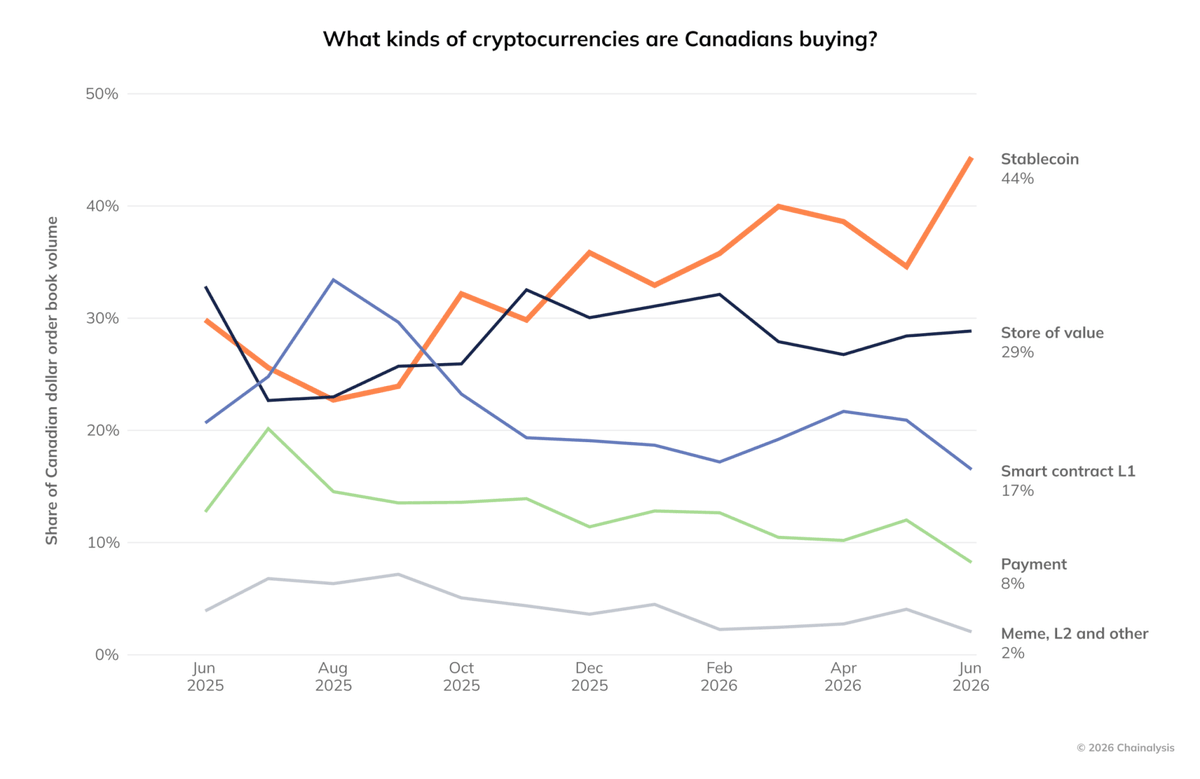
Stablecoins are now the largest share of Canadian dollar crypto order book volume.
44% in June 2026, up from 30% a year earlier and ahead of store of value assets at 29%. ethereum:0xa0b86991c6218b36c1d19d4a2e9eb0ce3606eb48 dominates the stablecoin share.
Overall, Canada's crypto economy grew 2.3% in the year to June 2026. Underneath it is everyday use: the strongest peer-to-peer economy in the G7.
@money2020 is here! Chainalysis is in Las Vegas and we still have a few ways to connect.
Meet with our team at our private rooftop cabana, or join us Tuesday morning at the Chainalysis Wellness Zone at Canyon Ranch Spa. Come by for juice, coffee, and networking, take a complimentary Bootcamp, Pilates, or Yoga class—or do both!
There’s still time to sign up: https://t.co/Fm70eBkXkA
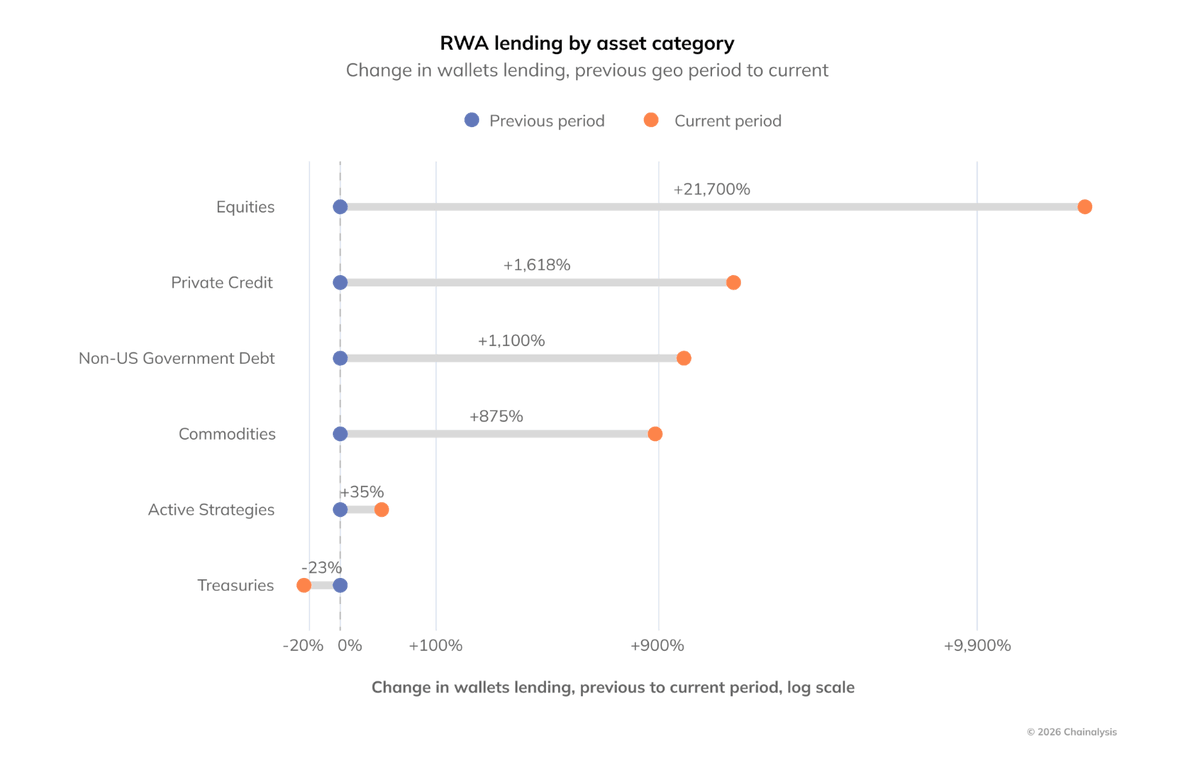
Private credit is hard to sell. Tokenization can give holders a way to borrow against it.
The number of wallets lending tokenized private credit grew 1,618% in the 2026 reporting period. The number lending tokenized Treasuries fell 23%.
Treasury holders already have established financing routes. For illiquid private credit, using tokenized positions as collateral offers a way to access cash without selling.
Tokenization adds value when it makes hard-to-sell assets usable as collateral.
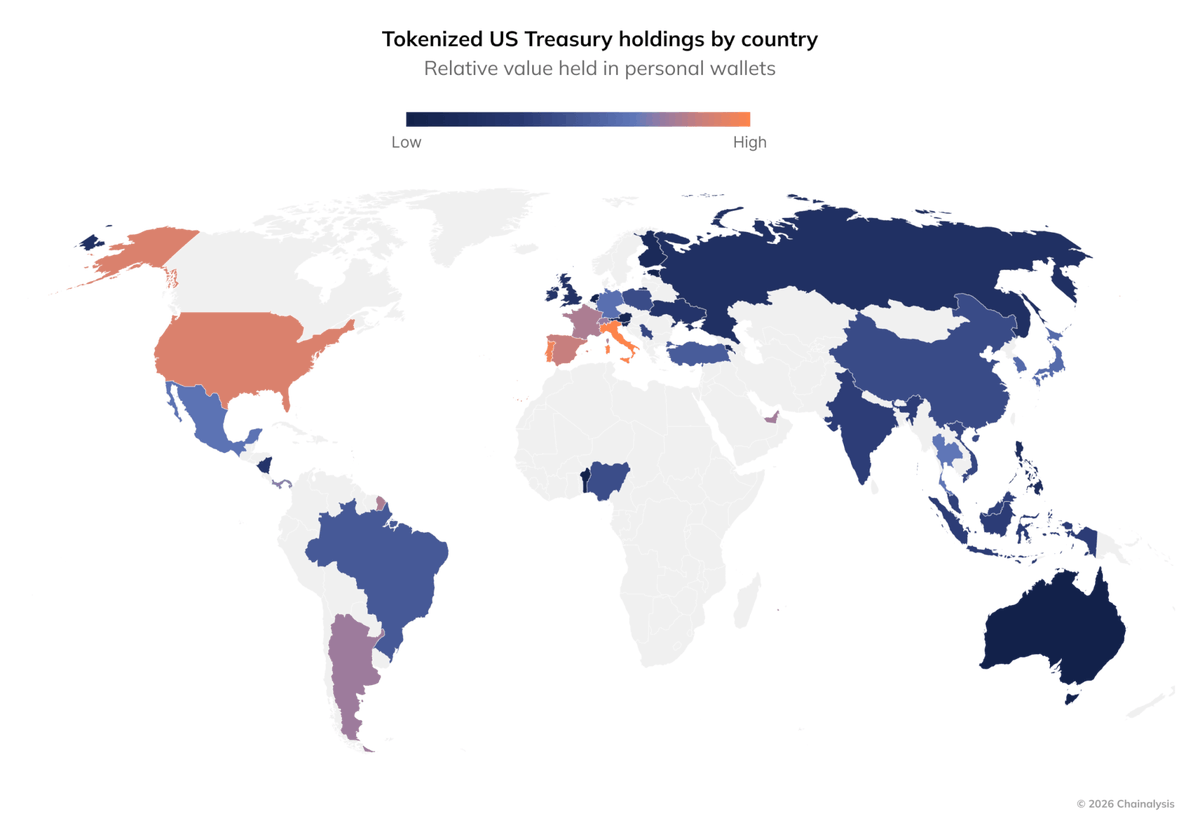
Tokenization is widening the overseas market for US government debt.
In our 2026 data, Italy, Portugal, and Singapore hold 66.9% of geolocated tokenized Treasury values. The US: 10.5%.
Tokenization lowers minimum position size and removes the need for a US brokerage relationship, giving overseas investors another route to US government debt.
Tokenized real-world assets grew 135% to $36.07B in the period ending Q2 2026.
Tokenized corporate credit grew 3,156%. Private equity grew 1,340%. US Treasuries grew 125%.
Of the three, Treasuries added the most in dollar terms: $8.56B, reaching $15.42B.
The market is diversifying around US government debt, not away from it.
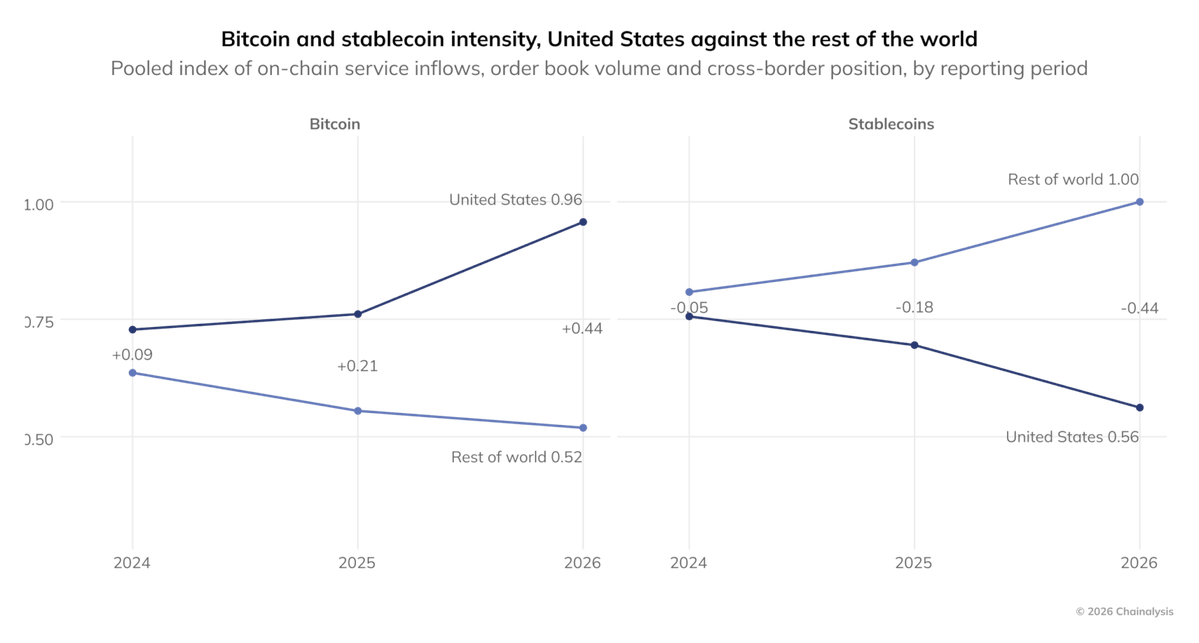
The US is exporting digital dollars and importing bitcoin.
99.1% of stablecoin order book trading volume is in dollar-pegged tokens. Stablecoins represent a smaller share of US crypto activity than elsehwere.
Stablecoins let users hold dollars without having a US bank account. US users generally have easier access to dollar banking, making that benefit less pressing at home
Bitcoin shows the reverse pattern. The US share of global bitcoin activity has risen every reporting period since spot bitcoin ETFs launched in Jan 2024. In 2026, the US became a net importer of bitcoin for the first time since 2022.
Together, these trends benefit the US market: stabelcoins extend the dollar's global reach, while imported bitcoin is accumulated in the US.
The US leads in AI agent payments on x402.
Building agentic software takes three kinds of inputs: a model to think with, tools to act with, and data to work from.
on x402, American wallets account for 88.1% of the payments to AI models that we can geolocate. 41.8% of payments to agent frameworks and tool catalogs. 23.2% of payments to data and search APIs.
The US also holds a 30% share of all the agent-to-service transactions we can geolocate, more than any other country.
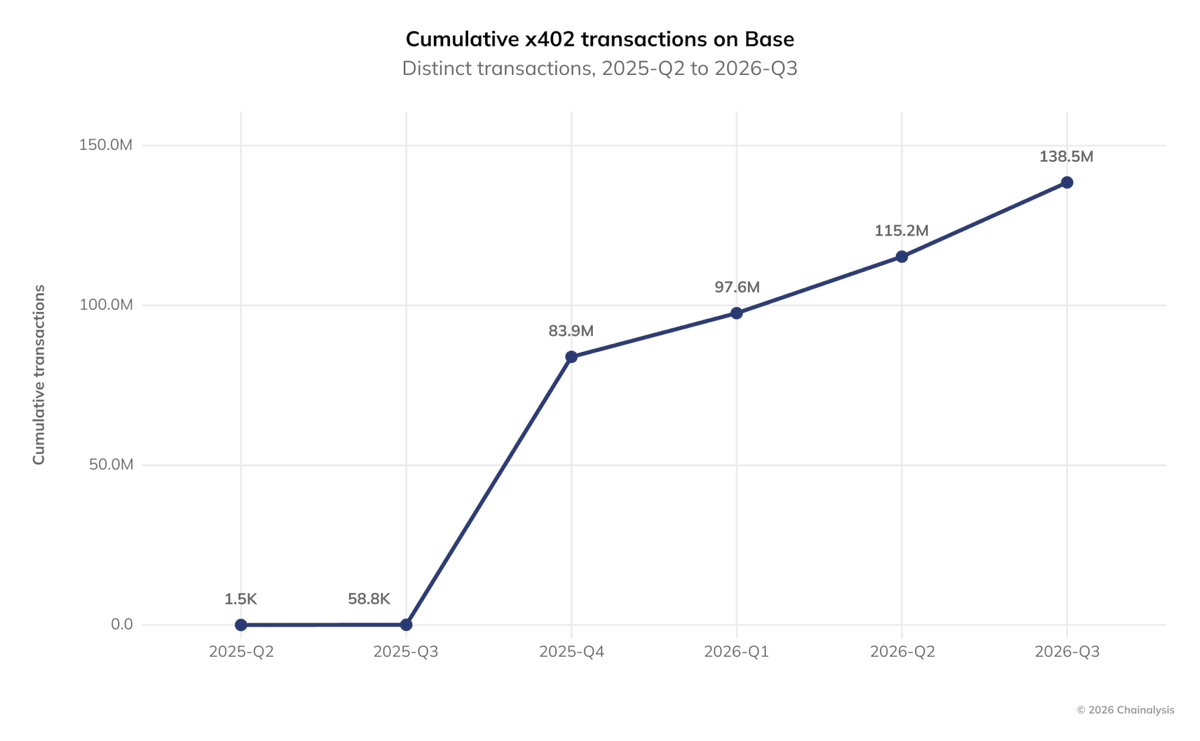
Agentic commerce is growing fast.
Cumulative x402 transactions on @base: 58.8k in Q3 2025. 138.5M in Q3 2026.
Transactions under a dollar do not make fiscal sense for a credit card network. Stablecoins that settle for under a cent do, so AI agents can pay per API call.
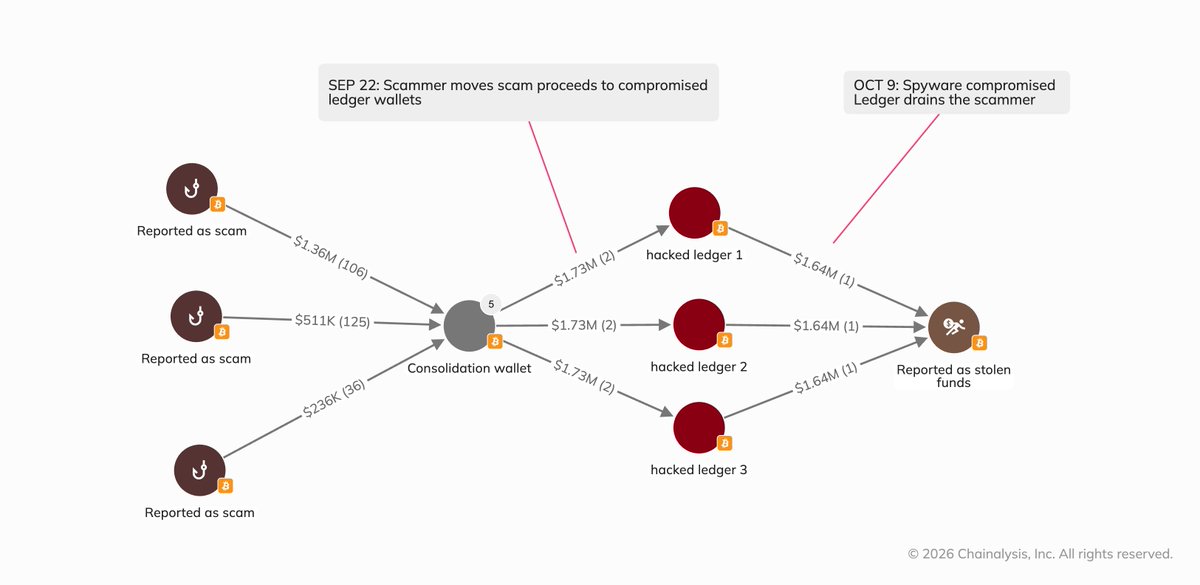
One of the biggest victims of the Ledger theft was a scammer themselves. They lost more than 60BTC, about $4.8M. The funds were from a task scam.
In this task scam, people were paid to fake sales and reviews of real items. Then a "negative balance" appeared, and they were told to add their own money in order to get paid.
On Sep 22, the person behind the scam moved the proceeds into three separate Ledger addresses. On Oct 9, thieves emptied all three. One transfer each, into the same wallet. The wallet is reported as stolen funds.
Chainalysis is actively investigating reports of funds stolen from holders of Ledger products. Our analysts have developed an overview of a sophisticated cross-chain laundering operation. We will continue to monitor the situation.