@jacqmelinek Multi stablecoin fragmentation just makes me want to build swap and variance engines. Have FRNT but need to pay JPM Coin, am praying you degens don't mess with the pegs.
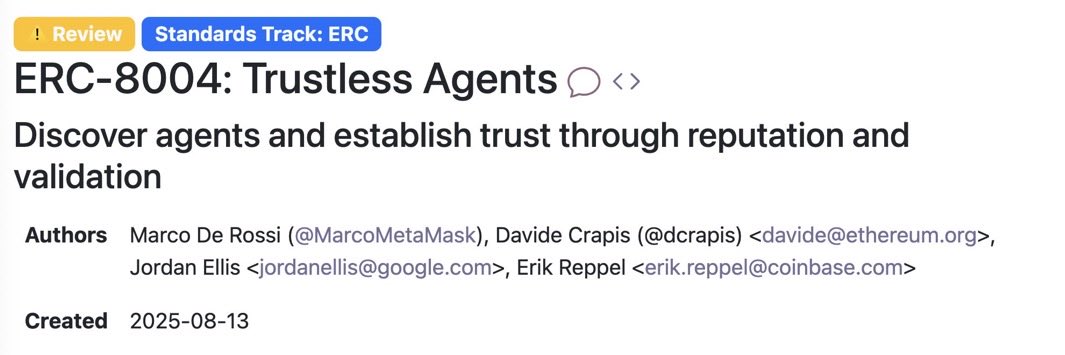
This is an historic moment for AI Agents
Thanks to the just announced ERC-8004 standard, AI Agents can now discover and trust each other without a central intermediary.
What it practically means? In short:
ERC-8004 turns AI agents into:
• Ownable assets (NFTs)
• Discoverable services (registry)
• Trustworthy actors (on-chain reputation)
• Verifiable performers (validation registry)
This is the missing piece to make decentralized AI economies real and scalable and the broader Crypto × AI space will be the first to benefit from it.
➥ ERC-S: The Standard That Gives Tokens Real Value
ERC-20 built the foundation of DeFi, but it also exposed its biggest flaw, tokens with no real intrinsic value.
ERC-S is a new answer to that problem. It links tokens to real company performance while staying compliant.
Here's all you need to know about ERC-S in 30s 🧵
— — —
► What is ERC-S?
@ethereum Request for Comment (ERC) is the framework that defines how tokens are created and interact on Ethereum.
Simply put, ERC-20 is the base standard for fungible tokens. It powered DeFi’s growth but represents utility, not value, so most tokens fade once hype ends.
ERC-S is the model proposed by @StreetFDN. It links tokens to real company cash flows, giving holders compliant exposure to business growth and turning tokens into assets with real value.
—
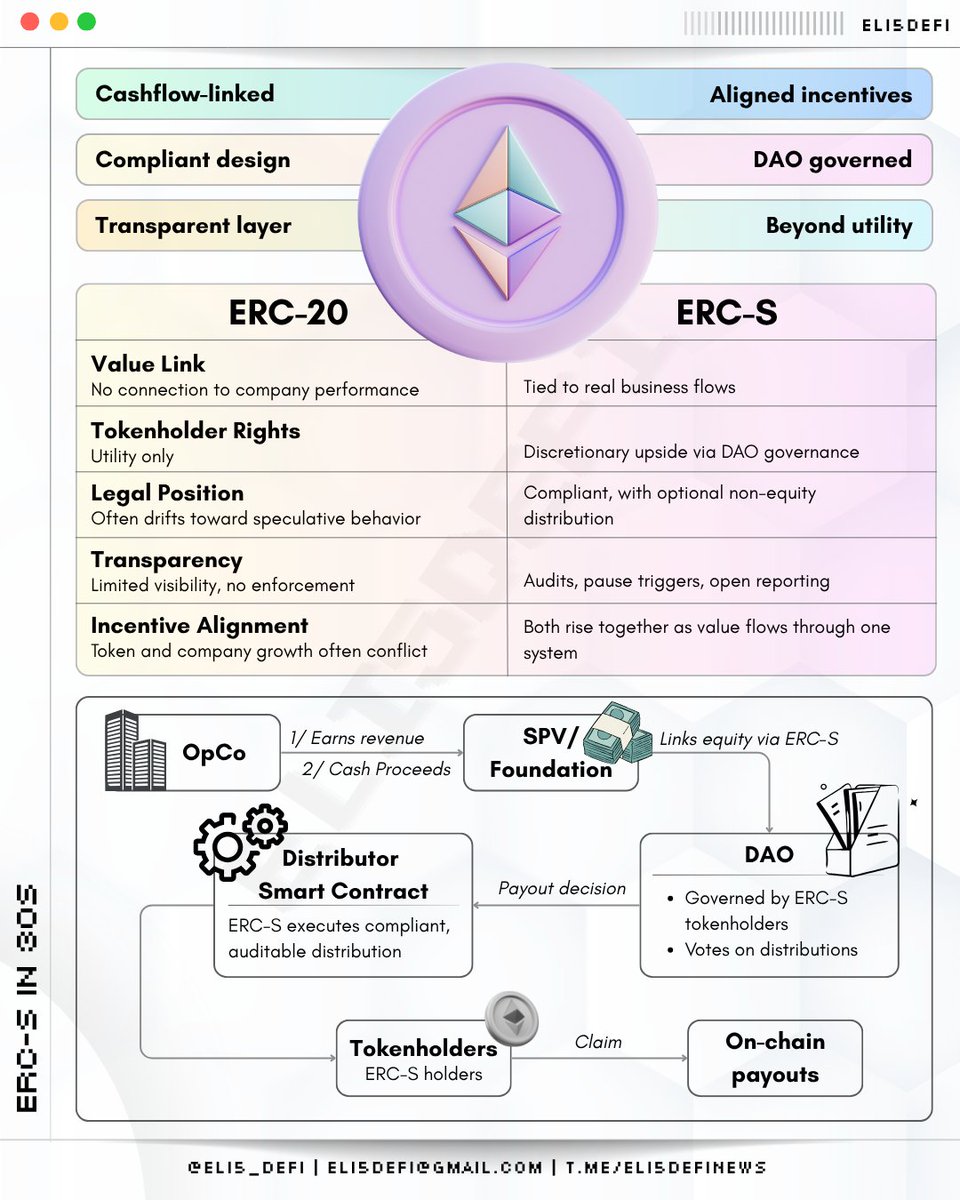
► ERC-20 vs ERC-S
Value link:
ERC-20 → no connection to company performance.
ERC-S → ties tokens to real business flows.
Tokenholder rights:
ERC-20 → utility only.
ERC-S → discretionary upside via DAO governance.
Legal position:
ERC-20 → often drifts toward speculative behavior.
ERC-S → compliant with optional, non-equity distributions.
Transparency:
ERC-20 → limited visibility, no enforcement.
ERC-S → audits, pause triggers, and open reporting.
Incentive alignment:
ERC-20 → token and company growth often conflict.
ERC-S → both rise together as value flows through one system.
If one comparison matters most, it’s this: ERC-20 runs on speculation, ERC-S runs on substance.
—
► How it Works
ERC-S connects the company, its equity, and its tokenholders through one transparent structure.
Flow: OpCo → SPV/Foundation → DAO → Tokenholders
➤ OpCo is the operating company that earns revenue.
➤ SPV/Foundation holds the company’s equity and receives the proceeds.
➤ DAO votes on when and how much to distribute.
➤ Tokenholders claim payouts on-chain through a distributor.
Distributions are discretionary, keeping ERC-S non-security.
Audits, pause triggers, and dual-key custody add protection and trust.
This structure links token value directly to business performance, aligning holders with the company.
—
► Why it Matters
ERC-20 made fundraising easy but separated holders from real company value, pushing founders to chase hype instead of performance. Tokens became short-term trades rather than long-term assets.
ERC-S fixes that by aligning holders, founders, and investors in one structure that shares success. Startups can raise capital without selling equity, while holders gain exposure to real growth.
—
► Wrap-Up
ERC-20 built DeFi’s foundation and made token creation simple, but it never linked tokens to real company value. Most projects grew on speculation and faded once the hype passed.
ERC-S upgrades that model with transparency, compliance, and real economic alignment. It allows tokens to reflect business performance without becoming securities, marking a new phase where Ethereum assets are backed by revenue and trust.
--
CC - @MiyaHedge
Outlook & Activity: Watching $BTC $145K projection and Fed data delays; $ADA strong on upgrade buzz, $SNEK/ $HOSKY up 15%/8% on memecoin frenzy; institutional rotations dominate short-term, with long-term tokenized assets as key theme. #crypto
Performance Snapshot: $BTC dominance at 56.8% as VC coins ( $SOL et al.) average +2.7% daily to ~$79; $ADA up 4.8% in 24h; market cap tops $4.33T, with alts outperforming amid ETF staking innovations and $428M liquidations.
#CryptoMarkets#crypto
Market Resilience: $BTC rose 1.7% to $125,143 with $5.95B in ETF inflows led by BlackRock; ETH gained 4.2% to $4,696, while $ADA surged 4.8% to $0.8772 amid 85K active addresses and 72% staking participation, buoyed by macro hedges against U.S. shutdown and 3.1% inflation.
🧵#Solana's ETF Dream vs. SEC Nightmares: socials chatter. #Solana's on fire—TVL $12.6B, SOL +55% in 3 months—but SEC ETF approvals? A rollercoaster of delays & red flags. From 90% odds to shutdown limbo, here's the real talk on concerns like centralization & manipulation. 🤔
6) Bottom line: Solana's speed edges ETH, but SEC's caution tempers hype—watch Oct 16 deadlines & shutdown resolution. If approved, DeFi boom; if not, innovation exodus to Asia. Cardano's compliant vibe? A blueprint. Bullish or bracing for delays? #SolanaFuture#Crypto
Macro Tailwinds & Risks: Fed's 95% Oct cut odds to 3.6% lift assets, but 2.9% inflation & shutdown volatility loom. Watch $BTC $120K, Solana ETFs, ADA Fund 14. Biggest risk factor? #CryptoOutlook#Cardano