The EU’s 20th Russia sanctions package introduces a full sectoral ban on Russia-based crypto service providers and decentralized platforms, marking a major shift toward crypto-focused enforcement.
It explicitly targets entire categories of evasion infrastructure rather than individual entities, tightening pressure on the Russian crypto ecosystem.
State-backed instruments like the RUBx stablecoin and Russia’s digital ruble CBDC are now prohibited due to their role in sanctions circumvention.
Third-country VASPs in regions such as Central Asia, the Caucasus, and the UAE face increased designation risk for facilitating Russian-linked flows.
The EU also sanctioned specific exchanges, including Kyrgyzstan-based Meer, tied to trading of Russia-linked stablecoins like A7A5.
A key innovation is the activation of the EU’s anti-circumvention tool, allowing enforcement against entire networks and settlement ecosystems.
The package includes 120 additional individual designations and expands shadow fleet sanctions to 632 vessels.
It also introduces tighter controls on dual-use exports and logistics corridors used for re-export to Russia.
Compliance expectations for VASPs are significantly increased, requiring broader screening, enhanced due diligence, and ecosystem-level monitoring.
Overall, the package signals a new era where crypto infrastructure itself is treated as a primary sanctions enforcement target.
The New Rails explores how digital assets are transforming global finance through stablecoins, tokenized real-world assets, AI-driven transactions, and blockchain-based payment networks. The report highlights how these technologies are making financial systems faster, more efficient, and increasingly programmable.
Key trends include the growing use of stablecoins for cross-border payments, the tokenization of assets such as government bonds and real estate, and the emergence of AI agents capable of executing financial transactions autonomously. The report also emphasizes the importance of sustainable tokenomics and evolving regulatory frameworks to support institutional adoption.
Conclusion: Digital assets are rapidly becoming a core component of modern financial infrastructure. As traditional finance and blockchain technologies converge, institutions that adapt early will be better positioned to benefit from increased efficiency, innovation, and access to new markets.
Links 2026 brought together leaders from crypto, law enforcement, and traditional finance, with discussions centered around three major themes: the growing role of AI, the convergence of crypto and TradFi, and the importance of collaborative intelligence networks.
During the event, Jonathan Levin announced the launch of new AI agents designed to help investigators and compliance teams analyze on-chain activity faster and more efficiently. Speakers also emphasized that while criminals are increasingly using AI for fraud and cybercrime, investigators are leveraging the technology to strengthen blockchain intelligence and investigations.
The event also featured expanded support for Stellar, enabling enhanced monitoring, compliance, and investigation capabilities for Stellar-based assets and tokens across the ecosystem.
Here’s a cleaner and more professional rewrite:
Learn How to Investigate Crypto-Related Crime
Like fiat currency, cryptocurrency is used in a range of illicit activities, including scams, ransomware, money laundering, child exploitation, terrorist financing, sanctions evasion, and darknet market transactions. In 2024, transactions linked to illicit activity reached $40.9 billion. While this represents only a small fraction of overall crypto activity, it highlights how criminal actors continue to exploit emerging financial technologies.
As blockchain-based finance is still relatively new, many law enforcement agencies are still building the tools and expertise needed to investigate crypto-related crime. This white paper is designed to support that learning process and covers:
How cryptocurrency works and where it intersects with criminal activity
How blockchain intelligence can be used to investigate illicit transactions
How law enforcement agencies are already successfully disrupting crypto-enabled crime
Key capabilities to look for in a blockchain intelligence solution
The Resolv exploit showed how a single compromised key can trigger massive losses in DeFi without exploiting smart contract code itself. After gaining access to Resolv’s AWS KMS environment and privileged signing key, the attacker minted around 80 million unbacked USR stablecoins using only a small USDC deposit.
The attacker then converted the newly minted USR into wstUSR, swapped it across multiple liquidity pools, and ultimately extracted roughly $23–25 million in ETH. The sudden flood of unbacked tokens caused USR to lose its dollar peg and crash by nearly 80%.
The incident highlights a growing reality in DeFi: security risks now extend far beyond smart contracts to off-chain infrastructure, cloud environments, and privileged keys. Despite multiple audits, the lack of real-time monitoring and automated response systems allowed the exploit to unfold within minutes.
Out now — download your copy today!
2020 marked a year of rapid change in the crypto ecosystem, and the 2021 Crypto Crime Report captures the latest shifts in illicit activity and emerging threats.
Inside the report, you’ll find original research and case studies exploring how cybercriminals are using cryptocurrency today, including:
The impact of the COVID-19 pandemic on darknet markets and scam activity
How emerging technologies such as DeFi are being used to launder illicit funds
Why ransomware activity surged to record levels in 2020
And additional key trends shaping the crypto crime landscape
Whether you are a government investigator, compliance professional, or crypto enthusiast, this report provides essential insights into the evolving threat environment.
Download your copy today and explore the full findings.
For a deeper dive, watch Part 1 and Part 2 of our Crypto Crime webinar series.
OFAC has sanctioned UK-registered crypto exchanges Zedcex and Zedxion for operating in Iran’s financial sector and facilitating transactions linked to the IRGC, marking its first action directly targeting digital asset exchanges tied to Iran’s economy.
Zedcex reportedly processed over $94 billion in crypto transactions and used multiple IRGC-linked Tron wallets, highlighting growing concerns around sanctions evasion through digital assets and increasing compliance pressure on global crypto firms.
OFAC has updated sanctions against the Central Bank of Iran (CBI) by adding new cryptocurrency wallet addresses to its SDN list. The move followed a major enforcement action in which $344 million in USDT was frozen by Tether in cooperation with U.S. authorities.
According to reports, the frozen funds were linked to Iranian financial networks, intermediary wallets, and transactions connected to sanctioned entities. The action highlights growing concerns over the use of stablecoins for sanctions evasion and illicit financial activity.
The update also comes during rising tensions in the Strait of Hormuz, where Iran recently introduced maritime transit tolls for commercial ships. Investigators believe cryptocurrency may have been used as a payment method due to Iran’s limited access to traditional global banking systems.
Blockchain analysis suggests that some of the funds were moved through DeFi platforms and cross-chain bridges before re-entering the Iranian crypto ecosystem. The case demonstrates how governments and stablecoin issuers are increasingly working together to monitor on-chain activity and disrupt large-scale money laundering networks.
The New Reality of Crypto Tracking in 2026
In 2026, the illusion of anonymity in crypto is fading faster than ever.
For years, many users believed that moving funds across multiple wallets, chains, or even mixers could effectively hide the origin of assets. Today, that assumption no longer holds true.
⸻
What has changed?
Blockchain intelligence has evolved into a highly sophisticated ecosystem:
Multi-layer tracking can now follow assets across different blockchains
Behavioral analysis identifies patterns, not just transactions
Even fragmented transfers can be reconnected into a single traceable flow
⸻
The biggest misconception
Most users still believe risk only comes from direct interaction.
But in reality:
Indirect exposure is now one of the primary triggers for risk detection.
A wallet can be flagged without ever directly interacting with a suspicious source.
⸻
Why funds get frozen today
Freezing is no longer based on obvious activity.
It can happen due to:
Historical exposure to flagged wallets
Connections through multiple intermediate addresses
Risk scoring algorithms used by exchanges and compliance systems
⸻
What smart users do differently
The behavior of experienced users has shifted:
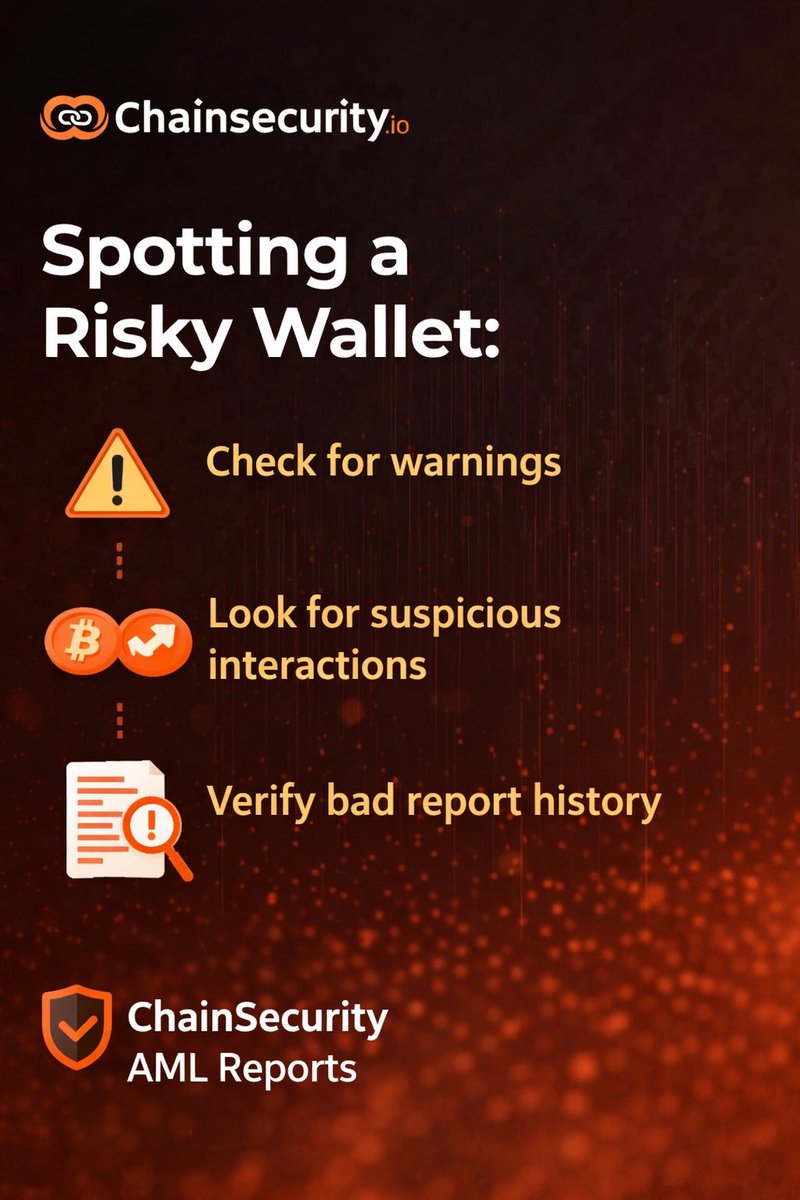
They check wallet risk before receiving funds
They analyze transaction history before sending assets
They rely on detailed AML reports instead of assumptions
⸻
Conclusion
Crypto is no longer just about moving assets.
It is about understanding where those assets come from.
In today’s environment,
Transparency is not optional — it is protection.
ChainSecurity provides the clarity needed to navigate this new reality.
Tracking Crypto Assets in 2026: A New Era of Security or a New Threat?
In 2026, the crypto space has entered a new phase where it is no longer just about profit and investment.
Security and transparency have become the most critical factors in the game.
With increasing regulatory pressure and the advancement of blockchain analytics tools, transaction tracing has reached a level where even complex, multi-step paths can be analyzed.
⸻
What has changed?
New AML algorithms can now detect indirect connections between wallets
Even if assets pass through multiple wallets, their path remains traceable
Small exposure to suspicious sources can still lead to a high risk of freezing
⸻
An important reality many overlook
Many users believe that as long as they do not directly interact with a suspicious wallet, they are safe.
In reality:
Even indirect exposure can place your wallet under scrutiny.
⸻
The role of professional reports
In this environment, having a precise analysis of your wallet is essential:
Evaluating direct risk
Analyzing indirect network connections
Identifying high-risk sources in transaction history
⸻
Where is the future heading?
AML systems will become faster and more accurate
Exchanges will act with greater sensitivity
Professional users will verify wallet status before every transaction
Bot Update in WhatsApp
Our bot has been upgraded with new features.
– Enhanced functionality
– Improved speed and accuracy
– Greater security and stability
Update your experience today.
The crypto market plunged at the start of December after a 119M$ exploit in Yearn Finance’s yETH pool, pushing Bitcoin down over 3% and Ethereum 5%, and triggering more than $400M in leveraged liquidations as major altcoins also fell.
In 2025, cryptocurrency exchanges faced a record surge in security breaches, marked by the theft of over $1.5 billion from Bybit. The incident highlighted the growing inadequacy of reactive security models against increasingly sophisticated threats. Industry data shows that 62% of stolen assets were drained from hot wallets, while 33% of breaches involved social engineering.
Following its January security incident, Phemex overhauled its security architecture from the ground up. The redesigned system, leveraging blast-radius assessment and behavioral analysis for each transaction, successfully blocked 847 suspicious withdrawal attempts, including 127 confirmed account-takeover cases. This proactive approach enables threat detection at a scale beyond human capabilities.
Phemex stated in its announcement:
“Trust is built through verifiable structure, not promises.”
The U.S. Department of Justice (DOJ) has filed a historic forfeiture complaint to seize 127,271 Bitcoins (worth approximately $12 billion).
The assets are linked to an international “pig butchering” scam allegedly operated by Chen Zhì, the chairman of Cambodia’s Prince Group.
Filed in the Eastern District of New York, the case is described as the largest cryptocurrency seizure in DOJ history, targeting funds laundered through unhosted wallets and payment networks associated with Huione.
In today's world, complying with AML (Anti-Money Laundering) regulations is not just a legal requirement, but a cornerstone of trust in financial markets. Without AML, transparency and security deteriorate, and risks increase for everyone.
📲 SMS Trap: How One Message Can Steal Your Crypto on P2P Platforms
When selling cryptocurrency for fiat on P2P platforms, scammers often use a scheme involving fake SMS or email payment notifications.
💰 You’re about to receive a $2,000 crypto payment — but have you checked the sender’s wallet?
One risky wallet could trigger:
🚫 Exchange restrictions
⚠️ Frozen funds
🕵️♂️ Regulatory scrutiny
✅ Get a full risk report in under 1 minute — just via WhatsApp. No app, no account.
#CryptoSecurity #WalletCheck #Bitcoin #CryptoRisk #ChainSecurity #Web3Safety #CryptoCompliance #BlockchainTools
🧠 Ever wonder what a wallet “Risk Score” actually means?
It’s not just a number — it’s a full analysis of the wallet’s behavior across the blockchain.
✅ A low score means a clean history and low exposure to suspicious activity.
⚠️ A medium score could indicate some interaction with flagged platforms or mixed funds.
🚨 A high score suggests potential links to:
•Scam operations
•Hacked/stolen funds
•Sanctioned services
•Darknet or mixer activity
💬 Why is this important? Because exchanges, dApps, and compliance systems use this score to decide whether your transaction gets processed, flagged — or blocked entirely.
📲 ChainSecurity instantly gives you this score in a detailed PDF via WhatsApp.
#CryptoRisk #WalletRiskScore #BlockchainSecurity #ChainSecurity #RiskAnalysis #CryptoCompliance #AML #WalletCheck #CryptoTools #Web3Safet
🕵️♂️ One of the biggest darknet takedowns of 2025
The U.S. government has seized 145 domains linked to the illegal marketplace BidenCash, which sold over 15 million stolen credit card records and generated $17 million in revenue.
🚨 This wasn’t just data theft — it was full-on cybercrime at scale.
To attract users, BidenCash even leaked 3.3 million stolen cards for free between 2022 and 2023!
📉 More than 117,000 users bought and sold sensitive data like card numbers, CVV, full names, addresses, emails, and phone numbers — often paid for in crypto.
🔍 This incident is a reminder that wallet safety isn’t optional.
Before you engage with any address, check it for risk.
Stolen funds often pass through seemingly clean wallets.
At ChainSecurity, we help you:
✅ Detect suspicious wallets instantly
✅ Receive PDF risk reports via Telegram & WhatsApp
✅ Stay compliant and protected against scams
🛡️ Think before you sign — the darknet never sleeps.
#CyberSecurity #BlockchainSecurity #CryptoCrime #BidenCash #WalletCheck #AML #Darknet #CryptoScam #ChainSecurity #RiskDetection #CryptoNews #OSINT #DigitalSafety #Web3Security #FinancialCrime #USGovernment #CyberCrime 🧠💻🔒