Ele gasta isso rodando a infra de IA da @culturabuilder.
Tá servindo a demanda da comunidade e dos clientes com volume alto: centenas de bilhões de tokens e cerca de 100k requisições/dia em média, usando modelos abertos (Qwen, DeepSeek etc.) + agentes.
Não é mineração nem gasto aleatório. É o custo operacional de escalar a plataforma (comunidade, vibe coding, IA privada pra empresas etc.). Com esse volume, rodar em GPU própria/alugada sai mais barato e com mais controle do que depender só de API.
150-200k/mês é o preço de manter o motor da operação ligado.
“Anywhere in the world, solana is the best place to run an sov market… So we need cheap fast censorship resistant global state machines.”
Solana is the infrastructure
$ORE is the SoV
🏆 1ST PLACE IN THE LIGHTER × @tradeXYZD TRADING COMPETITION 🚀
Rewards just hit. Final leaderboard confirmed it: Rank #1 with over $18M in eligible volume.
📊 44.43% reward share → ~$1,777 in $LIT
90 points total 🔥
This was on @Lighter_xyz RH (Premium/Plus) through XYZD. High volume, proportional share, rewards in the bag.
Who else was grinding this one? Drop it in the comments 👇
@Lighter_xyz@tradeXYZD #Lighter #LIT #Trading #Crypto
It's fucking $1 BILLION in trading volume flowing through our app in just 4 months 🚀
When I started @tradeXYZD, my goal was simple: help users participate in perp trading at the lowest possible cost.
And I'm proud to say we've achieved that.
Before XYZD and @vesper_mm, traders were comfortable paying even $200 CPM.
But look at how things have changed.
Now, even when users see $100 CPM, they complain that it's too expensive. 😂
And that says a lot about how low we've managed to bring trading costs.
And we're just getting started!
The most interesting part of $ORE's design isn't live yet.
TLDR: Today, revenue generated by the ORE Reserve auto-compounds in isolation. Eventually, that revenue could be streamed to uORE holders (miners holding unclaimed rewards) as SOL mining credits, allowing the protocol to increasingly fund its own mining activity. The result is a flywheel that could strengthen mining incentives, lift staking yield, and put ORE on a path to net deflation.
First, it's worth understanding why ORE is different.
Bitcoin, Zcash, Ethereum, and Solana all use their native assets to incentivize network security. ORE doesn't have that requirement. It inherits Solana’s security, so it can direct its incentives toward a different objective: rewarding those who accumulate and hold the asset.
ORE is a store of value by design, and nearly every mechanism in the protocol reinforces this objective.
Consider how value flows through ORE today:
- Miners deploy SOL to earn ORE, aiming to acquire it below market price.
- A 10% refining fee on claimed rewards is redistributed to holders of unclaimed rewards (uORE).
- Mining revenue funds ORE buybacks, burial, staking rewards, and the Reserve.
- The Reserve provides liquidity while generating its own revenue through LP fees and yield-bearing assets like JitoSOL and USDv.
The result is a system where mining activity supports holders through multiple mechanisms, while the Reserve continues to grow and generate additional liquidity and revenue.
But there's one more piece to the design. Arguably the most interesting.
In AI, recursive self-improvement (RSI) describes a system capable of improving its own capabilities, with each improvement enabling further improvements.
ORE has a potential economic equivalent.
Today, the simplified flow looks like this:
Mining → Reserve → LP fees + yield → Reserve.
The Reserve grows, generates revenue through LP fees and yield, and reinvests that revenue into itself. A straightforward compounding mechanism.
But the loop back to mining remains open.
Now consider what happens when Reserve revenue is redirected to uORE holders as SOL credits, usable exclusively for mining ORE.
The flow becomes:
Mining → Reserve → LP fees + yield → SOL mining credits → Mining → Reserve.
The loop closes.
This is the recursive moment.
Consider the significance of this change.
Today, mining depends on SOL supplied by users. With mining credits, the Reserve’s own revenue becomes a new source of capital to fund that same activity.
Originally powered by user capital, ORE could become increasingly self-powered.
A protocol generating its own fuel.
There are two particularly interesting second-order effects here.
First, Reserve-funded mining credits could increase competition for ORE rewards, driving up production costs. To the extent this stimulates incremental mining activity, it generates additional protocol revenue, supporting buybacks, burial, staking rewards, and Reserve growth.
Second, and perhaps most importantly, this creates a potential path toward sustained net deflation.
At sufficient scale, additional protocol revenue could fund enough buybacks and burial to consistently exceed new ORE issuance.
To be clear, mining credits aren't live today, and it may be years before the economics justify turning them on.
The Reserve first needs sufficient scale and sustainable revenue to fund meaningful mining incentives without compromising its liquidity or long-term growth.
More importantly, the incremental mining activity needs to generate enough additional value to justify redirecting revenue away from direct compounding.
But the potential end state is worth considering: an economic system that compounds recursively, under its own power.
From farming projects to founding my own, and now making it into Lighter's weekly updates...
Man, it's been one hell of a journey🚀❤️
But, but, but... guys, here's the update
Our competition is STILL LIVE, and you have 3 DAYS LEFT 🔥
🎯 100M Volume Target
💰 $10K in ethereum:0x232ce3bd40fcd6f80f3d55a522d03f25df784ee2 Rewards
And the best part?
EVERY SINGLE PARTICIPANT GETS REWARDED 💸
No matter how big or small you are, everyone who participates gets a share of the rewards.
This week's market-wide selloff gave the @ORE Reserve a real stress test.
Per the MineShaft Weekly (@zinnresearch), in a single 24h window:
- Absorbed 184+ $ORE ($25K+ of selling)
- Buried 61+ ORE (~$9K)
- TVL held above $500K
Meanwhile 83%+ of circulating ORE stays staked (81–84% since June).
Not financial advice. I continue to mine & hold over 1k ORE.
FYI, solana:oreoU2P8bN6jkk3jbaiVxYnG1dCXcYxwhwyK9jSybcp Motherlode (ML) approached 2x probability rate. ML payout set at 1:500 (at 100 ORE). Currently, ML stand just under 200 ML.
Understand probability tho, it’s still 1/500 per round., lol but it’s long overdue and huge payout lottery for degens and calculated players!
@ORE
⛏️
You have very limited time to scoop up cheap $ORE
I have been charting for over 6 years and this chart doesn't lie.
Imo, this thing is going with or without the rest of the market thanks to its built in tokenomics. It shows real disconnect from bitcoin and narratives.
the underrated projects on @solana series is back 👀
episode 27: @ORE is building a new kind of digital store of value on Solana. they call it “gen z bitcoin,” and here’s why.
like bitcoin, ORE has to be mined. it fair launched in april 2024 with no pre-mine, no insiders, and a hard cap of 3 million tokens.
the interesting part is that all protocol revenue goes toward buying back ORE, growing its reserve while shrinking supply. scarcity alone doesn’t guarantee value, though. demand still matters.
ORE crossed $40M in mining revenue a year after launch, and its reserve passed $350K in just a month.
which project should we cover next? 👀
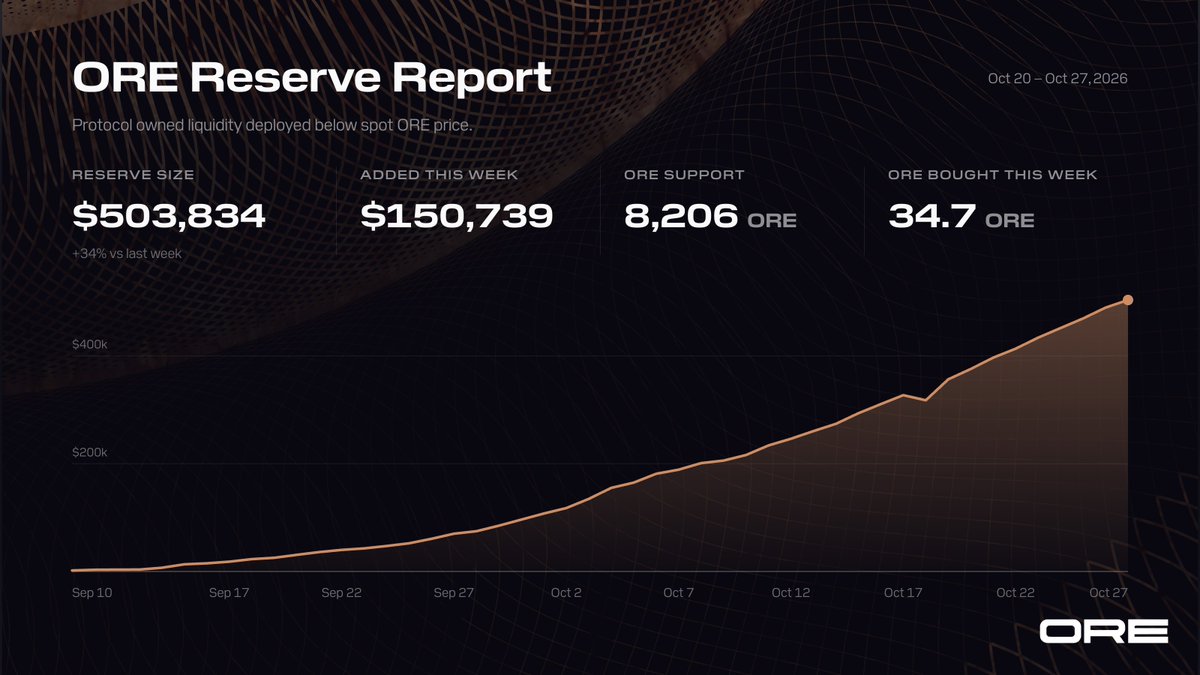
The ORE Reserve has crossed $500,000.
Another $150,739 in liquidity was added this week, averaging more than $21,500 per day.
The Reserve has now received $592K in total deposits, $77K of which has been used to acquire 729.8 ORE at an average cost of $105.52.
The Reserve now provides buy-side support for approximately 8,206 ORE across its liquidity positions.