Beijing's trade template: China overtook Germany in exports of industrial machinery and equipment, in exports of specialized industrial machinery and will any minute overtake it in share of road vehicle exports.
Coming to a Data Center near you next.
Unfortunately, we are being blocked by certain oligarchs in order to maintain their monopolistic chokehold on the Indian people. You can guess who they are …
This is a crime against the people of India!
My salute to the Indian pilot Captain Smit Machchhar for his extraordinary bravery.
Despite being stabbed and seriously injured, he fought back, resisted, opened the cockpit door, and enabled passengers and crew to overpower the attacker — preventing a catastrophic mid-air disaster.
He saved the lives of 174 people, including Israeli citizens and other nationals.
I wish Captain Machchhar a speedy and full recovery.
He is a true hero.
🚨Singapore's View on an Increasingly Multipolar World
Russia, Ukraine, Kishore, how do you see that conflict ending?
Cuba has a sovereign right to choose a Chinese base.
What, what do you say to that?
You know, when you, when you have great powers,
great powers have interests, and is in...
If you wanna ensure a more peaceful world, understand the red lines of all the great powers.
The United States has got clear red lines.
Russia has got clear red lines.
China has got clear red lines.
India has got clear red lines.
And once you understand where the red lines are, and you don't go near the red lines, then you, then you...
That's how you preserve the peace. But if you keep saying, "No, my interests matter and yours don't," that's how you end up with wars.
#Forward
Mr. Parekh did not increase his personal stake to in HDFC ltd thru esops ( Ref to link attached- Menaka's intv with Mr Parekh 2023.)
But when it came to HDFC’s stake in HDFC Bank, he was very clear about maintaining it. He never allowed HDFC’s stake to fall below around 20%. That was a deliberate position maintained by HDFC right up to the merger.
That is the difference in philosophy. There are people who, when they quit or exit, sell everything for their personal benefit. Mr. Parekh’s approach was very different, he always believed in creating and sharing wealth with the larger HDFC family benefitting staff at the lowest possible incl office boys. If he wanted he could have allowed himself to take larger share of ESOPs by limiting it only to middle and sr employees and not all staff as per the general practice across most corporates.
Saudi Arabia is learning a lesson that money and American weapons could never erase: you cannot buy your way out of geography.
For years, Riyadh behaved as though its oil wealth and its alliance with Washington made it immune to the consequences of its regional policies.
It accumulated weapons, hosted foreign forces and poured billions into military adventures while treating Iran as an enemy to be contained.
Now the bill has arrived.
With the Strait of Hormuz effectively strangled and the kingdom’s vital East-West oil pipeline to the Red Sea disrupted, Saudi Arabia’s ability to move its most valuable commodity has been severely compromised.
The kingdom can possess some of the world’s largest oil reserves, but reserves sitting underground do not pay the bills.
Oil has to reach the market.
And suddenly, the country that imagined itself the dominant power of the Gulf may have to knock on Tehran’s door.
That is the bitter irony.
Iran, the state Saudi Arabia spent years trying to isolate and contain, now possesses enormous leverage over the regional environment in which Saudi Arabia must operate.
If Riyadh wants relief, it may have to negotiate with Tehran,and Tehran will not be doing favors out of charity.
Iran will demand a price.
It will demand political concessions. Security guarantees.
Changes in Saudi regional policy.
An end to support for hostile operations.
Whatever the final bargain looks like, one thing should be obvious: Saudi Arabia will be negotiating from weakness, not strength.
And what of the United States?
The American military presence has not prevented this strategic nightmare. Billions spent on weapons and decades of dependence on Washington have not abolished the vulnerability created by geography.
American bases cannot make the Strait of Hormuz disappear.
They cannot permanently protect every pipeline.
They cannot manufacture a stable regional order through military force.
So perhaps it is time for Riyadh to ask the question it has avoided for generations:
Why should Saudi Arabia continue hosting US military forces when those forces have failed to provide the strategic security they promised?
The answer should be a complete rethink.
Get rid of the permanent American military footprint.
Stop treating the Gulf as an arena for American-Iranian confrontation.
Stop imagining that endless weapons purchases constitute a foreign policy. And start negotiating directly with the countries that Saudi Arabia actually has to live beside.
Because Iran is not going away.
Iraq is not going away.
Yemen is not going away.
The Gulf is not going away.
Washington can send aircraft carriers.
It can deploy troops.
It can sell another hundred billion dollars of weapons.
But it cannot change the map.
Saudi Arabia's real security will ultimately have to come from diplomacy, regional arrangements and mutually understood limits,not from renting an American shield while antagonizing its neighbors.
The age of assuming that Washington will solve every Saudi security problem is over.
If Riyadh now has to negotiate with Tehran, it should negotiate seriously.
And if that means paying a steep price for years of strategic miscalculation, perhaps that is precisely the point.
Sometimes the price of avoiding diplomacy is eventually having to negotiate from your knees.
Rumor: Huawei founder and CEO Ren Zhengfei (任正非) and his family have fled China ahead of new regulations that begin Sept. 15 and would restrict entry and exit to China, media report, adding some reports allege he escaped China by sea from the Dapeng Peninsula. Others say there is a heavy police presence at Huawei’s headquarters. Huawei has so far made no official statement. 1/3 #huawei
BREAKING: India’s fertility rate has fallen below the replacement level for the first time, as the world’s most populous country heads toward eventual population decline. — The Economist
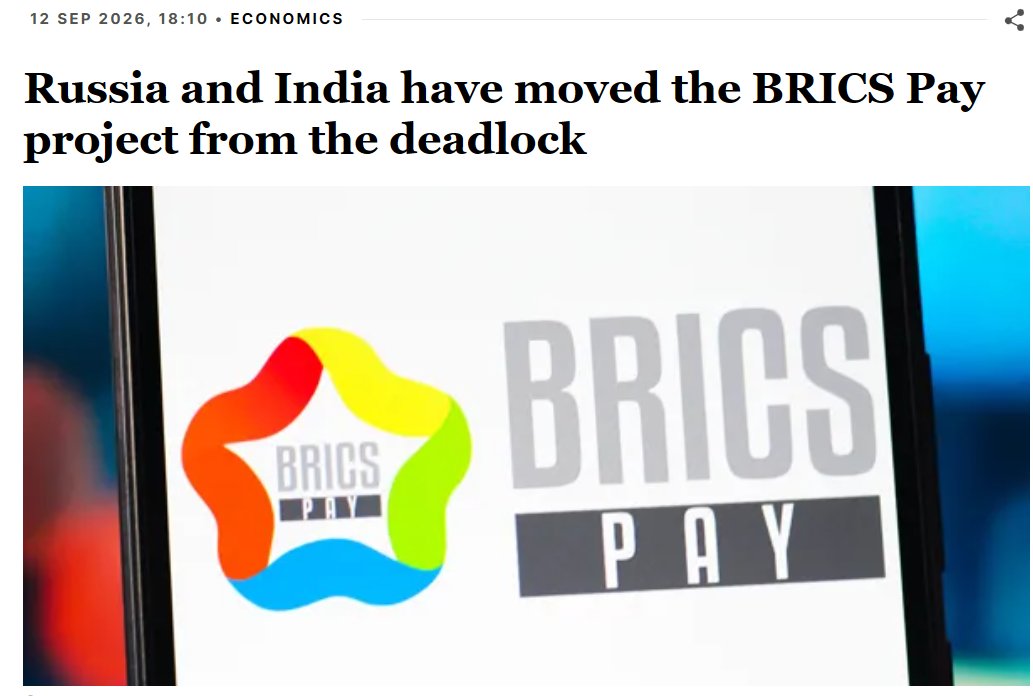
BRICS: Russia and India agree on BRICS PAY, to bypass the US Dollar:
"The system will allow payments between companies (B2B) and citizens (C2B) directly in national currencies (rubles, rupees, yuan, etc.), bypassing the US dollar as an intermediary."
"The agreement signed during the BRICS summit in India on a new payment system of the BRICS countries - BRICS Pay - transfers the project, which has been talked about for almost ten years, to the stage of practical deployment.
With the help of BRICS Pay, businesses will be able to make payments between countries directly in national currencies, citizens will be able to pay for purchases with their cards in any BRICS country, and the system will protect states from external sanctions influence.
On Friday, the Russian Direct Investment Fund (RDIF), BRICS Pay and the Indian BRICS Pay India agreed to cooperate on the development of the BRICS Pay system in India and the creation of cross-border payment services within the framework of the BRICS association. This was announced by the RDIF during the visit of Russian President Vladimir Putin to India, Interfax writes.
As part of the agreement, the parties intend to explore the possibility of integrating BRICS Pay with the payment infrastructure of India, prepare potential pilot projects, and then launch a cross-border payment service. The initiative is designed to contribute to the creation of an open, sustainable and technologically independent infrastructure for settlements between the BRICS countries, including using national currencies.
The Russian company BRICS Pay is a technological partner of the project. According to the head of the RDIF, Kirill Dmitriev, during the XVIII BRICS summit in India, the Russian delegation focused on the financial track: "We lead a group for interaction on financial issues, and payment issues are very important here."
BRICS Pay India will become a business and coordination partner in India. It will interact with banks, payment organizations, merchants and other participants in the Indian market. The first prototypes and pilot transactions of the payment system were tested in previous years. However, now the project is officially moving into the stage of practical deployment and scaling.
BRICS Pay is a decentralized payment and settlement infrastructure that should link the existing national payment systems of the participating countries, such as the Russian SPFS (Financial Messaging System), the Chinese CIPS, the Brazilian Pix and the Indian instant payment interface UPI. The system will allow payments between companies (B2B) and citizens (C2B) directly in national currencies (rubles, rupees, yuan, etc.), bypassing the US dollar as an intermediary.
The topic of de-dollarization of the BRICS was one of the central in the speeches of US President Donald Trump, who takes a tough stance and calls the bloc "anti-American." He has publicly threatened to impose 100% tariffs on any BRICS country that tries to create an alternative currency or actively promote the replacement of the dollar in settlements.
Russian Finance Minister Anton Siluanov called the creation of an independent BRICS payment system "a vital necessity." He has repeatedly said that Russia is not trying to destroy the old financial order, but is creating a forced insurance. "If the current and familiar system fails and does not work, then we need to create an alternative. An alternative is always better if there is one," Siluanov said in an interview with journalist Pavel Zarubin.
According to the head of the Ministry of Finance, traditional tools (such as SWIFT) have been completely "politicized" by the West. In this regard, the BRICS need autonomous cross-border settlement mechanisms to protect commercial flows from external pressure and the risks of blockages."
-Vzglyad
I resigned from Anthropic today. I spent the last three years doing pretraining research at both OpenAI and Anthropic. Neither company is acting responsibly. They are racing straight to self-improving superintelligence and gambling with our lives. More thoughts below.
The de-dollarization trend appears to be far from global:
The US Dollar’s proportion of official global FX reserves is down to 57%, its lowest in at least 30 years.
This percentage has declined -20 points since 1999, with China and, to a lesser extent, Russia driving much of the decline.
Over the same period, the combined proportion of the 4 major reserve currencies, the US Dollar, Yen, Euro and Pound, has fallen -12 percentage points, to ~87%, also its lowest in at least 30 years.
Meanwhile, roughly equal numbers of countries increased and decreased their US Dollar reserves between 2015 and 2023.
Therefore, the decline is heavily concentrated among a small number of reserve holders, suggesting the US Dollar's position in most reserve portfolios remains relatively stable.
The threat to the US Dollar’s reserve currency status appears limited.