Joined @TigerBeetleDB full time this week, where I would be working at the intersection of distributed systems, storage & databases alongside a phenomenal team. Looking forward to growing with the company! :)
TigerBeetle actually stopped using Antithesis back in 2025.
We’re different to most software companies in that we were born in the Deterministic Age, and don’t have legacy code.
We had already started and been using our own inhouse VOPR DST simulator since 2021, well before we tried Antithesis (which was purely defense-in-depth on top of already owning our testing), and we already have three of our own inhouse simulators:
- VOPR (DST but also Protocol-Aware, and thus also with state space verification, not only state space exploration as with a deterministic hypervisor, so it’s already able to do more things like stress durability to the breaking limit of availability, cf. @chaitybhandari’s recent talk on our YouTube on “Protocol-Aware DST”)
- Vörtex (non-DST physical harness, similar to Jepsen, as a physical canary to check VOPR)
- PARSEC (DST, next gen state of the art simulator, proprietary, we haven’t talked about it, but PARSEC tests not only safety or availability like VOPR, but also performance, e.g. simulating the latency/bandwidth characteristics of all kinds of cloud or physical hardware and verifying request/reply SLAs… and even verifying our cost models, e.g. simulating the cost of S3 PUTs relative to business margins for different workloads plus fault injection etc. The principle is that if “testing a distributed system for correctness is like sticking a fork in your eye” then PARSEC “testing a distributed system for not only correctness but also performance and margin is like sticking a million forks in both your eyes”.)
The big difference in all this is that TigerBeetle simulators are protocol-aware, and for DST, also do state space verification (as @DominikTornow and I have been realizing, the hard part is not actually the determinism, or the deterministic hypervisor, but the workload and the verifier, to make these protocol-aware, so your simulator assesses components from the inside out, and across components, e.g. the simulator itself understands the “2f plus 1” of consensus or how many storage faults it can inject while expecting a cluster to remain available, or how to measure gross margin, or SLAs etc.).
Again, most software shops should probably pay for and use Antithesis to outsource their testing, especially for legacy code.
What we do at TigedBeetle is probably overkill (compared to what most places need), but, for us, it’s more than “educational”, it’s also valuable in accelerating our engineering, to own our determinism and to have different simulators and own our testing.
I recently got laid off from Couchbase and I'm looking for new roles right now - I bring experience working on high-density production storage systems (LSM Trees) and I'm really curious + actively learning about Inference and AI infra in general. I also keep up with research 1/n
There’s no excuse for new software not to be logical, not to be deterministic.
Investing in owning your testing, to be DST-first, and to accelerate the local development velocity of your team, is probably the best technical decision you can make.
October in TigerLand is out!
- Official Rust client published!
- State Machine Fuzzer rewritten
- The Tale of TigerStyle x Object Storage
https://t.co/YZNVa2e5kE
What’s also remarkable is that object storage SDKs tend to include upwards of 10+ dependencies (not to mention transitive).
If you’re embedding one of these in your stack, you’re bringing in a SBOM you have no control over.
Whereas this is 15x throughput AND zero dependencies.
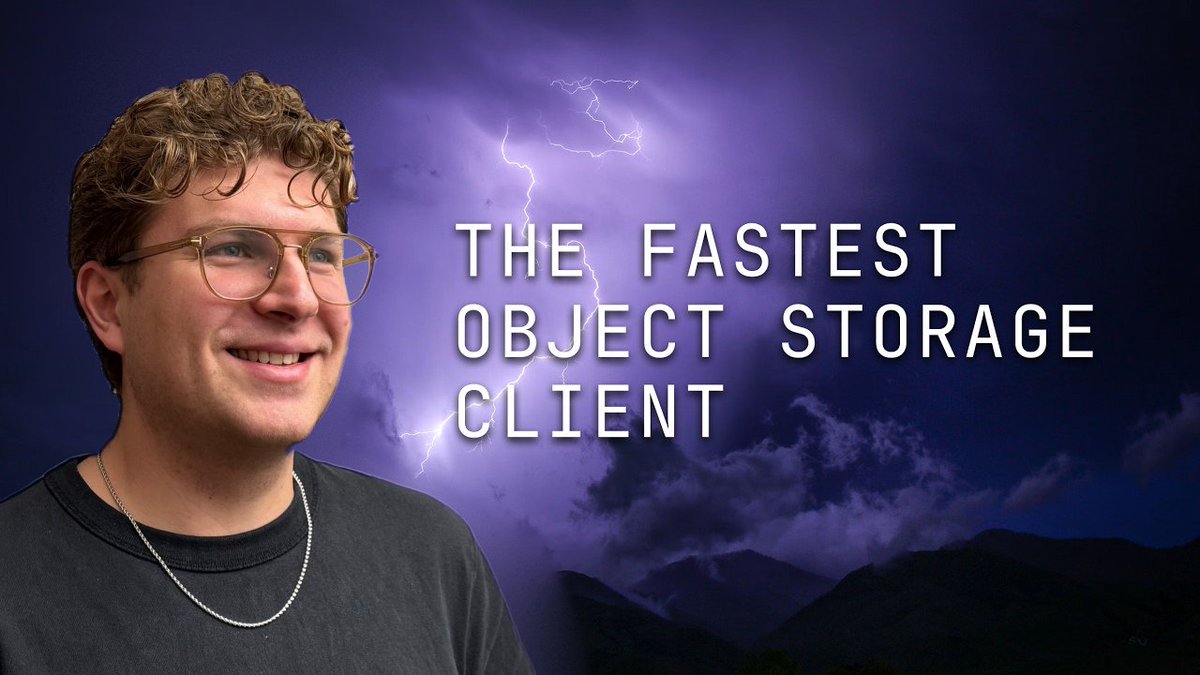
We built the fastest object storage client (that we know of) from scratch in Zig, and TigerStyle'd it.
For the curious, the story! By @georg_kreuzmayr.
https://t.co/KsIWjoz1od
It’s memory hierarchy all the way down.
S3 is the future, the world’s disk. It’s not the only storage medium, nor should it be (again, memory hierarchy).
But there’s hot and cold data, and the well-designed architectures will respect this.
Whether it be L1/L2/L3 and main memory, or NVMe and HDD, or pure replication and erasure coding.
The best designs exploit the memory hierarchy.
Talking to database people is such a breath of fresh air amidst all this AI chaos :)
For the last one hour, I was talking to Joran (@jorandirkgreef), the creator of TigerBeetle DB, and he shared a great way to think about infrastructure code.
The total cost of ownership of an infrastructure component like a database is very low relative to the value it delivers. The number of people using it is huge, and the lifetime of this code is also very long.
So even if you spend a year handcrafting it, it can be totally worth it. The world will keep using it for a very long time, provided it is good.
Infrastructure is not just an expense or throwaway code. It is an asset.
He also shared a beautiful line that I will be reusing a lot: "The database is the last bastion of software craft."
In fact, last week, I rebuilt MongoDB in Rust and got 4x storage savings, 3x faster performance, 100% compatibility, and blah blah blah...
But I had no confidence in what it actually did (even when tests passed) because I do not fully understand the codebase of something that will be mission critical.
The person building a database needs to be highly confident in what it does, how it works, and why it works that way; hence, the craft.
We spoke about so much more, but this is the part I thought would be most useful to share with you all.
Hope this helps.
Most consensus protocols are expressed in terms of “event-based transfer”.
But what if you could express a consensus protocol in terms of “state-based transfer”?
We’re not changing TB’s protocol any time soon… but join matklad and Tobi for a fun adventure into the future!
Tomorrow, the next chapter of IronBeetle⚡️— designing a consensus algorithm from scratch!
(Note the new time slot: 3pm UTC on Fridays for ‘how TigerBeetle works from the inside’ with matklad, steaming on X, Twitch and YouTube.)
Once again a fantastic time in Accra with #MojaCom32 last month! It's a joy to witness the @mojaloop community's growth, and progress towards inclusive Instant Payments worldwide.
September in TigerLand is out!
- Forest fuzzer made simpler and stricter
- All Systems Distributed talks now available
- Jonas Axboe is @RadicalCUP North America champion
https://t.co/KjUI8CFMTi
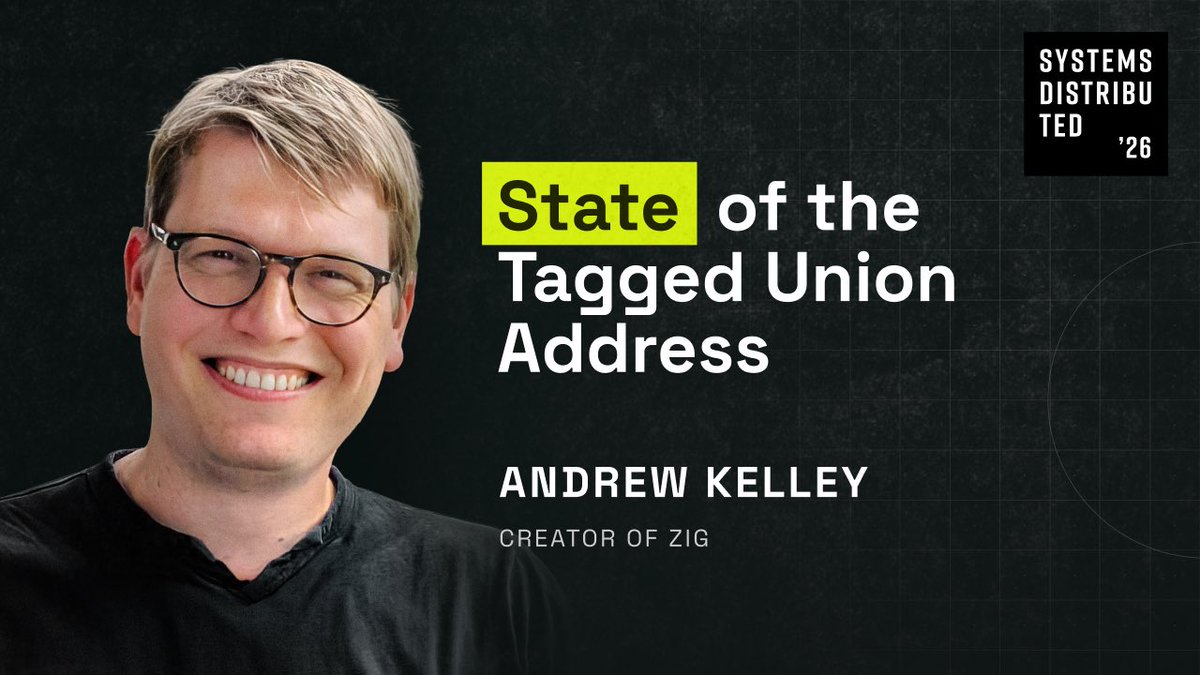
Tomorrow, Andrew Kelley’s State of the Tagged Union Address. Join us! With Andrew in the live chat.
Sep 28, 9am PT / 12PM EST / 6PM CET
https://t.co/3LbQBItlXB
Tomorrow, Systems Distributed ‘26 online continues with Ram Alagappan’s Forkable Shared Logs: how to let AI agents safely operate on live data.
Sep 21, 9am PT / 12PM EST / 6PM CET
https://t.co/eWzAPKDD7x