Sri Lankan by citizen of a planet called Earth, just another human being. please excuse my grammar mistakes. I just simply type without proofreading.🤷♂️
@erangatennakoon AI might be used to fix the old issues. That’s positive. If things got corrected within that period.
AI might be used to manipulate those issues by malicious actors
That’s the negative part.
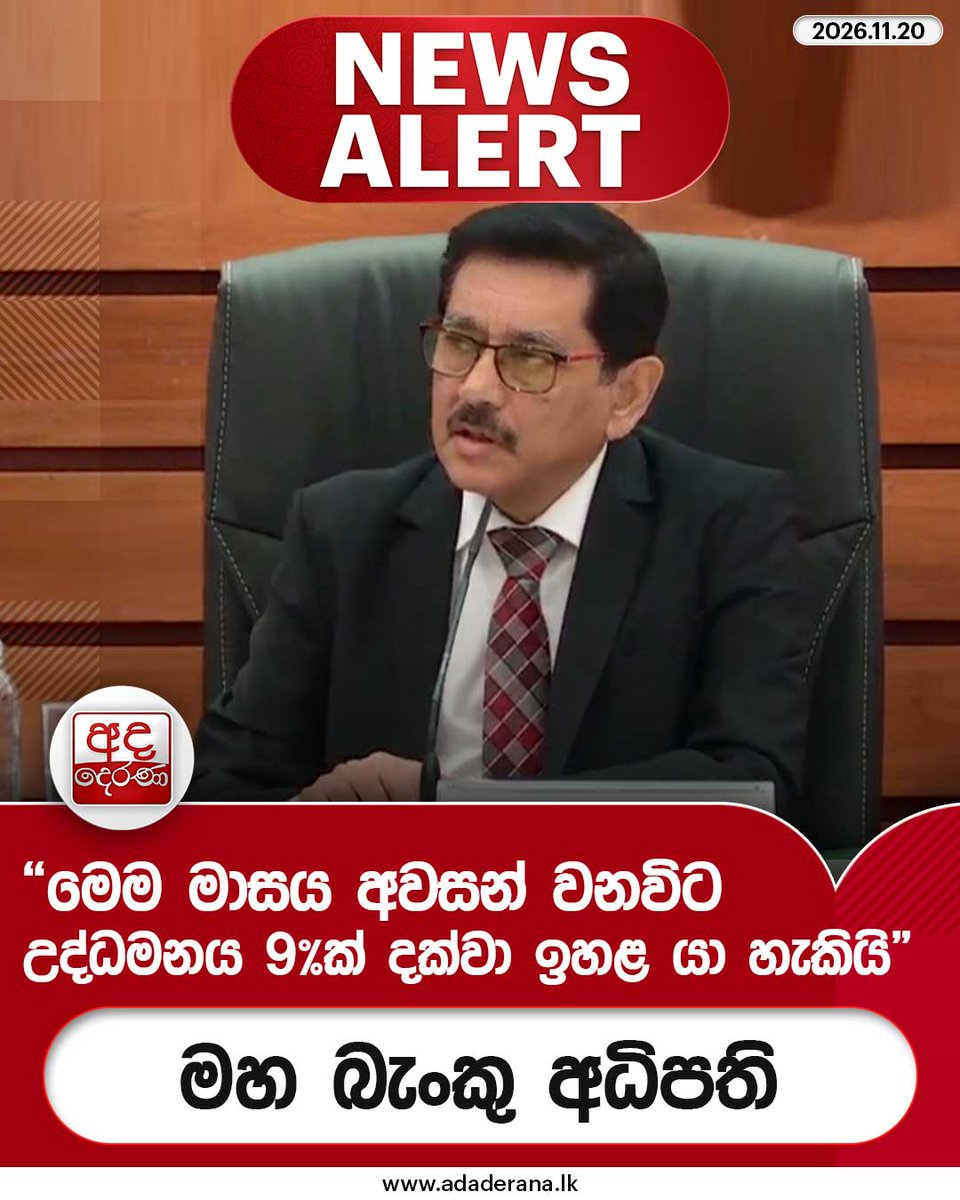
Unexpected rate hike by CBSL,
Maybe precautionary measure.
I thought it will be hold or even a 1/4% reduction because Oil prices have come down by 15% and holding for last 2 weeks at these levels.
Main reason for Inflation to go up is not much demand side it’s cost push because of Oil,LKR depreciation.Higher commodity prices and Logistics.
Oil and Commodities have fallen sharply.
With Higher Taxes,Interest rates going up it’s not easy for businesses to manage.
I thought with budget proposals for higher GDP of 7%,
1/4% reduction would given a signal for Growth momentum.
Anyway CBSL knows better with their Data points to make this call.
At least a Hold would have been better.
SJB Parliamentarian Kabir Hashim drew laughter across the parliamentary chamber today after playfully altering a well-known JVP political rhyme to critique the government over economic hardships. Reciting the tweaked verse—"Hunger in the belly, sorrow in the heart, Lamborghinis for Pelawatta, and starvation for the people"—Hashim took a sharp satirical swipe at the ruling party's headquarters and the cost of living! 💬⚖️
#SJB #Kabir #Hashim #LKA #SriLanka #SLParliament #JVP #Pelawatta #SLPolitics #SriLankaNews #TrendingLK #NewsCenter
@cbsl and #NandalalWeerasinghe is delusional to think there is demand side pressure on prices. There is not. Period. See the corporate P&Ls and the Balance Sheets in September quarter. They are weak. Why do you also not collect anecdotal evidence too before deciding on interest rates? I think you @CBSL #MonetaryPolicyBoard must be held accountable for this decision and its bad consequences on corporate and household balance sheets and their economic wellbeing.
JVP thought that just by fooling the nation by saying they have a plan to run the country, they could then run it after winning with the help of their supporters’ ideas and laundering services. The whole country is going to suffer. That’s what happened. 😅
The JVP spent thirty years preparing to win power. It did not spend a single day preparing to use it. This is the central, defining, and increasingly undeniable truth of the JVP government, and it is reflected not in one failure or two, but in every decision, every crisis, every appointment, every reversal, and every emergency meeting convened after the emergency has already occurred. The party that told Sri Lanka it was ready to govern has governed for two years, and the evidence of those two years is a catalogue of improvisation by people who arrived in office with slogans where plans should have been, with ideology where expertise was required, and with the absolute conviction that wanting to do the right thing was the same as knowing how to do it.
The JVP won the presidency in September 2024. It won a two-thirds parliamentary majority in November 2024. Its first act of consequence was to appoint a Speaker of Parliament. The party that campaigned on integrity, on transparency, and on a new political culture in which credentials mattered and merit determined appointment selected Asoka Ranwala, a man who listed on his LinkedIn profile and on Parliament's official website a PhD in biochemistry from Waseda University and a degree in chemical engineering from the University of Moratuwa. Within weeks, questions emerged about the authenticity of these qualifications. Ranwala could not produce the documents to verify his doctorate. The main opposition filed a motion of no confidence. On December 13, 2024, barely a month into the new parliament, the Speaker of the House resigned, admitting he did not have the documents required to confirm his educational qualifications. The party that promised a new political culture could not verify the CV of the person it placed in the highest office of the legislature. This was not an inherited problem. This was not a legacy of the previous government. This was the JVP's first major appointment, vetted by the JVP's own internal processes and approved by the NPP's own leadership, and it collapsed before the year was out because nobody in the party thought to check whether the man they were making Speaker actually had the degree he claimed to have.
The Ranwala affair was not a scandal of corruption. It was a scandal of incompetence, of a party so unprepared for the mechanics of governance that it could not perform the most basic due diligence on its own people. And it set the tone for everything that followed.
In January 2025, 323 shipping containers classified as 'red alert', meaning they were flagged for mandatory physical inspection by Sri Lanka Customs, were released from the Colombo Port without inspection. Not just without full inspection, but without any inspection. Thirty-seven of the 151 red consignments were released without even being scanned, despite protocols that mandate scanning as the minimum requirement. The containers were released on the authority of an internal committee operating outside standard Customs Department procedures. Customs itself declined responsibility, stating that the release was ordered by the government. The contents of those containers remain unknown. In a country with a documented history of arms smuggling, drug trafficking, and customs fraud, 323 uninspected, red-flagged containers were waved through the port by a government that had been in office for less than three months. The opposition demanded answers. A committee was appointed. The report was submitted to the President, yet the public has not been told what was in the containers. A party that was ready to govern would not have released uninspected, red-flagged containers. A party that understood the security implications of customs enforcement, and that had spent any time studying the operational requirements of the institutions it was about to command, would not have overridden the inspection protocols that exist for the specific purpose of preventing exactly this kind of breach.
In April 2026, the NPP's Minister of Power and Energy, Kumara Jayakody, became the first NPP minister to face a no-confidence motion over irregularities in coal procurement for power generation. The Auditor General's report identified anomalies in the procurement process. President Dissanayake himself admitted to Parliament that the coal procured was of inferior quality, affecting power generation and increasing energy costs. The NPP used its two-thirds majority to defeat the no-confidence motion 153 to 49. Days later, Jayakody resigned anyway, the first ministerial resignation of the NPP government, forced out not by the opposition, but by the weight of the evidence his own president had acknowledged. A government that was ready to govern would not have appointed a minister who presided over a coal procurement scandal within eighteen months of taking office. A government that understood the energy sector would not have allowed inferior coal to be purchased, would not have needed an Auditor General's report to discover that the coal was inferior, and would not have first defended the minister with its parliamentary majority only to accept his resignation days later when the defence became untenable.
In November 2025, Cyclone Ditwah struck Sri Lanka. It was the worst natural disaster since the 2004 tsunami, killing 644 people. The Director-General of the Department of Meteorology issued a clear public warning on television on November 12, more than two weeks before the cyclone hit. Despite this accumulation of alerts, there was little visible response from the highest levels of government. The government delayed declaring a state of disaster. Critical opportunities for advance evacuations, controlled reservoir releases, and pre-positioning of personnel and supplies were lost. Survivors accused the government of failures in early warning, coordination, and basic communication. Ordinary citizens, not the state, were the first responders. Two months after the cyclone, the government had still failed to adequately address the scale of devastation. A party that was ready to govern would have had a disaster response framework in place. A party that understood the responsibilities of the executive would have acted on the meteorological warnings with the urgency that over six hundred lives demanded. The warnings were there. The time was there. The institutional capacity was there. What was not there was a government that knew what to do with any of it.
The party that built its identity on opposing Indian influence signed a secret defence cooperation agreement with India during Prime Minister Modi's visit in April 2025 and refused to disclose its contents, stating that the agreement could not be made public without India's consent. The same party then signed another undisclosed defence agreement with the United States. The party that condemned every previous government for secret pacts with foreign powers has now signed at least two such pacts and kept them from the public, from Parliament, and from the very electorate that voted for transparency. A party that was ready to govern would have understood that the transition from opposition to government requires the transition from demanding transparency to providing it. The JVP demanded disclosure from others for thirty years and cannot provide it itself, not because disclosure is impossible, but because the agreements it has signed apparently contain commitments it does not want the public to examine.
The JVP promised to abolish the executive presidency. It has not. It promised to repeal the Prevention of Terrorism Act. It has instead drafted the PSTA, which is broader and more dangerous. It promised provincial council elections within one year. It has been two years. It promised to allocate six percent of national income to education. The last budget allocated less than two percent. It promised to reform the health sector. Health spending was cut from Rs. 410 billion in 2024 to Rs. 383 billion in 2025, worsening medicine shortages. It promised economic reform. Reforms have stalled. SriLankan Airlines continues to haemorrhage public funds. Inflation has risen to 8.3 percent, a forty-month high. The party promised everything and has delivered a Speaker who could not prove his qualifications, a minister who resigned over a coal scandal, a cyclone response that killed hundreds through institutional paralysis, secret defence pacts with the very nations the party spent decades demonising, and a mayor who asks private companies to send him December gift parcels.
The JVP does not know how to govern. It knows how to campaign. It knows how to organise. It knows how to mobilise. It knows how to identify what is wrong with every other government. It does not know how to run one itself. Its ministers are inexperienced. Its appointees are selected for loyalty rather than competence. Its parliamentary majority, the largest any party has held in a generation, is used not to pass transformative legislation, but to defeat no-confidence motions against ministers who will resign days later anyway. Its response to every crisis is a meeting, a committee, a task force, or an announcement that something will now be done about the thing that should have been done before the crisis occurred.
The 159 new faces in Parliament were presented as a strength, as proof that the old politics had been swept away. They are, in practice, a weakness, because governing a country requires skills that political campaigning does not teach, and the JVP has 159 legislators who know how to win an election but do not know how to draft legislation, manage a ministry, oversee a procurement process, respond to a natural disaster, negotiate an international agreement, or maintain a drainage canal. The party's institutional knowledge is concentrated in one man, Tilvin Silva, and in the Politburo he has controlled for thirty-one years, and that knowledge is the knowledge of party management, not state management. The JVP knows how to run the JVP. It does not know how to run Sri Lanka. And the country, two years into the experiment, is discovering the difference.
Every failure listed here is not a failure of intention. It is a failure of capacity. The JVP intended to be different. It intended to be clean. It intended to govern well. It simply did not know how, because knowing how requires preparation, and the JVP prepared for thirty years to win power and did not prepare for a single day to exercise it. The slogans are the same. The conviction is the same. The capacity is absent. And the country, which gave this party the largest mandate in its democratic history because it believed that wanting to do the right thing was sufficient qualification for doing the right thing, is learning, at the cost of lives, livelihoods, and institutional integrity, that it is not.
The JVP was not ready. It is reflected in every move it makes. And the people who gave the party the chance it asked for are the ones paying the price for an organization that spent thirty years rehearsing the speech and never once practiced the job.
#SriLanka #JVP #NPP #LKA
@Ru173418052 You would not agree with this but in my opinion Trump change the game for worst in 2016 . Politics was civil before that. Diplomatic relations were affected as well due to that. It’s just my opinion in short form