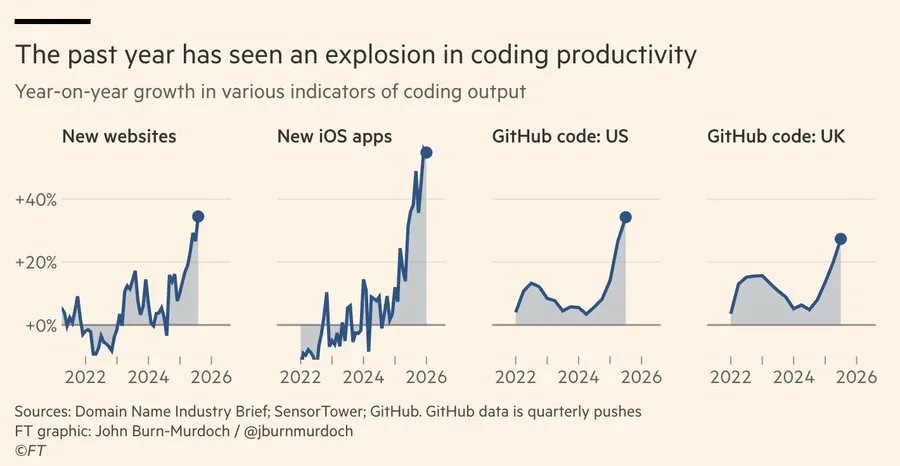
Look at this chart.
The Financial Times published this data recently and it's been stuck in my head since I first saw it.
This is the inflection point.
New websites, iOS apps, GitHub commits, all going parabolic.
A teenager with Claude can ship what used to take a funded team and six months of runway.
Solo developers are launching full SaaS products over a weekend.
Designers who've never written a line of code are building functional apps.
The barrier to creating software has, for all practical purposes, collapsed.
Which leads to a question that I think is more important than most people realize:
If everyone can build, what happens to the *value* of building?
When the supply of something explodes, the thing itself gets cheaper.
That's Markets 101. And software supply is going vertical right now.
The logical next step is that the money and energy that used to flow toward production has to find a new home.
It flows toward the only bottleneck that remains: getting people to actually pay attention.
Human attention is, I think, the last genuinely scarce resource in an economy where production costs are collapsing toward zero.
AI can generate a million apps. It still can't make anyone download one.
It can write a million blog posts. It still can't make anyone read them.
And this is why it's never been more important to learn how to engineer attention.
If you understand both marketing and AI, you're now holding a combination that companies will pay 100x for.
Most people are learning one or the other.
The person who can do both, who can capture attention AND use AI as the lever to do it at scale, is probably the most valuable person in any room right now.
There's an assumption floating around that AI will commoditize marketing the same way it's commoditizing code.
People think "vibe marketing" will follow the same path as "vibe coding"
And I get why that's the intuition.
AI can write copy, generate ads, build landing pages. Same playbook, same compression.
But I don't think it works that way, and the reason comes down to something I keep calling the taste problem.
AI is already deeply embedded in marketing.
The algorithms that decide what you see on every platform, the recommendation engines, the ad targeting, etc all of it runs on AI.
That part is done. But knowing how to read those systems, how to work with them, how to craft something that the algorithm wants to push and that a human actually wants to engage with, that still requires taste.
And "good enough" marketing simply doesn't cut it anymore.
"There is no demand for average" - Naval
The bar for what breaks through keeps rising precisely because AI is flooding every channel with competent, forgettable content.
You can prompt AI to write a tweet.
You *cannot* prompt it to write a tweet that 50,000 people share.
That gap between "technically correct output" and "people actually care" is taste, and taste is built from years of understanding narrative, timing, cultural context, when to be funny, when to shut up.
There's no shortcut. I've watched plenty of people look for one.
What's sort of counterintuitive is that AI actually widens the gap between people who have taste and people who don't.
If you have it, AI becomes a genuine force multiplier.
You test 40 subject lines in the time it used to take to write 4.
You draft a full campaign in an afternoon and spend your real energy on the 15% that makes it land instead of grinding through the 85% that's just scaffolding.
But if you don't have taste, AI just helps you produce more mediocre work, faster (which is arguably worse than producing mediocre work slowly, because at least then you weren't flooding your own channels with it).
Code has a finish line. It either works or it doesn't. You can write tests, benchmark it, measure performance.
A model can evaluate whether code does what it's supposed to do.
But attention, trust, brand, these are built from a thousand small decisions that compound over months and years.
They're the residue of every interaction someone has with you, and none of it can be reverse-engineered by running inference on a competitor's marketing.
This is why distribution specifically resists commoditization in a way that engineering doesn't.
So the people who spent the last few years building audiences, developing their voice, earning trust one reader at a time, they're holding something that just got *radically* more valuable.
The landscape shifted around them.
Every other competitive advantage in tech got cheaper overnight, and theirs didn't.
Human attention will forever be scarce.
Therefore in an age of AI abundance, the art of capturing it is the last moat.
Calling all high schoolers! Do you have what it takes to pass the IMPOSSIBLE Civics Test?
Step up and compete for scholarships totaling $250,000 as we celebrate America’s 250th birthday!
Sign up today for the Presidential 1776 Award at https://t.co/KRbxEzNYDW!
Coś dla fanów Hugh Granta i filmu "To właśnie miłość". Na igrzyskach #MilanoCortina2026 australijski snowboardzista Scotty James odtworzył słynną scenę tańca.
I might get some pushback for this, but I honestly think a lot of parents, especially in places like Silicon Valley and especially many Asian parents, are training their kids for the wrong world.
I see kids at the age of 7-8 packed with after-school math, more reading, more test prep, with the goal to make them “smarter.”
But from my perspective, living deep in the AI world every single day, I’m pretty sure raw intelligence is about to become a commodity.
Very soon, AI is going to do math better than the best mathematician, it’ll diagnose better than top doctors around the world, it’ll draft contracts better than elite lawyers, and it’ll learn faster than any PhD, instantly, endlessly, and without any fatigue.
All of that knowledge will live right in your pocket.
So think about it… if we’re raising kids to win by being “the smartest in the room,” we’re really training them for something that’s already being replaced.
In my opinion, this is a waste of time, $, and effort.
What I focus on with my kids is very different.
I care about willpower.
I care about passion.
I care about loving something enough to stick with it, especially when it feels hard.
And as a Dad, my job is to support that, whatever it is, and teach them to never give up.
I could be totally wrong though…
But when I look at where AI is headed, I don’t think the future belongs to the kid who memorized the most formulas or did the most math problems, etc.
In the future, I think the winners are going to be kids who
1/ can push through frustration
2/ can stay curious
3/ can keep going deeper into their passions than others
4/ can use AI tools to build cool things
5/ has the will power to never give up
In this day and age, school doesn’t really teach this and I don’t think after-school classes teach that either. I don’t think any of this can really be taught at school tbh, it’s something that is developed inside the home through the environment we as parents cultivate.
In a world where AI will help you build anything, create anything, and learn anything instantly, I don’t think the real edge will be intelligence anymore like the past.
The edge will come down to grit, discipline, emotional strength, and to keep going as others quit.
AI will be so deeply woven into our kids’ lives whether we like it or not.
That part is unavoidable.
However, what is avoidable is raising kids who only know how to follow instructions, chase grades, and wait for approval.
I always tell my kids, I don’t care what grade you get in a test. I care that you know what you got wrong, why you got it wrong, and what you’re doing to avoid that mistake in the future.
Because I firmly believe in the future, the kids who will thrive the most will be the ones who want something badly enough to go after it, who aren’t afraid to fail, and those who know how to leverage AI.
Just my two cents.
But if we’re serious about the future, I think it’s time parents start training for that world, NOT the one we grew up in.
@jackneff Perhaps only those who are watching solo or who don’t care about the game. But consumers who look at the Super Bowl as a social sporting event will be less likely to scan IRL. Maybe will do for the replays.
What’s the most important investment you can make in your long-term health and happiness? A study that has tracked participants for 85 years says the answer is close personal relationships. https://t.co/0UTZYdKt5g
Key point “However, the success of the metaverse is weighed by a greater focus on maximizing the human experience aimed at delivering positive experiences for consumers” Metaverse to possibly create $5T in value by 2030: McKinsey report https://t.co/t1YlWPdh0C via @cointelegraph
From the always-brilliant @priyaparker, if we deal with Thxgiving challenges through imaginative response we’ll be better for it right now, and in years to come.
Abandon Your Thanksgiving Script https://t.co/urdbp752ns