Professor of Marketing, University of Surrey. My interests are in AI, digital assets, social media, Sri Lanka and geopolitics - sometimes not in that order
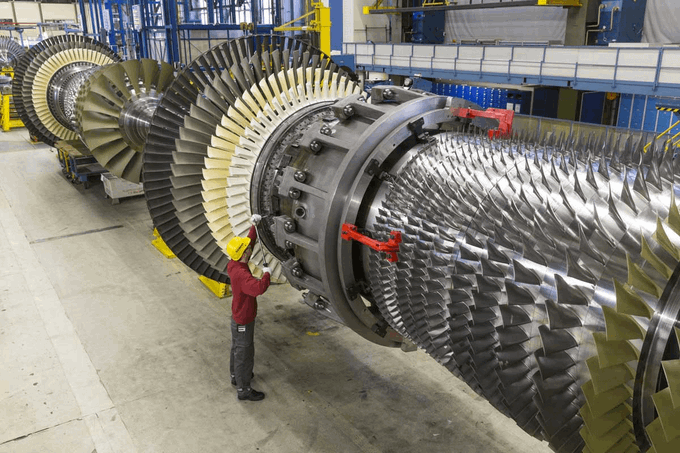
You've seen this image do the rounds.
The story goes Gas turbines blades - 5 years booked - single crystal blade technology - only 3 companies etc.
Yes & No.
Here's a no nonsense, first principles breakdown:
Firstly, Single crystal blades are used in a gas turbines (power) or a jet engines SPECIFICALLY where temperatures exceed 1,600°C
A single crystal blade is a piece of metal made of one continuous grain of nickel superalloy. No grain boundaries, no weak seams.
That is why it can survive 1,600°C gas at 10,000 g of centrifugal force for 30 years.
But SC blades for Jet engines vs power turbines are very different.
Same process but very different.
In a jet engine, the single-crystal blade is the Stage 1 rotor of the high-pressure turbine. It is roughly 10 centimetres long and weighs a few hundred grams.
It spins at 15,000 to 20,000 RPM. It runs in cycles, takeoff to landing, ten times a day.
What kills a jet blade is fatigue i.e - The slow weakening of metal under repeated cycles of stress and temperature change.
A power turbine Stage 1 blade is roughly 20 to 30 centimetres long, including the root and shank. It weighs 1.5 to 5 kilograms
It spins at a steady 3,000 to 3,600 RPM. It does not cycle, it sits in 1,600°C gas continuously for months.
What kills a power turbine blade is creep i.e - The slow stretching of metal under continuous heat and centrifugal force, year after year.
Different killer = different alloy.
Power turbine blades carry more rhenium for creep resistance.
AND Different size means different physics.
Growing a defect-free single grain through a 30 cm volume is multiple times harder than through a 10 cm one.
Casting yields are lower.
That's WHY the number of facilities that can do IGT-grade SC reliably is much smaller than the number that can do aero-grade.
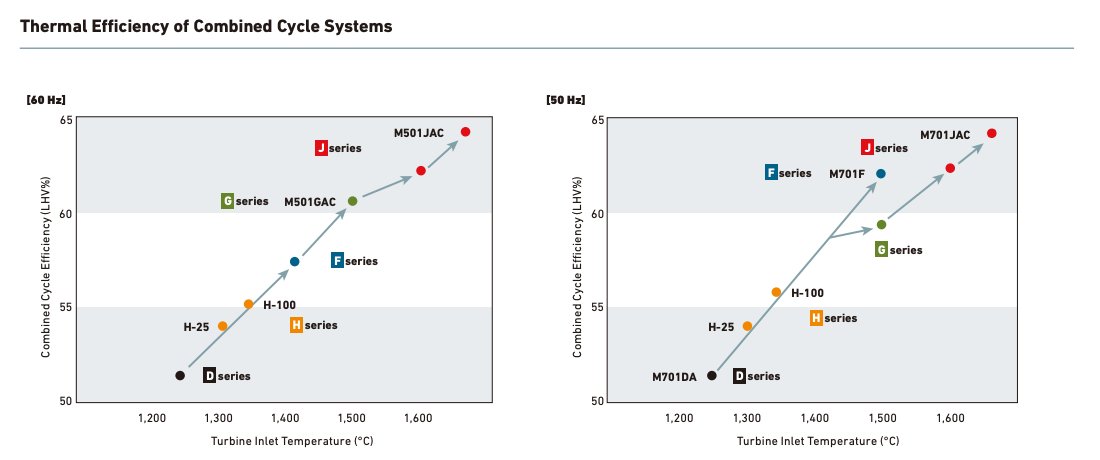
EVEN Within gas turbines we have F-class, H-class, J-class and theese Gas turbines for power generation are sorted by firing temperature.
Meaning, higher firing temperature means higher efficiency, which means more electricity per cubic metre of gas.
1. F-class (mature, 1990s onwards) fire at around 1,300°C with combined-cycle efficiency of 58 to 60%.
2. H-class / HA-class (2000s onwards) fire at 1,450 to 1,500°C with combined-cycle efficiency of 60 to 63%.
3. J-class / JAC-class fire at around 1,600°C with combined-cycle efficiency of 63 to 64%, using rhenium-rich alloys at the absolute limit of metallurgy.
As firing temperature rises, the metallurgy gets harder.
The reason customers want H and J, not F is that each generation jump cuts fuel cost by 5 to 8% per MWh.
For a 1 GW base-load plant, that is over ~₹1,000 crore in fuel savings every year.
Every utility, hyperscaler, and LNG developer specifying new capacity wants H-class or J-class, not F.
WHERE IS THE BOTTLENECK TODAY FOR GAS TURBINES?
F-class capacity has plenty of headroom. Customers do not want F.
H-class and J-class capacity are the constrained ones.
Howmet's IGT-grade Stage 1 single-crystal line for H and J class is sold out. The in-house casting lines at GE Auburn, Siemens Berlin, and MHI Takasago are sold out.
WHO CAN ACTUALLY MAKE THEM?
For aero, capable countries number about 8.
For heavy-duty power turbines, the commercial club drops to 3 as far as ROW is concerned.
GE Vernova in the US, Siemens Energy in Germany, Mitsubishi Power in Japan + China & Russia have turbines that perform with varying performance parameters.
Hope this was insightful. If you're still reading. follow and repost. Tc.
My latest piece uses Sri Lankan cricket as a powerful lens to examine a vital question for any nation: do our institutions reflect the credibility we claim to want? 🇱🇰🏏
https://t.co/73gj1ItDXR
#Governance#SriLanka#Cricket#Leadership#InstitutionalCredibility
In this insightful interview, economist Dhanusha Gihan Pathirana dives into Sri Lanka's economic hurdles and outlines strategies for recovery.
Watch here: https://t.co/RfskeFPkbj
#SriLanka#Economy#PolicyReform
🌊 Sri Lanka's recovery from #CycloneFengal is a moment to rebuild smarter! 🌱 Tackling risks, seizing opportunities, & fostering climate resilience can pave the path to sustainable growth. Read my opinion on navigating this critical phase: #SriLanka#EconomicRecovery
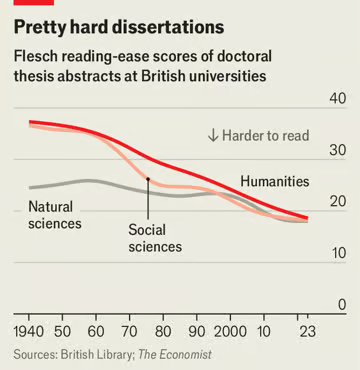
Academic writing is getting harder to read, especially in the humanities. How can we make scholarship rigorous yet accessible? Let’s rethink how we share ideas to engage broader audiences.
Read: https://t.co/7c3Am6D4tW
#AcademicWriting#Clarity#Education#Storytelling
Knowledge is a skyscraper. You can take a shortcut with a fragile foundation of memorization, or build slowly upon a steel frame of understanding.
@naval
If you want to understand Chinese philosophy and its capacity to embrace contradictions, the very best place to start is the Yin-Yang theory.
It's surprisingly misunderstood and understudied by those interested in China, but if there's one foundational theory for Chinese culture, that's the one. And whilst it sounds simple and straightforward on the surface, when you delve into it, it gets quite complex, with fascinating philosophical and cultural implications.
Most importantly, I firmly believe that the Yin-Yang theory is where the cultural misunderstandings between China and the West begin. In the West, probably due to our Christian roots, we tend to see the world in absolutes: we need to have light triumph over darkness, good defeat "evil", etc.
However, this is totally antithetical to the Yin-Yang theory. Let me explain why.
The Yin-Yang theory stems from the notion that nothing exists without its opposite. Light has no meaning without darkness, truth without lies, etc. There is this duality in all things.
But duality, and here comes the most common misunderstanding, doesn't mean things are ever absolute. There is never absolute light, absolute truth, etc. That's what the Yin-Yang symbol is meant to depict: black and white always coexist even though one can be predominant.
And not only do they co-exist but they're interdependent, if one dies or completely overpowers the other, they both die. This is why it's antithetical to having absolutes: absolutes means death and void. If darkness somehow were to triumph over light (which is actually impossible in Yin-Yang theory), both light and darkness would disappear.
That was the "simple" bit. Digging a bit deeper, there's a relatively complex notion in that the Yin constantly influences the Yang and vice versa.
For instance when you have a "Deficiency" of Yang, the Yin becomes relatively important. Think about dimming the light in a room: light fades, so darkness becomes relatively more present even though no "darkness" is added. You can also have the opposite: an "Excess" of Yin makes Yang relatively less important. Think about adding ice to a drink: the drink becomes overpowered with cold even though you didn't remove any heat.
But importantly, even if Yin were to completely overpower Yang or vice versa, there is always a little seed of one in the other. That's what's symbolized by the presence of a small dot of each color in the opposite sections of the Yin-Yang symbol: within the deepest core of one energy lies the seed of its opposite. In fact, according to the Yin-Yang theory, if Yin or Yang reaches an extreme point, it will turn into the opposite. A bit like the old proverb: “the road to hell is paved with good intentions”. If you seek to maximize "good" to an absolute level, you'll eventually end up with "bad".
You'll have guessed it, the name of the game is consequently to strive for harmony in all things, and stay well clear of absolutes. A "win-win" status if you will where the Yin and Yang perfectly balance each other. Harmony is probably the most important value in Chinese culture, the equivalent of "freedom" in the West (even though the latter is often evoked in very ironical or cynical ways).
Philosophically speaking, the Yin-Yang theory has many implications:
- Interconnectedness: Nothing exists in isolation but is part of a larger whole. This is the root of why Chinese culture is collectivist: you cannot see yourself as just a disconnected individual because reality is such that everything depends on and impacts everything else.
- Relativity: what is considered Yin or Yang is not absolute but depends on context and comparison. This can be applied to moral and ethical judgments, suggesting that good and bad, right and wrong, are not fixed absolutes but depend on perspective and circumstances.
- Change and transformation: Yin and Yang are in a perpetual state of dynamic balance, implying that change is the only constant.
- Unity of opposites: Yin-Yang theory presents a paradigm in which opposites are not seen as conflicting and mutually exclusive entities, but as complementary and essential parts of a unified whole. This encourages a holistic approach to understanding complex systems.
- Potentiality and transformation: The presence of Yin within Yang and Yang within Yin symbolizes the potential for transformation within all states and beings. It's a fluid view of existence, where there is always the potential for renewal and improvement.
Studying the Yin-Yang theory also allows to understand better the Chinese approach to geopolitics and in particular:
- Their insistence on interdependence and on "win-win", and their disgust for "zero-sum" games because they operate on the principle of winners and losers (again, no absolutes in Yin-Yang: if you "win", it means you actually lose too). The BRI is a great example of this, as an attempt to foster cooperation and development that ultimately benefit everyone.
- Their comfort with competing ideologies, and the total absence of proselytism for their own ideology (they don't look to spread "Socialism with Chinese characteristics" abroad): because at the end of the day, without opposing ideologies and if ever "Socialism with Chinese characteristics" were to become dominant, it would die. And much like all Yang needs to have a bit of Yin in it and vice-versa, even within the PRC they're happy to have places with a totally different system like Hong Kong, as long as they remain harmonious within the system.
- Their strategic patience: the ultimate aim of following Yin-Yang principles in geopolitics is to achieve a harmonious balance, minimizing conflict and instability. Strategic patience reflects a preference for achieving objectives through peaceful means over time and avoiding direct confrontation. This also embodies the fluid perspective of Yin-Yang on the world, suggesting that with patience, every geopolitical situation has the potential for positive change.
- Their non-interference policy: this is the cardinal aspect of Chinese foreign policy and it echoes the Yin-Yang emphasis on respecting natural balances and others' harmonies. Again, strikingly different to the Western liberal approach, which puts emphasize on bringing "freedom" everywhere.
- Their hatred of absolutists: nothing irks the Chinese more than absolutists of any kind - domestically or abroad - who strive to impose their views or ideology without regard for balance or the interconnectedness of things. This goes totally against the Yin-Yang principle of seeking harmony and balance, rather than dominance or suppression of opposing forces.
I could write a lot more on Yin-Yang, as the depth and the implications are quite profound when you dig into it. But I simply wanted to give you a glimpse into just how completely differently the world is seen in China, and why it's always an immense mistake to analyze them through the prism of Western concepts and values, which we often think are universal but absolutely aren't.
Discover the power of Generative AI in retail! Dive into these seven impactful use cases. Your thoughts on AI in retail? Share below! #RetailInnovation#GenerativeAI#FutureOfRetail via @forbes https://t.co/ApiKisV0Iu
Storytelling transforms! From Palawa traditions to data challenges, explore the blend of human touch & AI impact. #BusinessNarratives#DataStorytelling#AI via @forbes https://t.co/g9ekK1XrYN
AI is reshaping fashion at warp speed. BI says that generative AI could inject $275 billion into profits But here’s the twist: while the potential is crystal clear, the path ahead is uncertain. #AI#GenerativeAI https://t.co/sEYCzvaNgC
@lufthansa staff being racist. Asian person is offered only a vegetarian meal (even when non vegetarian option is requested), but the white person sitting next to him is offered a choice of Salmon or Chicken. #racism#discrimination#lufthansasucks
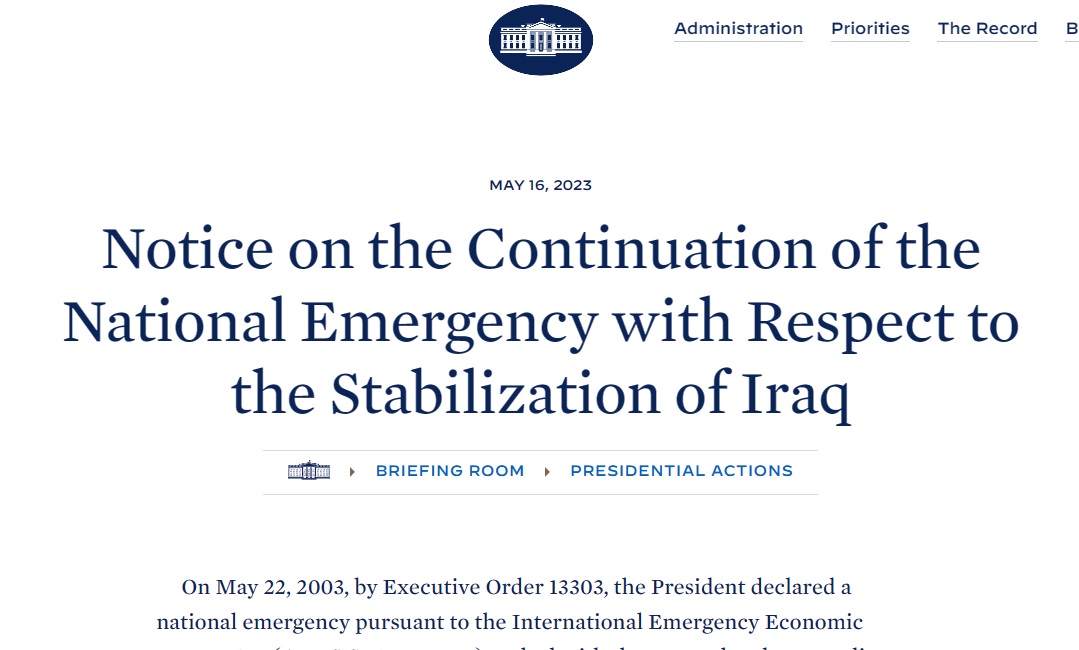
Went unnoticed: U.S. President continues to control all Iraqi oil revenues, decision going back to 2003.
This is how the U.S. controls Iraqi governments and policy making!
See background in the thread:
ChatGPT is great, but it has limitations.
It can't generate summaries, websites, logos, or videos for you.
Here're 7 Insanely powerful AI tools that excel at these tasks: