The key to happiness is not in things, but in gratitude.
Daily, I stop, take a deep breath & find a single happy memory.
As I go into it & experience it again, it makes me smile. The more thankful I am, the happier I get.
It becomes addictive.
Try it. It might just work for you
Today was the worst day on SPX this year, the worst day in 164 trading days, and the 2nd worst day in the past year. It was the 8th worst day in the past decade.
George Blankenship got really emotional telling the story of early Tesla
And it shows why Tesla’s survival story is one of the wildest in startup history
The Model S wasn’t just another car. It was Tesla’s first true everyday car
And it was Tesla’s do-or-die moment
Thousands of people trusted Elon Musk enough to hand over $5,000 deposits…
No car in their driveway
No guarantee Tesla would survive
Just belief in a promise
But behind the scenes, the reality was brutal
In Q2 2012, Tesla delivered just 12 cars in the entire quarter
Wall Street was circling like vultures
The media was waiting for Tesla to die
Short sellers were waiting for the collapse
And the company was running straight into one of the most terrifying production hells in startup history
Then Elon did something insane
He publicly tweeted that Tesla would be profitable by Q1 2013
That wasn’t a prediction
That was a survival command
To make it happen, Elon set the number:
4,750 deliveries....
The mission became clear:
Deliver thousands of Model S cars before the quarter ended
The number that mattered inside the company became 4,750
The pressure inside Tesla became unreal
George Blankenship had to email Elon every single night at exactly midnight with the raw survival numbers:
How many deliveries still stood between Tesla and death
By the final week, job titles disappeared
IT guys were washing cars
Marketing guys were moving cars
People who had never worked in delivery were suddenly doing whatever it took
Nobody was “above” the work
Nobody was waiting for someone else.
Everyone was fighting for the same thing:
Keep Tesla alive
Then came the final Saturday of the quarter.
At 3 PM…
Car 4,750 was delivered
Tesla had done the impossible
Blankenship stood on his desk, looked at his exhausted team, and told them:
“What you just did is monumental… not just for Tesla, but for what we’re going to do for mankind.”
That quarter, Tesla shocked the world with an $11M profit.
The stock exploded from around $20 to $90
But the real story isn’t the stock
It’s that Tesla crossed the line between impossible and inevitable
They didn’t just build a company.
They forged the foundation of the EV revolution
Mark Douglas never said "control your emotions," and he never said "test your edge with 20 trades."
These are the two most widespread misreadings of his work.
Both are still repeated daily.
Both are doing real damage.
Let me start with the first.
Most traders believe that the best traders are better at controlling their emotions.
That they feel the same fear, the same greed, the same hesitation, but somehow push through it with superior willpower.
Douglas said the opposite.
"The best traders are not afraid."
"They do not perceive market information as painful."
"There is nothing to control, because there is nothing to fight."
He was not describing emotional control.
He was describing the absence of the emotions that most traders are trying to control.
The best traders do not override their fear.
They have restructured what they believe about the market so completely that fear does not arise.
A chart is pixels.
It does not produce fear.
Your interpretation of it does.
When that interpretation changes, when you stop believing that this trade matters, that this loss is dangerous, that this moment will define you, the emotional response disappears.
Not because you learned to suppress it.
Because the trigger no longer exists.
"Consistency is a state of mind. Once achieved, you will not be able to function any other way."
This is the line most people skip.
Consistency is not forcing yourself to follow rules.
It is reaching a mental state where breaking them becomes unthinkable.
That state does not come from willpower.
It comes from a transformation of belief, built through testing and practice with your own hands.
That is the first misreading corrected.
The second misreading is worse.
Almost no one even recognizes it as a misreading.
Douglas described an exercise: execute 20 trades in a row, following the same rules, with zero deviation.
No skipping.
No hesitating.
No adjusting after a loss.
Most readers saw the number 20 and concluded: "20 trades is enough to know whether my system works."
That was never the point.
The exercise was not a test of the system.
It was a test of you.
Douglas was measuring one thing: can you execute 20 trades without a single emotional intervention?
Not "does this system produce profit in 20 trades?"
But "can you follow your rules 20 times in a row without your fear, your hope, or your opinion overriding a single one?"
This is a consistency drill.
Not a statistical test.
And there is a detail most readers miss entirely.
Douglas described these 20 trades as "one trade."
Not 20 separate events.
One.
That means the exercise does not end after 20 trades.
It begins again.
And again.
You are not running one set and drawing conclusions.
You are repeating the set over and over, treating each round of 20 as a single unit, until executing without deviation becomes your default state.
The total number of trades this produces is enormous.
That is the point.
The exercise demands a volume of repetition that most readers never realized was being asked of them.
And yet, most traders run 20 trades once, see a loss, and conclude the system is broken.
Or they see a few wins, conclude it works, and go live.
Both conclusions are meaningless.
Statistical accuracy depends on sample size.
This is not a trading opinion.
It is a mathematical law that applies to medicine, engineering, polling, and every other field that relies on data.
Short-term randomness can push a 55% win rate system down to 30% or 35% over 20 trades.
If you saw that number without context, you would say something is wrong.
Nothing is wrong.
That is what small samples look like.
The system did not change.
The sample is just too small to show you the truth.
20 data points cannot tell you whether any system works.
The variance is too wide.
The confidence interval is too large.
Random noise dominates the data at that scale.
If you run 20 trades and conclude "this does not work," you are not making a data-driven decision.
You are reacting to randomness.
"But Mark Douglas said 20."
Douglas never claimed that 20 trades was a statistically valid sample.
The readers did.
They took a consistency drill and turned it into a statistical test.
That was never his instruction.
That was their misreading.
Probability does not say "Oh, Mark Douglas recommended this sample size, so I will make the law of large numbers work for just 20 trades."
It does not negotiate.
It does not make exceptions.
It works when the sample is large enough, and it does not work when it is not.
Douglas opened the door to probabilistic thinking in trading for an entire generation.
His work gave countless traders their first real contact with this way of seeing the market.
But the math does not forgive a misreading just because the source was respected.
And here is the part almost everyone skips.
Douglas assumed you already had a system with a verified edge before you started the exercise.
The drill was never meant to be your first contact with your system.
It was designed for a trader who had already done the work: defined the rules, tested the numbers, confirmed the edge across a sample large enough for the statistics to be reliable.
The 20-trade exercise comes after all of that.
It is the final step, not the first.
Without that foundation, the exercise loses its meaning.
You are not practicing flawless execution of a proven system.
You are executing an unverified idea 20 times and hoping the results tell you something.
They will not.
If you want to honor what Douglas actually taught, do what he assumed you would do first.
Build a system where every condition is defined and every decision is resolved before the chart opens.
Test it across a sample large enough for the statistics to stabilize.
Know what your system produces before you ever sit in front of a live chart.
Then, and only then, use the exercise for what it was designed for.
Not to test the system.
To test yourself.
To repeat it until following your rules is not an effort but a reflex.
The system was already proven before the drill began.
The only question left is whether you can follow it.
That is what the 20-trade exercise was always about.
And that is the part almost everyone skips.
The trust game begins with a system worth trusting.
The blueprint that gives your strategy edge and repeatability [Trading System Architecture]
→ https://t.co/tXIFR0jr2T
The losing phase in trading lasts much longer than anyone tells you. You lose, you fix something, you still lose. You study harder, things get slightly better, but the losses are still more than the wins. At some point that slow progress starts to feel like no progress at all, and that is exactly where most people stop.
Keep going, because every trader who made it through this phase will tell you the same thing: the progress was always happening, you just could not see it yet.
Every stage for a millionaire trader:
Stage 1 – The Gambler
Right now you’re trading outcomes, not structure. Your decisions are emotional, inconsistent, and heavily influenced by P&L. There’s no stable process yet just reactions.
To move to Stage 2 (The Student): commit to one market, one setup, and journal every trade. Your goal is to replace chaos with structure.
Stage 2 – The Student
You’re learning aggressively, but execution is inconsistent. You believe more knowledge will fix the problem it won’t. The issue isn’t information anymore, it’s application.
To move to Stage 3 (The Emotional Trader): stop adding strategies and master one setup. Track execution quality, not profits.
Stage 3 – The Emotional Trader
You know what you should do, but you don’t always do it. Discipline breaks show up under pressure overtrading, cutting winners early, revenge trades. Awareness is high; control is unstable.
To move to Stage 4 (The System Trader): reduce size, enforce hard stop rules, and measure rule adherence percentage. Emotional stability comes before performance.
Stage 4 – The System Trader
You have defined entries, exits, and risk. Losses are planned and structured. Now the challenge is patience and selective execution not taking trades that almost qualify.
To move to Stage 5 (The Consistent Executor): trade less, wait for full confirmation, and eliminate impulse entries. Precision separates you now.
Stage 5 – The Consistent Executor
You trust your system and understand variance. Emotional swings are smaller and you no longer need constant action. The threat now is boredom and over‑optimization.
To move to Stage 6 (The Professional): think in weeks and months, not trades. Focus on capital preservation and long‑term consistency.
Stage 6 – The Professional
You operate on probabilities, not emotion. Risk management is automatic. Trading is process‑driven and stable.
Your job now: protect discipline, avoid complacency, and continue refining execution without increasing emotional exposure.
There's a guy who trades from a small office in Pune. Started with ₹2 lakh in 2021. By mid-2022, account was at ₹87,000.
He didn't blow up on one bad trade. He bled slowly. ₹3,000 here, ₹5,000 there. Death by a thousand cuts.
October 2022, he's sitting at his desk looking at his brokerage statement. He's made 89 trades in three months. Win rate: 61%. Should be profitable, right?
He pulls up Excel. Does the math properly for the first time.
Average winner: ₹890
Average loser: ₹2,340
He stares at the screen for ten minutes.
He was right more often than he was wrong. And still lost ₹1.13 lakh.
The problem wasn't his analysis. It was his exits. He was booking ₹800 profits the moment he saw green. But holding losers for days hoping they'd "come back."
He made one change: Next trade, whatever happens, hold until target or stop loss. No early exits on either side.
Felt horrible. First trade hit his ₹4,200 target. Three times he almost booked at ₹1,500, ₹2,200, ₹3,000. Sweating the whole time.
But he held.
Took him eight months to retrain that instinct. Account is at ₹4.6 lakh now. Win rate dropped to 54%. But average winner is ₹3,100 and average loser is ₹1,600.
Same person. Same analysis. Different exits. Different life.
#Trading
Expectancy shifts with the market backdrop. The right setup in the wrong environment eventually turns your edge into a drawdown. The same setup that grows your account in risk-on will grow your drawdown in risk-off.
Environment comes first.
You'll get periods you can't win enough, you'll get periods where you doubt you ever had it.
Over 13 years.
Max consecutive wins: 29
Max consecutive loss: 13
Felt like the king, felt like the dumbest person on earth.
Markets will make sure to test you like you have never been before and not feel any emotions doing so.
Hang in there.
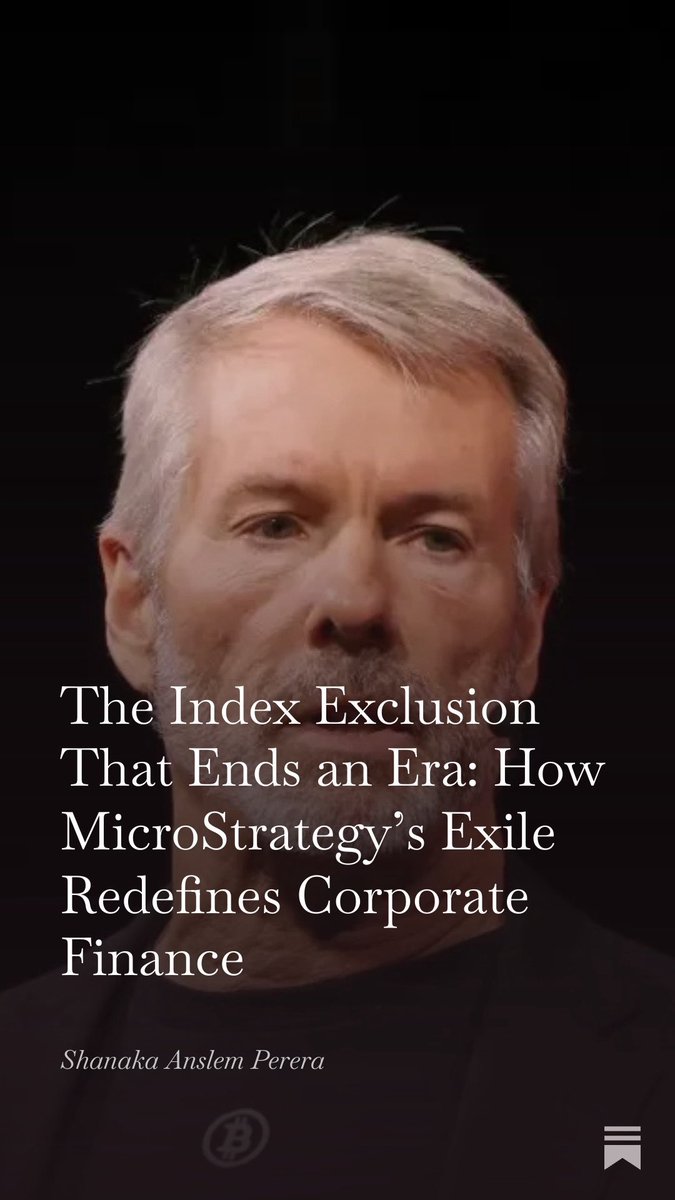
JANUARY 15: THE $9 BILLION PURGE
MicroStrategy owns 649,870 Bitcoin. Worth $56.7 billion. That’s 77% of everything they have.
On January 15, 2026 MSCI kicks them out of every major stock index. Not maybe. Not probably. It’s already decided.
Here’s what happens next:
$9 billion of forced selling hits the market within 72 hours. Pension funds. Index trackers. ETFs. They don’t get to choose. The algorithm forces them to sell. Every single share.
The company’s premium is already gone. It used to trade 2-3x above its Bitcoin value. Now? 1.11x. The lowest since 2020. The magic died before the announcement even drops.
Wall Street just drew a line: Bitcoin treasury companies aren’t stocks anymore. They’re funds. And funds don’t belong in the S&P 500 or Russell indexes.
This matters because Michael Saylor built a machine that let regular investors buy Bitcoin through their brokerage accounts. It worked for five years. That machine breaks permanently in 23 days.
The reflexivity loop that powered everything: raise money from stocks, buy Bitcoin, stock price goes up, raise more money, buy more Bitcoin. That cycle is dead. When you trade at net asset value, you can’t raise premium capital anymore.
JPMorgan’s November 20 research note confirmed it. The math doesn’t work anymore. The company that proved corporations could hold Bitcoin also proved the market will never let them disguise it as equity.
What comes after: MicroStrategy / Strategy Inc becomes a closed-end Bitcoin fund trading at a 10-20% discount. Forever. Just like Grayscale before spot ETFs existed. Liquidity collapses 60%. Volume disappears.
BlackRock wins. Every dollar that would have gone into MicroStrategy flows into Bitcoin ETFs instead.
The corporate Bitcoin era does not end with regulation or hacks or crashes. It ends with index methodology. The most boring document in finance just rewrote the entire playbook.
The funeral is 15th January 2026!
Read the deep dive article here - https://t.co/6MZctsDxoz
Miraculously, the truth about the climate agenda somehow made it on to mainstream UK television, disguised as comedy.
From 'Yes, Prime Minister' (2013).
Believe it or not, this was actually produced by the BBC.
I once asked a dear friend who has already crossed 70 and is gently stepping toward 80, “What changes do you feel in yourself these days?”
His answer stayed with me… and I think it will stay with you too.
He said,
After spending my life loving my parents, my siblings, my spouse, my children and my friends, I have finally learned to truly love myself.
I realized I am not Atlas. The world does not rest on my shoulders.
I stopped bargaining with the vegetable seller. A few extra coins won’t hurt me, but they might help him send his little girl to school.
I tip the waitress more than expected. The extra might make her smile after a long, tiring day.
I no longer stop the elderly mid-story to say, “You’ve told me this before.” Let them relive their memories. Those moments keep their hearts alive.
I’ve stopped correcting people even when I know they’re wrong. Peace is far more precious than proving a point.
I give compliments without holding back. They light up not just the other person’s day, but mine too.
I don’t stress about a spot on my shirt or a wrinkle in my clothes. Who I am speaks louder than what I wear.
I walk away from those who don’t value me. They may not see my worth, but I do.
I don’t play the dirty game of the rat race. I am not a rat, and life is not a race for me anymore.
I no longer hide my emotions. They are what make me human.
I choose relationships over ego. Ego builds walls. Relationships build homes.
I live each day like it could be my last, because one day, it will be.
And above all, I do what makes me happy. Because my happiness is my own responsibility. Happiness is always a choice.
So why wait until we are 70 or 80 to live like this? Why not start now? At any age. At any stage.
If you’re reading this today, maybe this is your sign to begin…. ❤️
✨Unknown
This is so true.
The more I read on social, let alone mainstream media, the more negative I become.
It's now a case of, "If something serious happens, or there's a high risk of it happening, I'll see it in the markets". I read the markets.





![samuraipips358's tweet photo. Mark Douglas never said "control your emotions," and he never said "test your edge with 20 trades."
These are the two most widespread misreadings of his work.
Both are still repeated daily.
Both are doing real damage.
Let me start with the first.
Most traders believe that the best traders are better at controlling their emotions.
That they feel the same fear, the same greed, the same hesitation, but somehow push through it with superior willpower.
Douglas said the opposite.
"The best traders are not afraid."
"They do not perceive market information as painful."
"There is nothing to control, because there is nothing to fight."
He was not describing emotional control.
He was describing the absence of the emotions that most traders are trying to control.
The best traders do not override their fear.
They have restructured what they believe about the market so completely that fear does not arise.
A chart is pixels.
It does not produce fear.
Your interpretation of it does.
When that interpretation changes, when you stop believing that this trade matters, that this loss is dangerous, that this moment will define you, the emotional response disappears.
Not because you learned to suppress it.
Because the trigger no longer exists.
"Consistency is a state of mind. Once achieved, you will not be able to function any other way."
This is the line most people skip.
Consistency is not forcing yourself to follow rules.
It is reaching a mental state where breaking them becomes unthinkable.
That state does not come from willpower.
It comes from a transformation of belief, built through testing and practice with your own hands.
That is the first misreading corrected.
The second misreading is worse.
Almost no one even recognizes it as a misreading.
Douglas described an exercise: execute 20 trades in a row, following the same rules, with zero deviation.
No skipping.
No hesitating.
No adjusting after a loss.
Most readers saw the number 20 and concluded: "20 trades is enough to know whether my system works."
That was never the point.
The exercise was not a test of the system.
It was a test of you.
Douglas was measuring one thing: can you execute 20 trades without a single emotional intervention?
Not "does this system produce profit in 20 trades?"
But "can you follow your rules 20 times in a row without your fear, your hope, or your opinion overriding a single one?"
This is a consistency drill.
Not a statistical test.
And there is a detail most readers miss entirely.
Douglas described these 20 trades as "one trade."
Not 20 separate events.
One.
That means the exercise does not end after 20 trades.
It begins again.
And again.
You are not running one set and drawing conclusions.
You are repeating the set over and over, treating each round of 20 as a single unit, until executing without deviation becomes your default state.
The total number of trades this produces is enormous.
That is the point.
The exercise demands a volume of repetition that most readers never realized was being asked of them.
And yet, most traders run 20 trades once, see a loss, and conclude the system is broken.
Or they see a few wins, conclude it works, and go live.
Both conclusions are meaningless.
Statistical accuracy depends on sample size.
This is not a trading opinion.
It is a mathematical law that applies to medicine, engineering, polling, and every other field that relies on data.
Short-term randomness can push a 55% win rate system down to 30% or 35% over 20 trades.
If you saw that number without context, you would say something is wrong.
Nothing is wrong.
That is what small samples look like.
The system did not change.
The sample is just too small to show you the truth.
20 data points cannot tell you whether any system works.
The variance is too wide.
The confidence interval is too large.
Random noise dominates the data at that scale.
If you run 20 trades and conclude "this does not work," you are not making a data-driven decision.
You are reacting to randomness.
"But Mark Douglas said 20."
Douglas never claimed that 20 trades was a statistically valid sample.
The readers did.
They took a consistency drill and turned it into a statistical test.
That was never his instruction.
That was their misreading.
Probability does not say "Oh, Mark Douglas recommended this sample size, so I will make the law of large numbers work for just 20 trades."
It does not negotiate.
It does not make exceptions.
It works when the sample is large enough, and it does not work when it is not.
Douglas opened the door to probabilistic thinking in trading for an entire generation.
His work gave countless traders their first real contact with this way of seeing the market.
But the math does not forgive a misreading just because the source was respected.
And here is the part almost everyone skips.
Douglas assumed you already had a system with a verified edge before you started the exercise.
The drill was never meant to be your first contact with your system.
It was designed for a trader who had already done the work: defined the rules, tested the numbers, confirmed the edge across a sample large enough for the statistics to be reliable.
The 20-trade exercise comes after all of that.
It is the final step, not the first.
Without that foundation, the exercise loses its meaning.
You are not practicing flawless execution of a proven system.
You are executing an unverified idea 20 times and hoping the results tell you something.
They will not.
If you want to honor what Douglas actually taught, do what he assumed you would do first.
Build a system where every condition is defined and every decision is resolved before the chart opens.
Test it across a sample large enough for the statistics to stabilize.
Know what your system produces before you ever sit in front of a live chart.
Then, and only then, use the exercise for what it was designed for.
Not to test the system.
To test yourself.
To repeat it until following your rules is not an effort but a reflex.
The system was already proven before the drill began.
The only question left is whether you can follow it.
That is what the 20-trade exercise was always about.
And that is the part almost everyone skips.
The trust game begins with a system worth trusting.
The blueprint that gives your strategy edge and repeatability [Trading System Architecture]
→ https://t.co/tXIFR0jr2T](https://pbs.twimg.com/media/HCkW3wjbgAA2WXL.jpg)