17y of indie dev on the side: Listary (millions of users) → (file search + agent context engine)
Day: CTO@stealth, running a 40+ team the AI-native way
Picking what's worth doing is rarer than figuring out how to do it.
In 2007, much of computer vision was chasing smarter algorithms. Fei-Fei Li made a different bet: the bottleneck wasn't just the model. It was data scale.
A baby doesn't learn to see from clever wiring alone. It learns by spending years looking at the world.
So she built ImageNet.
When people say "I could've done that," they mean the dataset.
They don't mean the bet.
Actually presentations aren't our most frequent one. It's research into writing. Analyzing user feedback into feature specs, keyword research into blog posts and outreach emails, etc. Cowork and Claude Code handle the whole loop: search the web, pull local docs via Gety, and draft. Runs 10x more often than any deck.
@claudeai Cowork is awesome for knowledge workers! Check our blog post on how to use Claude Cowork to turn scattered files into presentations: https://t.co/1XmwHaocHM
@jdrhyne I'd like to try your converter! I'm building https://t.co/D1qvZNu4Da , a local file search engine. PDF to markdown is an essential part of it. Currently using an in-house solution built on pdfium but looking for something different.
The file systems + search point really resonates. This is why we built https://t.co/h5EVwglifK.
We keep all our context in local files and GitHub repos. Agents need the right paragraph from thousands of files in milliseconds. grep can't do it, too slow, can't read PDFs or scans, no ranking. So we built a local search engine that indexes everything on disk, 0.01s results, any agent hooks in via MCP/API/CLI.
Worse still, you can't just monitor uptime and latency to catch it. Complexity buildup will rapidly break the system.
The core of architecture remains the same: isolate complexity, protect the fragile bits. What changed is who is the most fragile. 4/4
That's why the old rule is "If it works, don't touch it" and we just keep stacking layers.
But in an Agentic system, the executor is an LLM—and it is NOT immune to complexity. Stuff too much into the context window, and decision quality immediately slides. 3/4
In traditional software, we protect two fragile things:
1. Humans (cognitive overload from messy code)
2. Systems (bad state management causing crashes)
But the CPU itself is rock solid. It grinds through anything. 2/4
Whipped up an open-source tool over the weekend that turns the Apple Intelligence models in macOS 26 into an OpenAI-style API—works in any client you point at it 😎
MoD can also be combined with MoE to form MoDE (Mixture-of-Depths-and-Experts), achieving true sparsity in both horizontal and vertical dimensions. 4/4
Google's Mixture-of-Depths (MoD) could lead to new breakthroughs in LLM. Quantization/1.58-bit/MoE have repeatedly proven that scale trumps all else. *Scaling is the top priority*. Under fixed computational constraints, sparsity is an effective way to achieve larger scales. 1/4
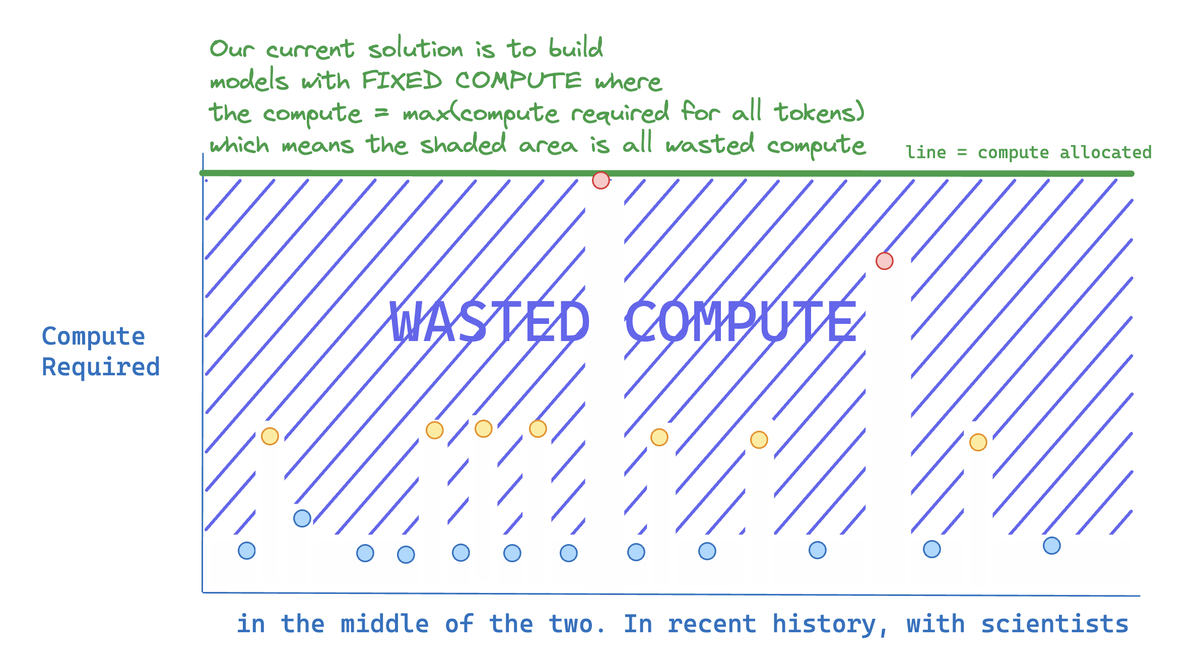
Why Google Deepmind's Mixture-of-Depths paper, and more generally dynamic compute methods, matter:
Most of the compute is WASTED because not all tokens are equally hard to predict
Existing model architectures have a fixed computational cost regardless of the difficulty of the predicted token. In contrast, MoD can skip certain layers through routing, significantly reducing the computational cost and allowing the model to scale to larger sizes. 3/4