I translated my latest essay into English on Medium.
“Where Does Judgment Come From? — The Hidden Dead End of the AI Native Era”
As AI increasingly takes over execution, humans are often told to focus on “direction” and “judgment.”
But where does that judgment actually come from?
For decades, society has cultivated judgment as a byproduct of real work — friction, failure, responsibility, and embodied experience.
My concern is that AI may optimize away not only tasks, but also the very developmental pipeline through which humans acquire the ability to truly judge.
https://t.co/Z5jMlaNwTn
#AI #Education #FutureOfWork #HumanJudgment #AIAlignment
In some very real sense, Ozempic was invented in 1990. Pfizer ran the human trials and just never published them.
They showed it lowered blood glucose in diabetics, slowed gastric emptying, and killed hunger; the same 3 things that make Ozempic work today.
The joint venture agreement said internal data stayed internal, and that was that. Pfizer killed the program in 1991. The reasoning, as far as I can tell, was that nobody would ever want an injectable diabetes drug besides insulin.
So, the license went back to the hospital in Boston that held the patents.
Novo picked it up in 1992 and spent the next two decades building liraglutide, then semaglutide.
It's insane that data sat in a filing cabinet for 30+ years.
I only know this because Jeffrey Flier, one of the Harvard scientists in the room, finally wrote it up. He's in his late 70s and didn't want the history to die with him.
This makes you wonder what else is in those filing cabinets.
Ozempic could've existed 27 years ago.
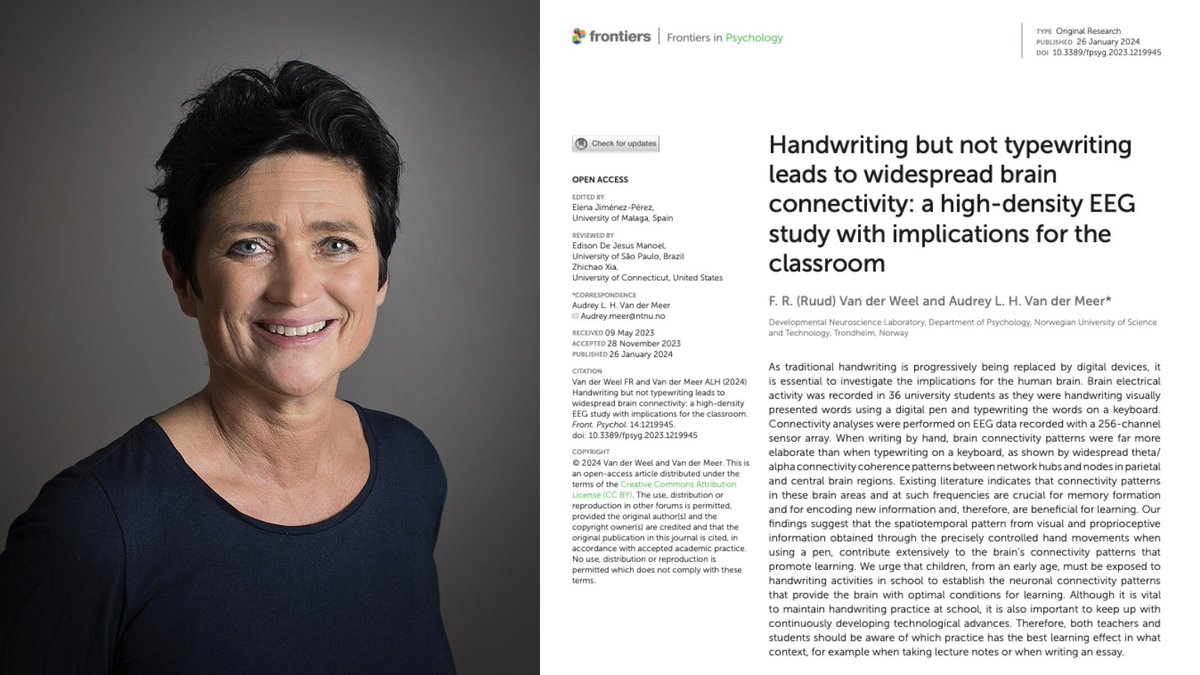
A Norwegian neuroscientist spent 20 years proving that the act of writing by hand changes the human brain in ways typing physically cannot, and almost nobody outside her field has read the paper.
Her name is Audrey van der Meer.
She runs a brain research lab in Trondheim, and the paper that closed the argument was published in 2024 in a journal called Frontiers in Psychology. The finding is brutal enough that it should have changed every classroom on Earth.
The experiment was simple. She recruited 36 university students and put each one in a cap with 256 sensors pressed against their scalp to record brain activity. Words flashed on a screen one at a time.
Sometimes the students wrote the word by hand on a touchscreen using a digital pen, and sometimes they typed the same word on a keyboard. Every neural response was recorded for the full five seconds the word stayed on screen.
Then her team looked at the part of the data most researchers had ignored for years, which is how different parts of the brain were communicating with each other during the task.
When the students wrote by hand, the brain lit up everywhere at once.
The regions responsible for memory, sensory integration, and the encoding of new information were all firing together in a coordinated pattern that spread across the entire cortex. The whole network was awake and connected.
When the same students typed the same word, that pattern collapsed almost completely.
Most of the brain went quiet, and the connections between regions that had been alive seconds earlier were nowhere to be found on the EEG.
Same word, same brain, same person, and two completely different neurological events.
The reason turned out to be something nobody had really paid attention to before her work. Writing by hand is not one motion but a sequence of thousands of tiny micro-movements coordinated with your eyes in real time, where each letter is a different shape that requires the brain to solve a slightly different spatial problem.
Your fingers, wrist, vision, and the parts of your brain that track position in space are all working together to produce one letter, then the next, then the next.
Typing throws all of that away. Every key on a keyboard requires the exact same finger motion regardless of which letter you are pressing, which means the brain has almost nothing to integrate and almost no problem to solve.
Van der Meer said it plainly in her interviews.
Pressing the same key with the same finger over and over does not stimulate the brain in any meaningful way, and she pointed out something that should scare every parent who handed their kid an iPad.
Children who learn to read and write on tablets often cannot tell letters like b and d apart, because they have never physically felt with their bodies what it takes to actually produce those letters on a page.
A decade before her, two researchers at Princeton ran the same fight using a completely different method and ended up at the same answer. Pam Mueller and Daniel Oppenheimer tested 327 students across three experiments, where half took notes on laptops with the internet disabled and half took notes by hand, before testing everyone on what they actually understood from the lectures they had watched.
The handwriting group won by a wide margin on every question that required real understanding rather than surface recall.
The reason was hiding in the transcripts of what the two groups had actually written down.
The laptop students typed almost word for word, capturing more total content but processing almost none of it as they went, while the handwriting students physically could not write fast enough to transcribe a lecture in real time, which forced them to listen carefully, decide what actually mattered, and put it in their own words on the page.
That single act of choosing what to keep was the learning itself, and the keyboard had quietly skipped the choosing and skipped the learning along with it.
Two studies. Two countries. Same answer.
Handwriting makes the brain work. Typing lets it coast.
Every note you have ever typed instead of written went into your brain through a thinner pipe. Every meeting, every book highlight, every idea you captured on your phone instead of on paper was processed at half depth.
You did not forget those things because your memory is bad. You forgot them because typing never woke the part of the brain that would have made them stick.
The fix is the thing your grandmother already knew.
Pick up a pen. Write the thing down. The slower road is the faster one.
Michael Bloomberg, founder of Bloomberg LP, on why showing up early and staying late beats being the smartest person in the room:
"I'm not smarter than anybody else, but I can outwork you."
Bloomberg shares his key to success:
"Make sure you're the first one in there every day and the last one to leave. Don't ever take a lunch break or go to the bathroom. You keep working. You never know when that opportunity is going to come along."
He explains how this approach shaped his early career at Salomon Brothers.
The managing partner of the company, Bill Salomon, was the second person to arrive each morning.
@MikeBloomberg was the only other one in the big trading room.
"If he had needed to borrow a match… if he wanted to ask something about a newspaper or a stock, he came over and so we became buddies."
The same thing happened at the end of the day. The number two guy, John Gutfreund, was the last one to leave except for Bloomberg. They'd share a cab or take the subway uptown together.
"You can't control that you're the smartest guy. There'll always be somebody smarter. But if you're there, then you absorb things. You put things together in ways that if you didn't have all that experience…"
He compares it to skiing:
"Reading a book on skiing doesn't teach you how to ski. You got to go and you got to ski and get lots of miles under your skis. And incidentally, if you don't fall, you're not skiing hard enough and you're not learning anything."
Bloomberg also touches on resilience when things don't go your way:
"You got to be smart enough to say, 'Hey, I tried it. Don't let your ego get in the way. I can't keep doing this. I've got to earn a living, but a year from now, I'm going to come up with a better idea and then I'll go back and do it again.'"
He closes with a mindset that defined his career:
"There's never been a day that I haven't looked forward to going into work. Even the days I knew I was going to get beaten up. Even the day I knew I was going to get fired. I'd never been fired before. I wonder what it's like. Okay, let's go find out."
Psychology solved the AI memory problem decades ago.
We just haven't been reading the right papers.
Current AI architectures are failing because they treat memory like a hard drive.
Vector databases (RAG) are just flat embedding spaces. Conversation summaries compress a life into a bio. Episodic buffers give agents a 30-second memory span.
Past 10k documents, semantic search is basically a coin flip.
But in 2005, a landmark psychology paper mapped exactly how human memory actually scales.
It’s called the Self-Memory System.
Humans don't store memories like database rows. We construct them.
Our brains organize memory hierarchically: Lifetime periods. General events. Episodic details.
When you remember something, your brain doesn't perform a vector similarity search across billions of flat tokens.
It filters the past through the "Working Self", a dynamic system that retrieves only what is directly relevant to your current active goals.
This changes everything for how we build AI agents.
Right now, we are force-feeding models massive context windows and hoping they figure it out.
We are trying to solve a cognitive problem with a database engineering solution.
If we want AI that can actually reason across a lifetime of data, we have to stop building better hard drives.
We have to build an artificial Working Self.
An AI shouldn't retrieve the most "semantically similar" document. It should retrieve the memory that is most relevant to its current objective.
The blueprint for agentic memory has been sitting in psychology journals for 20 years.
We just have to stop thinking like software engineers.
And start thinking like psychologists.
the craziest part now is that the modern computer probably has to be entirely reinvented, from scratch. pretty much like how jobs & co brought apple ii to market.
like not improved. not given a chatbot sidebar or something but really from the ground up like the iphone redefined what it meant to be a pocket computer.
the current paradigm for computers was built around a human staring at a screen, moving a cursor, opening apps, managing windows, naming files, remembering where things live, & manually translating intent into interface actions.
that made sense when the human was the runtime. but in an ai native world, it starts to look kinda ridiculous.
you can see this ridiculousness when you use computer use agents… they are useful sure, but they’re also obviously transitional. they’re teaching ai to operate machines designed for humans, which is clever, but also kind of absurd. it’s like making a robot hand so it can use a doorknob instead of asking why the door needs a knob at all. yes i know humans also need to use a door knob, but maybe in the future humans don’t need to use a computer, or at least what we think of a computer today at all.
this all leads to some interesting questions:
- what is a file when the system understands context?
- what is an app when intent can route itself?
- what is a desktop when work can be decomposed, executed, monitored, & summarized by agents?
- what is a browser when the agent can retrieve, compare, transact, & remember?
- what is an operating system when the primary user is no longer just a person, but a person plus a swarm of delegated intelligences? or no person at all.
the old computer assumed navigation.
the new computer has to assume a new kind of intention. the old computer organized information. the new computer has to try to organize agency.
we’re still in the hacky middle stage at the moment with sidebars, copilots, agents clicking through legacy ui, & automation layers sitting on top of 40 year old metaphors.
the new computer is likely one where memory, context, identity, permissions, tools, agents, & interfaces are native primitives. this means desktop, mobile, browser, apps, files, folders deserves another first principles look.
Cumulative technical books in major world languages published by 1870 and 1910.
Japanese catch-up singularity. Rest of Asia all "sick men". French dominance. German knowhow probably gate-kept by individual firms more so than elsewhere.
What's wrong with writing with AI?
Alain deBotton says: "I don't just write to produce a certain numbers of words. I write in order to honor certain feelings, and AI can't know those feelings because it's not me.
It doesn't know what I want to say. And if I simply give my writing over to AI, it will crush my nascent sense about what it is I really want to say."
I’ve been beating this drum: by making traditional signals of effort/information obsolete (eg writing a thoughtful email), AI will *increase* the value of social capital and networks.
This is not a good outcome: information technology was supposed to “flatten” interactions. But I don’t see a solution on the horizon.