@BaoningWu The moment tensors are normally converted to fictitious forces and then applied to the momentum balance. You may refer to the Representation Theorem part of Aki & Richard for more info.
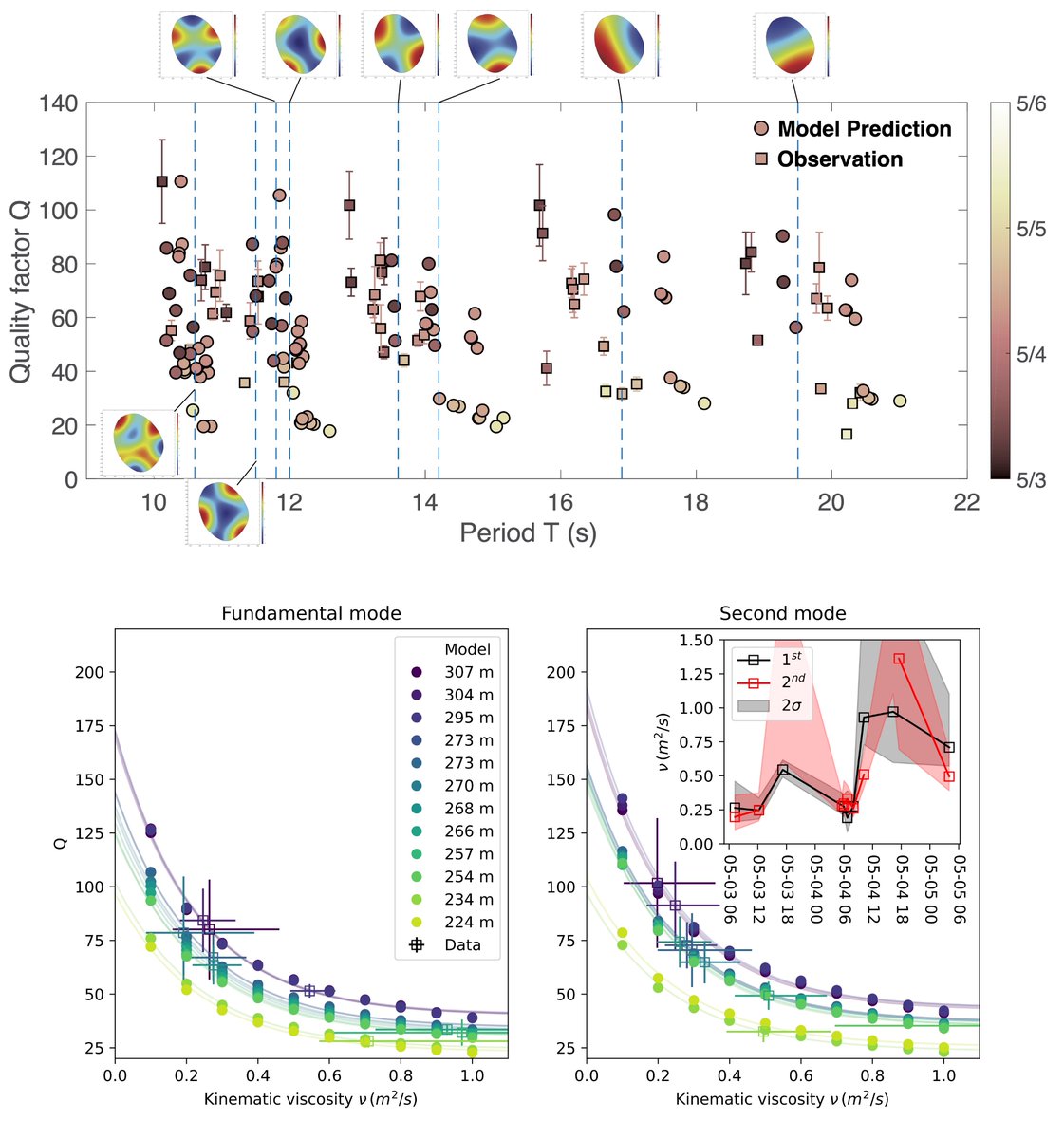
Another beautiful figure showing the predictive power of the 3D physics-based model in matching the observation and constraining in-situ magma viscosity!!
Three AGU poster alerts after a half-year hiatus on twitter:
1. V31D-04: "Magma sloshing in a three dimensional crater and its constraint on lava lake viscosity during the 2018 Kilauea Volcano eruption" by me @chaovite and my superb collaborator from CUHK @geoYanZhan.
2. V21B-02: "Resonances in a fluid-filled crack of arbitrary shape and its application to very long period (VLP) signals at Mayotte submarine volcano". By my master student PENG junjun, me @chaovite, @DocTerremoto@NathanShauer and DAI Kaoshan.
3. S51B-05: "Hypocenter depth variation on a vertical strike-slip fault in a damage zone governed by rate and state friction", by my PhD student DENG Shuai, me, @DocTerremoto and DAI Kaoshan.
Why are supershear earthquakes so rare? We address this question through theory and simulations of earthquake cycles on very long faults. Our new preprint with @DocTerremoto: https://t.co/jjpcvHjatj
A recorded seminar on the dynamics of very large earthquakes (rupture arrest and rupture speed): https://t.co/ufLmr5xjNQ
Invited by @chrisjmarone in the seminar series on earthquake physics of the ERC TECTONIC-FEAR projects.
Capturing the fully coupled 3D dynamics of the 2018 Palu earthquake rupture, seismic, acoustic and tsunami waves using #HPC - our poster is now live #AGU21 NH25B-0575 and our #SC21 paper is here https://t.co/4YwhV3lfFS
The effect of thermal pressurization is significant in the coseismic weakening of the fault shear zone. how did it act in the scenario of the 2021 M8.2 Chignik, Alaska event? Our preliminary results will be presented in #AGU2021
https://t.co/Izry1dyvOj
Want to understand how often do supershear earthquakes occur on rate and state faults? Check out our latest talk in AGU this year. #AGU2021@DocTerremoto https://t.co/PxCI83MIEi