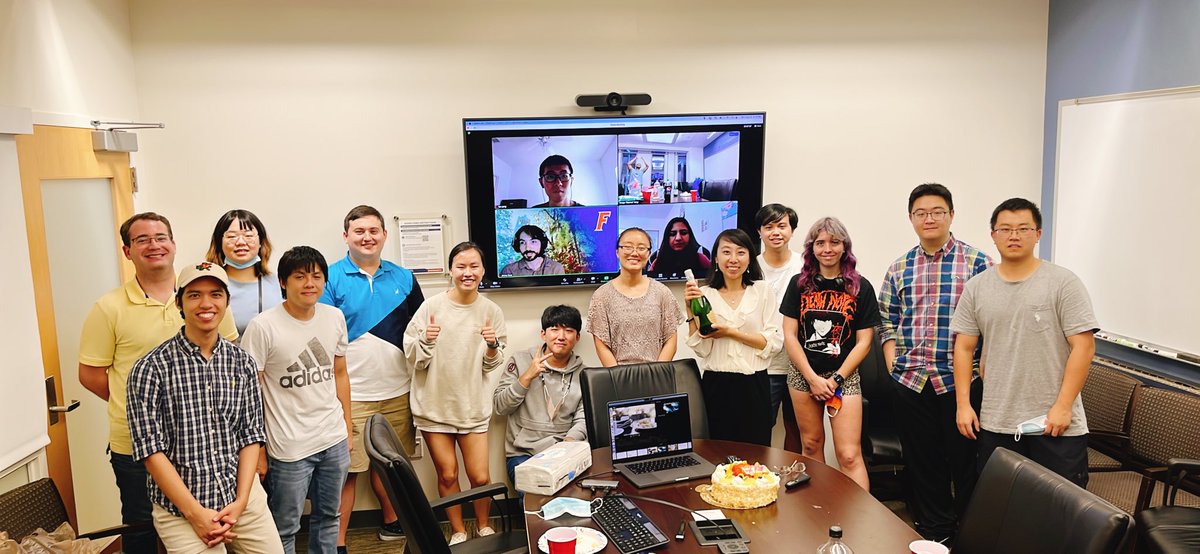
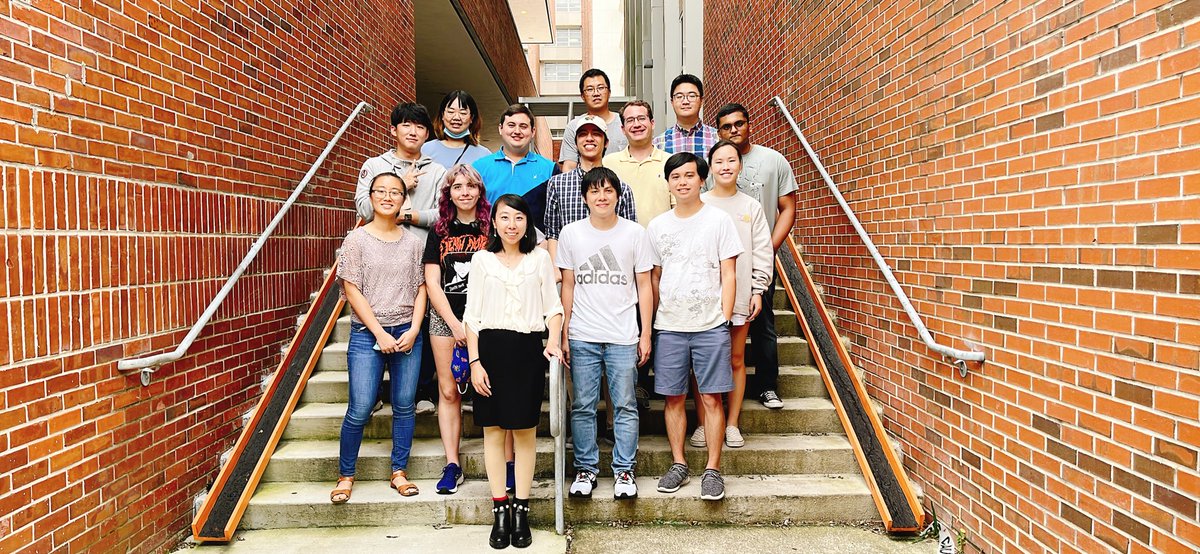
Thank you Dr. Fang! I'm deeply grateful for your guidance and support throughout my PhD journey. Couldn’t have asked for a better advisor—or a better lab family. Grateful beyond words! 🙏🎓💫
Ph.D. #5🎉 Congratulations to Chaoyue Sun (@chaoyue23) on successfully defending his dissertation "Advanced Graph Neural Networks for Infectious Disease Dynamics"!
He’s the 5th PhD graduate from SMILE Lab @LabFang. Way to go, Chaoyue! 👏🎓🔥
Super proud of SMILE Lab @LabFang’s member Chaoyue @chaoyue23 who is an exemplar PhD student with dedication, perseverance, and passion for research innovation! @UFBME@ECEflorida
The definition of 3D contrastive coding loss is not clear to me. Why the upper bound of the summation is 2N and is there any constraints for selecting pair v_i and v_ j in the numerator?
#SMILEJournalClub Paper "Self-Supervised Pre-Training of Swin Transformers for 3D Medical Image Analysis" proposed a pre-training strategy with three proxy tasks for the Swin UNETR model.
SMILE LAB @LabFang Mascot is here! #dalle2’s #AI model generates this cute alligator mascot with cues designed our lab’s mascot competition winner Chaoyue Sun @chaoyue23!
Random forests could also do regression work and provide variable importance analysis. I'm wondering what the advantage of causal forests comparing with random forests.
#SMILEJournalClub Today's journal club, we studied a paper about the causal forest: "Estimating Treatment Effects with Causal Forests: An Application.", which analyzed the effects of several variables on student achievement.
#SMILEJournalClub Today's journal club introduces a paper: Development and Validation of a Deep Learning Method to Predict Cerebral Palsy From Spontaneous Movements in Infants at High Risk. The author develops a GCN-based approach to infant skeleton for Cerebral Palsy detection.
#SMILEJournalClub In this week's journal club, we read paper "RadImageNet: An Open Radiologic Deep Learning Research Dataset for Effective Transfer Learning", where a radiologic images dataset is created for pertaining models in medical imaging applications.
The ROC curve shows the average model performance on 24 settings of training, and the settings include frozen layers and learning rates. I think, normally, we should compare the best performance between ImageNet and RadImageNet.
Table 2 is really exciting. It shows how DeepDR system helps healthcare workers, and I'm interested in how the experiments are performed. Also, I'm wondering why there is a clear gap in sensitivity between Moderate NPDR and Severe NPDR, but in Specificity the gap is not clear.
In this week's #SMILEJournalClub, we learned DeepDR, a deep learning system designed to detect Diabetic Retinopathy (DR). With three sub-modules for image quality assessment, lesion-aware, and DR level grading, DeepDR provides a comprehensive reference for patients' fundus images
For the DR grading sub-network, the labels show different levels of DR. Did they apply any technique to utilize this relationship among labels? (e.g., misclassifying PDR to non-DR receives a larger penalty than misclassifying PDR to severe NPDR)
The enhanced high-quality multi-modal imaging data with 100,000 participants provide an excellent basis for deploying machine learning or deep learning models for related health-related tasks.
We had so much fun and inspiration from our first lab meeting to kick off the Fall 2022 semester! @LabFang has been growing for the past 5 years at @UFBME and it is a tremendous joy to celebrate with all SMILE members who have contributed to our lab’s achievements!