Honored to be included in the 2026 World’s Top 2% Scientists list.
My research focuses on AI & robotics—particularly robot learning & Physical AI—exploring how intelligent systems can learn from data & interact meaningfully with the real world.
Looking forward to what’s next!🤖
Unfortunately, I won’t make it to Pittsburgh this time. @gaofeng220 from @StridingAI will be there helping with the workshop. Do say hi & feel free to chat with him about robot learning, real-world deployment, & more.
Have a great workshop, I’ll be following along from afar!
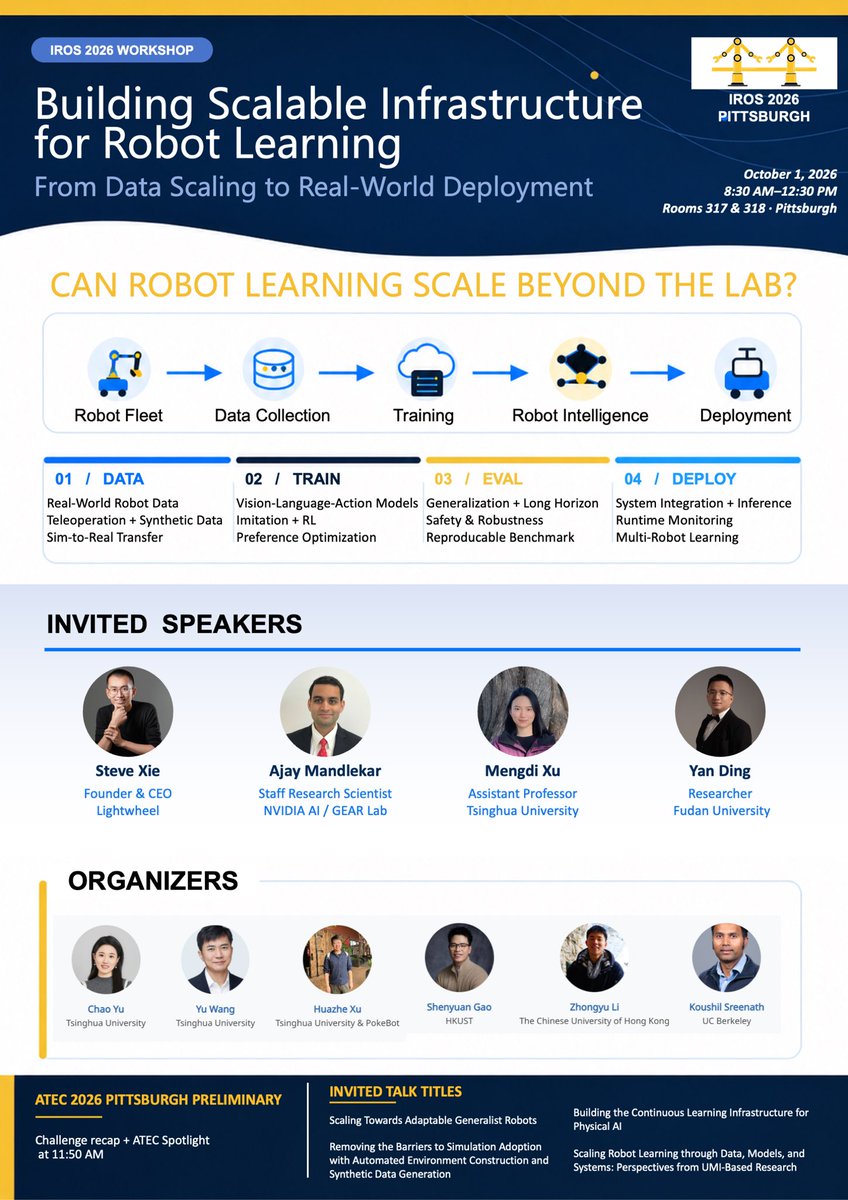
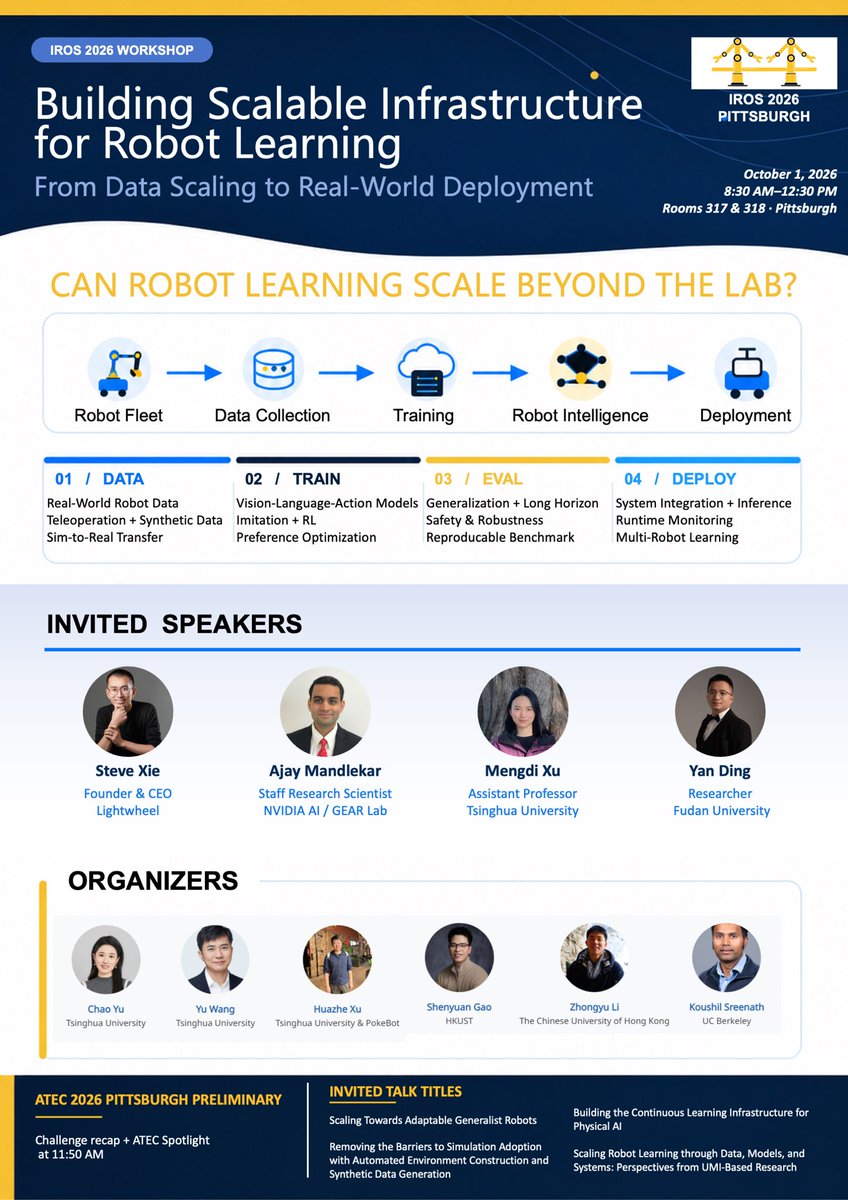
Scaling robot learning takes reusable & scalable infra for data, training, evaluation & deployment.
We're organizing ScaleInfra, a workshop at #IROS2026, to connect research with engineering practice.
8:30 AM–12:30 PM · Oct 1 · Pittsburgh · Rooms 317 & 318
https://t.co/V10LVVrtE9
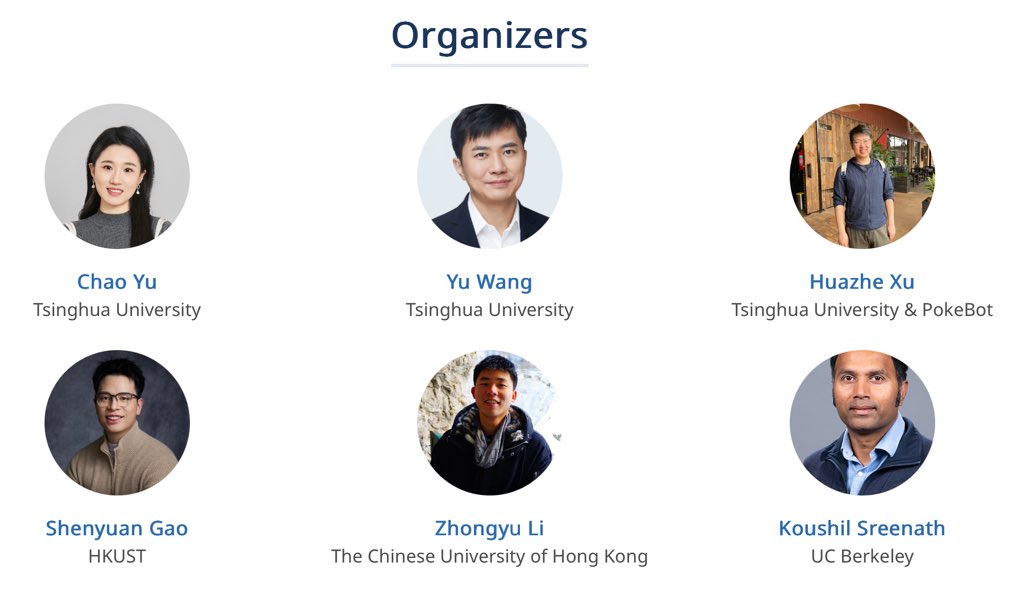
Many thanks to our co-organizers Yu Wang, Huazhe Xu (@HarryXu12), Shenyuan Gao (@ShenyuanGao), Zhongyu Li (@ZhongyuLi4) and Koushil Sreenath (@KoushilSreenath) for bringing ScaleInfra together.
We look forward to seeing you in Pittsburgh!
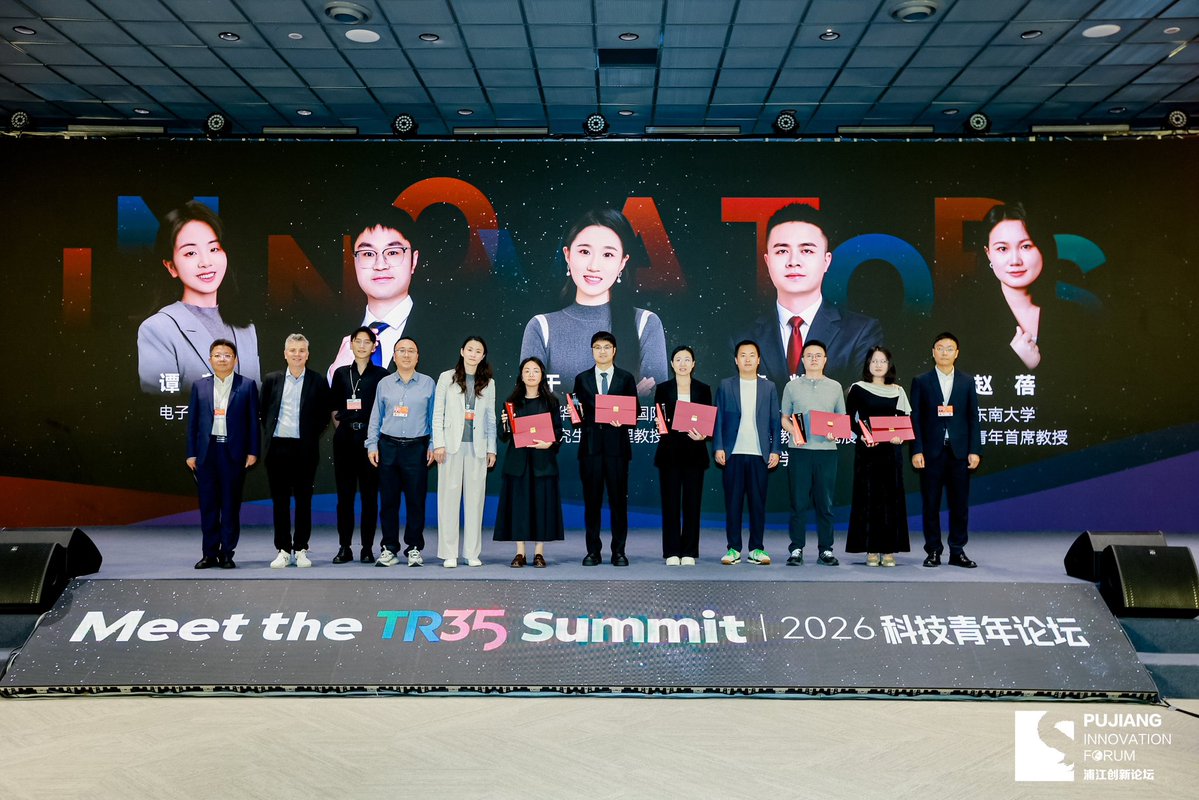
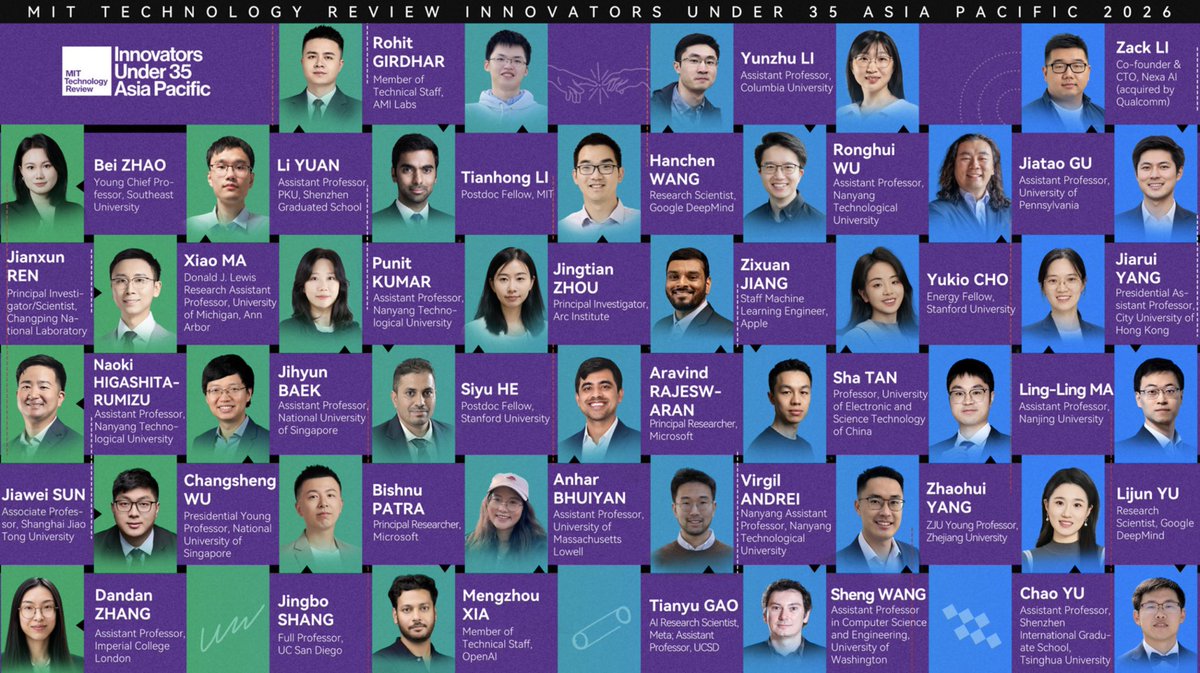
Assistant Prof. Yu Chao from @TsinghuaSIGS has been listed as one of the Pioneers of the Innovators Under 35 Asia Pacific 2026 @techreview. Her RLinf framework brings model training, computing, and robots together for smarter, continual learning.
Happy to see LaWAM officially featured in @LeRobotHF#LaWAM starts from a simple idea: instead of generating future videos step by step, predict a latent subgoal that captures how the scene should change through action. Excited to see how the open robotics community builds on it
🌍 New World Action Model in LeRobot ✨
LaWAM (CoRL 2026) replaces future-video generation with a single-step latent subgoal.
Given an observation + language instruction, the policy predicts a latent action. A 230M Latent World Model decodes it into future visual features in ONE forward pass, and the action expert conditions on that predicted subgoal to produce the next chunk - dynamics-aware foresight, no iterative video rollout.
🎯 98.6% LIBERO · 91.22% RoboTwin · 90.0% real-world manipulation
⚡ 187ms / action chunk on A100, 10 denoising steps
Thanks for the contribution by Zhongguancun Academy 🙌
Docs: https://t.co/Dc59GaDllL
Blog: https://t.co/ETyQT38nfb
Honored to be named a 2025 TR35 Asia Pacific 🏆
Thank you to everyone who has supported this journey.
🚀Onward with better AI models & RL systems for embodied intelligence.
#MIT#TR35
Happy to meet @itsjohnnynunez & @asierarranz from @nvidia in Beijing!
It was great to connect and exchange ideas on #Rlinf, Agentic Robotic Systems, and beyond.
Looking forward to more collaboration ahead. 🚀
Honored to host & speak at several roundtables during the #WRC.
My takeaway: in this industry, the first step is to build & ship.
But it’s just as important to share what doesn’t work. Sharing what we learn—successes and failures alike—can help steer them in the right direction.
A quick look at the results 👇
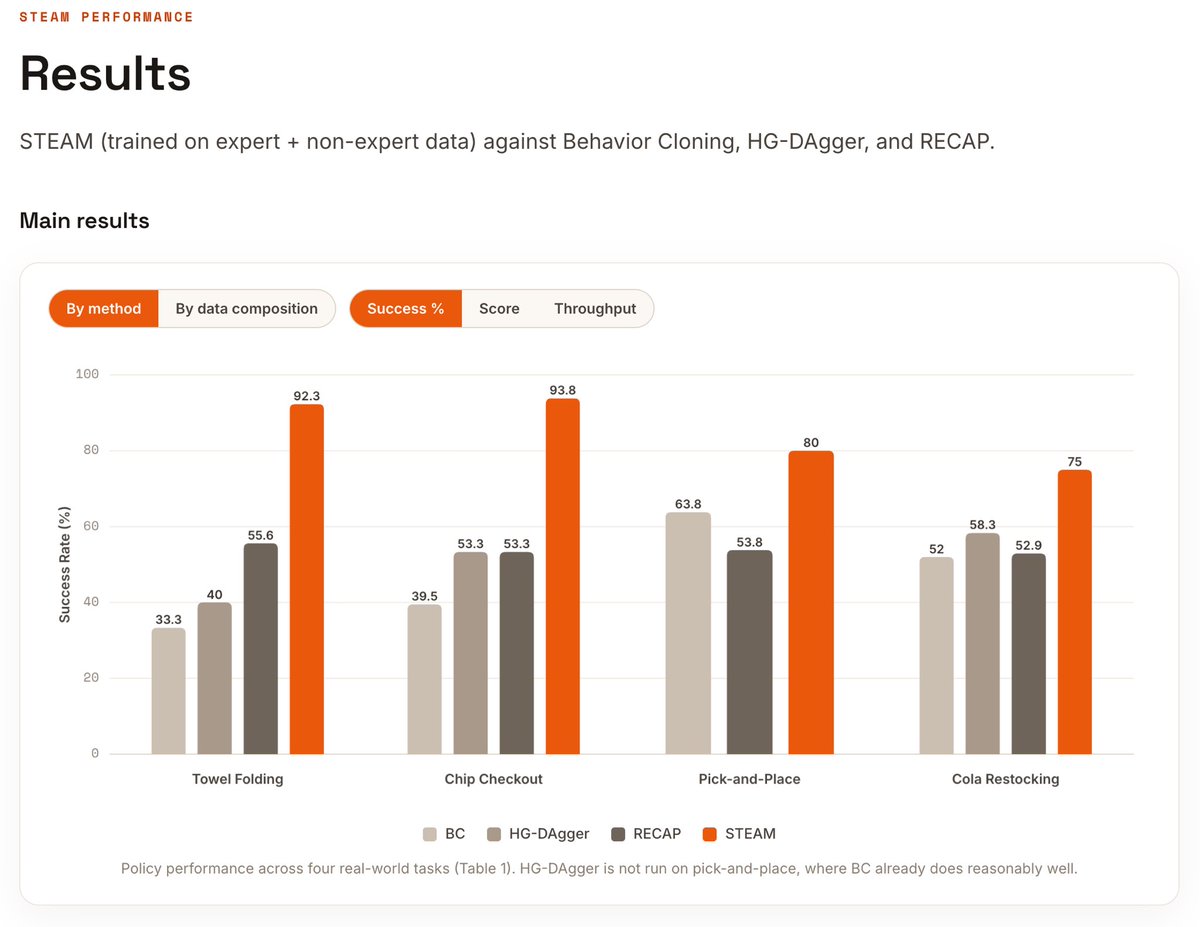
📈 STEAM improved real robot towel-folding success rate from 33.3% to 92.3%.
On four real-robot tasks, paired with CFGRL, STEAM lifts success rate by +59%, +54.3%, +23%, and +16.2% — towel folding, chip checkout, cola restocking, and pick-and-place.
Real-world robot data mixes useful progress with stalls, failures, and corrections. #STEAM learns frame-level advantages from expert demos—a label-free method to distinguish reliable local progress from regressions and improve policy learning.
🌐 Project: https://t.co/YRuMoDXMCQ
#STEAM trains an ensemble of temporal-offset predictors on frame pairs within expert trajectories, using the normalized temporal offset between two frames as a self-supervised signal.
#RLinf reimplemented #OpenPI in pure #PyTorch, closing the gap with its JAX reference.
We identified and fixed 22 numerical, structural, and semantic discrepancies—enabling reliable OpenPI SFT and RL in the PyTorch ecosystem.
Code: https://t.co/C1Ts4xJaSu
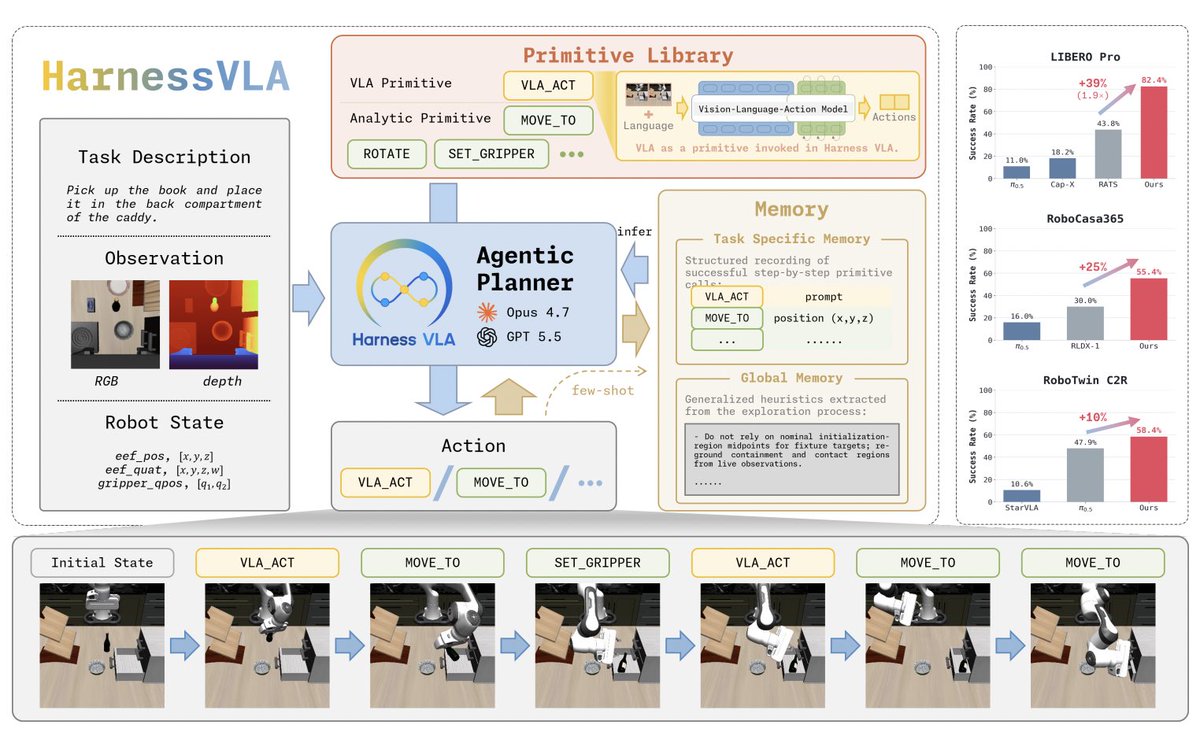
Excited to open-source Harness VLA-it learns to use frozen VLAs through memory-guided execution.
LIBERO-Pro: 82.4%
Pi_RLinf 50%
NVIDIA Cap-X 18.2%
Berkeley RATS 43.8%
Beyond VLA, the Harness Layer provides a general framework for Embodied AI models.
Code: https://t.co/4qi8lZY2C7
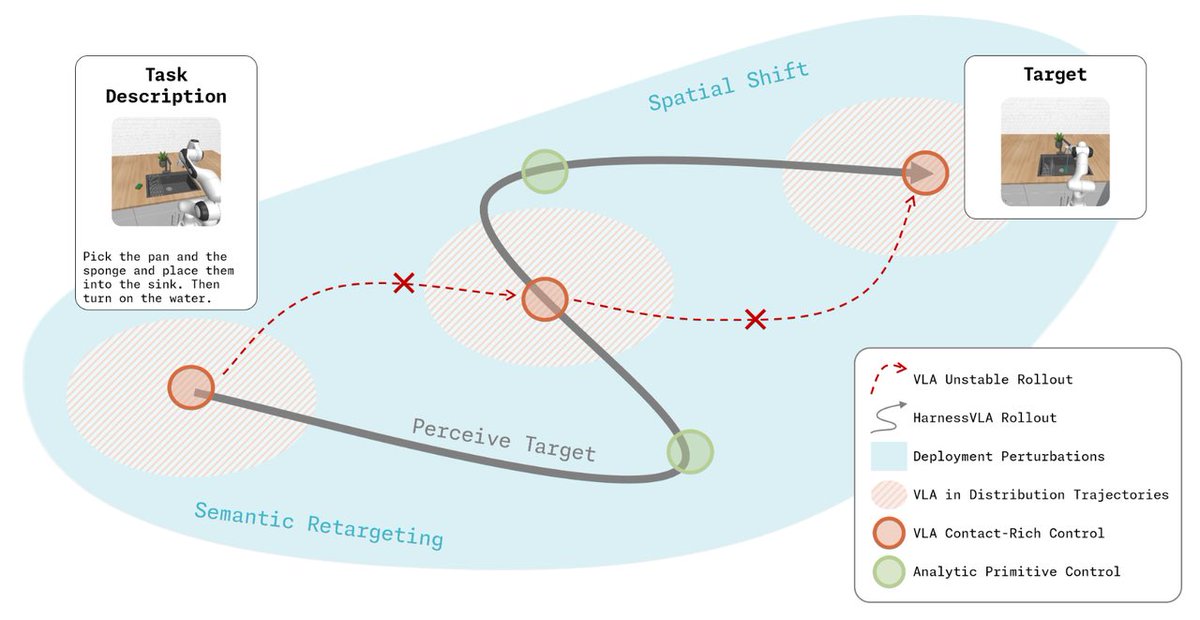
Harness VLA improves reliability because exploration teaches the planner how to use a fixed primitive set: where to ground entities, when to invoke VLA_ACT, how to re-stage failed contacts, and which failures should not be repeated.