i think robotics is approaching its gpt-2 moment (some would already argue gpt-3!)
broader pre-training is helping robots generalize to unfamiliar tasks cc @SkildAI@GeneralistAI@sundayrobotics
world models let them simulate what might happen next, opening up new ways to learn and plan before acting in the real world: see work from @odysseyml and @wayve_ai
Here’s a more personal breakdown of how we built Dyna-2.1 - the first Physical Agent to achieve 1-hour-long, dexterous whole-body autonomy.
A lot of the system came down to a few fairly fundamental design choices.
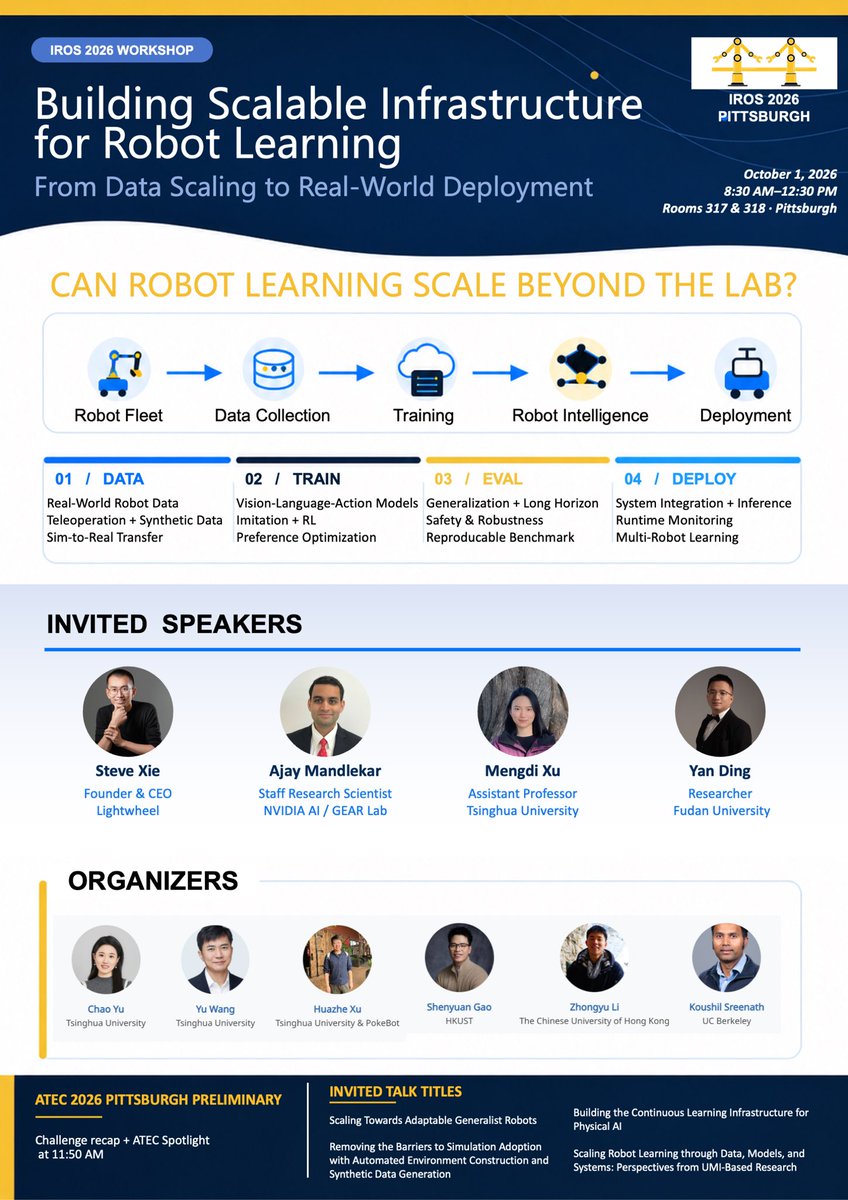
Scaling robot learning takes reusable & scalable infra for data, training, evaluation & deployment.
We're organizing ScaleInfra, a workshop at #IROS2026, to connect research with engineering practice.
8:30 AM–12:30 PM · Oct 1 · Pittsburgh · Rooms 317 & 318
https://t.co/V10LVVrtE9
RUMOR: OpenAI Astra model used "Looped Transformers"
We studied the 𝐒𝐜𝐚𝐥𝐢𝐧𝐠 𝐋𝐚𝐰 𝐟𝐨𝐫 𝐋𝐨𝐨𝐩𝐞𝐝 𝐓𝐫𝐚𝐧𝐬𝐟𝐨𝐫𝐦𝐞𝐫𝐬: arXiv 2506.18233
The main discovery is shown in the figure:
1. Loop does NOT increase knowledge capacity
2. Loop is effective in increasing reasoning capability
That being said, the benchmark gains does not come from knowledge gain, but from reasoning gain, e.g., the way the knowledge is being used.
Knowledge capacity and reasoning capability is disentangled by looping layers, as shown in the green dots. As model size grows (dot size grows), the knowledge capacity (x-axis) does not grow, but the reasoning capability (y-axis) grows.
In non-looped transformers, as shown in the blue dots, the knowledge (x-axis) and reasoning (y-axis) grow at the same time.
This might reveal another scaling axis that brings a new paradigm for LLM pre-training.
Happy to announce the full ABC release! We’re also excited that ABC was accepted to CoRL 2026!
Check out our website for code, 400+ hours of sim data on 24 tasks, and 5,850 labeled policy-evaluation episodes.
@arthurallshire@Cinnabar233@ritvik_singh9@redstone_hong@davidrmcall
🌍 New World Action Model in LeRobot ✨
LaWAM (CoRL 2026) replaces future-video generation with a single-step latent subgoal.
Given an observation + language instruction, the policy predicts a latent action. A 230M Latent World Model decodes it into future visual features in ONE forward pass, and the action expert conditions on that predicted subgoal to produce the next chunk - dynamics-aware foresight, no iterative video rollout.
🎯 98.6% LIBERO · 91.22% RoboTwin · 90.0% real-world manipulation
⚡ 187ms / action chunk on A100, 10 denoising steps
Thanks for the contribution by Zhongguancun Academy 🙌
Docs: https://t.co/Dc59GaDllL
Blog: https://t.co/ETyQT38nfb
Introducing OM-1, our first robot foundation model, zero-shot generalizing to any robot: table-top arms, industrial arms and humanoids.
- learned directly from human manipulation data
- no teleop/robot data
- close to human-level dexterity and efficiency
- multi-robot collab
I am seeing claims around LLMs, specifically Astra having made serious progress on robotics. The tasks that are demonstrated are simple pick and place tasks with parallel jaw grippers. LLMs can do planning, and the impressive demos in these tasks primarily show that. But robotics is also about dexterity and dynamics - which is why we need high frequency controllers/policies that can deal with torques and forces. So here is a simple challenge. Can you prompt an LLM to output the high frequency control commands for a legged robot in varying terrain e.g. https://t.co/JrbHBEWgVD RSS 2021, CoRL 2022 (this is by now 5 year old technology, so I am not picking a particularly hard task). I am not questioning the usefulness of LLMs for high level planning or in agentically assisting a robotics researcher (we use them all the time!).
Recently, there have been a lot of impressive demos of AI agents, like Claude, controlling robots.
I wrote a short blog post with my thoughts on the advent of these "robot-use agents."
https://t.co/5bUjZlZxCi
I think it's an important change in the trajectory of robotics!
A new Pareto frontier in video pretraining.
Excited to introduce LeVJEPA 🔥: a stable, efficient end-to-end pretraining method that matches V-JEPA 2 at up to 20x less pretraining compute!
No target encoder, no masked prediction, no stop-gradient or teacher-student schedule.
One encoder, trained with a single objective. 🧵
Generative models can’t discover what they can’t reach.
We’re excited to introduce ActFlow: a continued pre-training scheme that actively expands the valid design space reachable by flow and diffusion models. We call this generable set expansion — a new learning principle for out-of-distribution generative modeling, and a step toward evolvable search spaces for scientific discovery. (1/5)
Presenting compute-optimal scaling laws for human motion generation!!!
Human motion generation has historically been niche and difficult to scale. Animators, roboticists, motion analysts, and game developers all see the potential, but it rarely lives up to the rigor required in production.
We have long believed this is because all prior systems have been fantastically data constrained. Until today, we haven't been able to prove that scaling would actually help.
Today we present our flagship research paper: Compute-Optimal Scaling Laws for Human Motion Generation. (link: https://t.co/QvxrWtZoma)
We are building the world's largest, high-quality human-motion dataset. We trained hundreds of models across varying scales. They match the Chinchilla scaling found in language.
This places motion as the fifth data modality we understand how to scale. Text, images, audio, and video all have scaling laws. None of them really reflect the physical world. 3D human motion, across time, does.
Both autoregressive and flow matching motion models scale predictably. We can now predict, before training a model, how good it will be.
Motion is no longer data constrained. It is now a predictable and scalable frontier for physical and digital intelligence. Our largest models are training now, and the gap between generated motion and the real physical world is closing fast.
paper: https://t.co/QvxrWtZoma
blog: https://t.co/6f991xgWid
Scientific terms should have precision. If we use the terms VLM, VLA, WAM in an indiscriminate fashion, as is becoming common in robotics, we are not helping clarity in communication. Let's keep the historical origins of these terms in mind. VLMs arose as multimodal extensions of LLMs-the training was for tasks like VQA (VIsual Question Answering). These capture the static semantics of the scene behind an image. No dynamics. World Models (e.g. @ylecun , Ha & Schmidhuber 2018) on the other hand are primarily dynamics models, which go back to control theory -1960 (Bellman, Kalman etc.) This makes them natural for robotics planning / policies- I am in a state s, what action a should I perform to get to state s'. In classical control, these models were written down a priori by modeling the physics of the system; today we think of them as learned neural networks trained from temporal data e.g. video, robot trajectories. But the concept is the same. We shouldn't mix this concept with VLMs.
Meet FetchMan: a vision-based humanoid policy trained entirely in simulation that transfers zero-shot to diverse real-world scenes and objects.
Simulation has produced impressive locomotion policies that transfer to the real world. We wanted to see how far the same recipe goes for vision-based loco-manipulation. More below🧵
Zero-shot and one-shot generalization are why UMI remains important, even with the scalability of ego data. It hits a sweet spot between precision and scale, while teleop and ego data each sit at opposite ends of that trade-off.
To us, GEN-1.5 represents a new frontier of generality — one that challenges our own understanding of how these models behave when pretrained at a scale of physical interaction data few thought possible without shortcuts. We do not yet see where this asymptotes.
Read more in the full blog: https://t.co/lcyjwYzm7c
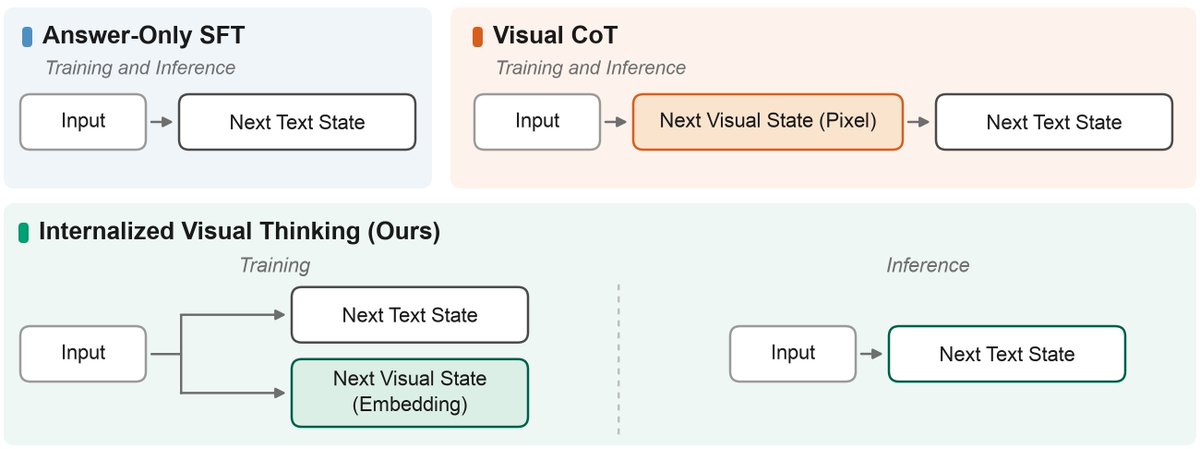
(1/11) Excited to share our new paper: Beyond Visual CoT: Internalized Visual Thinking for Proactive Video Reasoning 🚀
Can multimodal models learn to think visually during training, yet reason directly at inference without generating their visual thoughts? Inspired by the JEPA family of work, we jointly train MLLMs with next visual embedding prediction of future frames, achieving performance competitive with Visual CoT while reducing inference cost by more than 5×.
📄 Paper: https://t.co/uz8fMgBBYT
📝 Blog (including what didn’t work and open problems): https://t.co/fpLGmuDUw7
@DynaRobotics Deep respect and gratitude for sharing these foundational infra designs. Model ideas are often the easy part now. Building fast, reliable infra for rapid iteration is the real bottleneck, and many of these challenges resonate deeply with what we are facing. Thanks for sharing!
Deep respect and gratitude for sharing these foundational infra designs. Model ideas are often the easy part now. Building fast, reliable infra for rapid iteration is the real bottleneck, and many of these challenges resonate deeply with what we are facing.
When people talk about robotics, they usually talk about models, data, or hardware. Few people talk about the infrastructure that lets you iterate on all three quickly. Today we're publishing how we trained Dyna-2 on over 1,000,000 hours of egocentric video, repeatably. At this scale, most of what worked at ten thousand hours did not hold up:
• ingestion throughput was capped at 14,000 episode-hours per week — a million hours would have taken over a year
• building a training manifest took 48 hours before a run could even start
• reading a petabyte from cloud storage during training left GPUs exposed to latency and packet loss
🧵