Apple sold you an iPhone with its top camera settings switched off. On purpose.
$1,200 for a camera you've never actually used. Six settings are off by default, and they're the ones that can make your photos look dramatically better.
Fix these 6:
Apple CarPlay is installed in over 800 million vehicles worldwide.
Most drivers use it for 3 things: Maps. Music. Phone calls.
That's a fully integrated car operating system doing the job of a $20 phone mount and a Bluetooth speaker.
A sales rep who drives 35,000 miles a year told me: "I spend 2–3 hours a day in my car. For 4 years I used CarPlay for directions and Spotify. That's it. Then a friend who works at Apple showed me what CarPlay actually does. My car became a mobile office. My commute became productive time. I haven't missed a meeting, forgotten an errand, or answered a spam call in my car since."
"CarPlay in 2026 has widgets that predict your next destination before you type it. It has Shortcuts that run 5 automations the moment you start your car. It has a Driving Focus mode that silences everything except the people who matter. It has offline maps that work in zero-signal dead zones. It has smart home controls that open your garage door before you pull into the driveway. And it remembers where you parked every single time."
"Most drivers are using maybe 15% of what CarPlay can do. The other 85% is sitting right there on the dashboard, waiting."
Here are 11 CarPlay features that turn your commute from dead time into productive time:
🧵
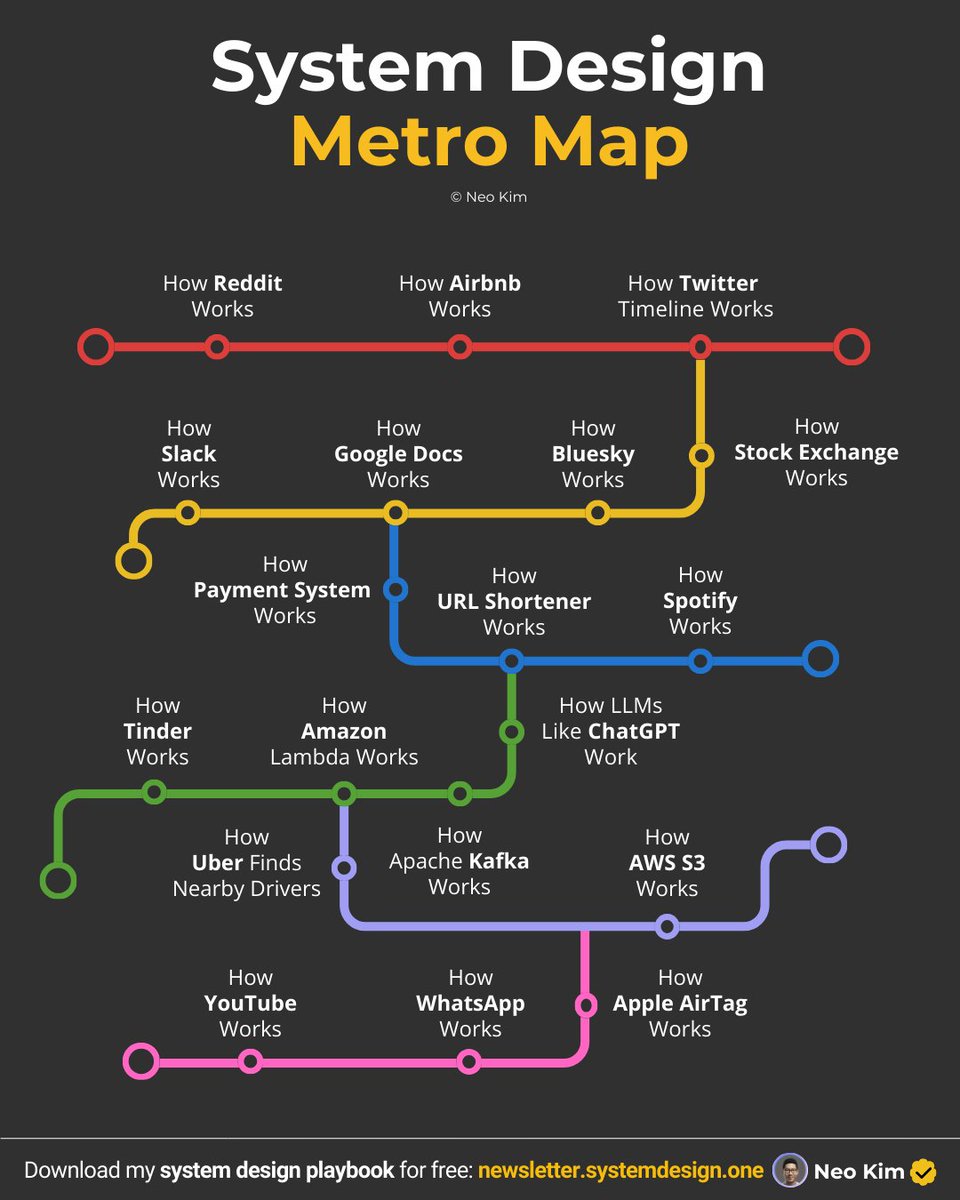
If you want to become good at system design (in 2 weeks), then learn these 15 case studies:
1 How Apache Kafka Works
↳ https://t.co/8rOy9KgCMo
2 How Google Search Works
↳ https://t.co/jwOaC4bhnv
3 How YouTube Works
↳ https://t.co/kHk3g6jz6t
4 How Google Docs Works
↳ https://t.co/W57IkAjXpT
5 How WhatsApp Works
↳ https://t.co/VScq8QwHMr
6 How Airbnb Works
↳ https://t.co/Bi5SAjfv5S
7 How Spotify Works
↳ https://t.co/BxrH3oHIFS
8 How Slack Works
↳ https://t.co/eIo29uOQOJ
9 How Reddit Works
↳ https://t.co/o6Pw2hhj3T
10 How Bluesky Works
↳ https://t.co/2rLYlRlky0
11 How Twitter Works
↳ https://t.co/pF2RYmPaIG
12 How Uber Computes ETA
↳ https://t.co/hw1hYJqQmj
13 How Bitly Shortener Works
↳ https://t.co/tGndgdhH0V
14 How Stock Exchange Works
↳ https://t.co/iFNSX9TM9O
15 How Payment System Works
↳ https://t.co/ARiLxGR43G
What else should make this list?
===
👋 PS - Want my System Design Playbook (for Free)?
Join my newsletter with 200K+ software engineers now:
→ https://t.co/ByOFTtOihX
===
💾 Save now & RT to help others ace system design.
👤 Follow @systemdesignone + turn on notifications.
Saga Pattern for Java/backend interviews:
When a user places an order, you need to withdraw money, reserve the product, and notify the warehouse. All in different services. What to do if one of them crashes?
A regular transaction won't help here. Welcome to Saga.
The idea is simple: break a large distributed transaction into a chain of small local ones. Each step is its own transaction in its own service. If something goes wrong, we launch compensating transactions in reverse order.
[Two approaches]:-
1. Choreography
Services communicate via events. Each one knows what to do next.
OrderService → [OrderCreated] → PaymentService
PaymentService → [PaymentDone] → InventoryService
InventoryService → [Reserved] → NotificationService
- Simple, no single point of failure
- Hard to track the entire flow, spaghetti of events
2. Orchestration
There's a conductor — the Saga Orchestrator. It knows the entire script and commands the services.
(code eg. in the image)
- The flow is visible in one place, easy to debug
- The orchestrator can become a bottleneck
[Important to understand]: a compensating transaction ≠ a DB rollback. This is a business operation. If the money has already been withdrawn, we don't roll back the DB row, we issue a refund.
In the Java ecosystem, Saga is used with:
→ Apache Kafka / RabbitMQ - for events between services
→ Axon Framework - built-in Saga support out of the box
→ Spring State Machine - for managing the orchestrator's state
→ Temporal / Conductor - infrastructure-level workflow orchestration
[When to use] :-
✔️ Microservice architecture
✔️ Multiple DBs, no possibility to use 2PC
✔️ Long-lived business transactions
❌ A monolith with one DB, just use @Transactional
Saga isn't a silver bullet, it's a compromise. You sacrifice isolation for scalability. Data can be temporarily inconsistent, and that's okay if the business is fine with it.
As a developer in 2026, how many of these AI related concepts do you understand?
- LLM vs SLM
- Tokens vs Context Window
- Prompt Engineering vs Prompt Chaining
- RAG (Retrieval Augmented Generation)
- Embeddings
- Vector Databases
- Agents vs Workflows
If you want to become good at system design, learn these 19 case studies (save this):
1 How Stock Exchange Works:
↳ https://t.co/iFNSX9TM9O
2 How Payment System Works:
↳ https://t.co/ARiLxGR43G
3 How YouTube Works:
↳ https://t.co/kHk3g6jz6t
4 How Google Docs Works:
↳ https://t.co/W57IkAjXpT
5 How Kafka Works:
↳ https://t.co/8rOy9KgCMo
6 How URL Shortener Works:
↳ https://t.co/tGndgdhH0V
7 How WhatsApp Works:
↳ https://t.co/VScq8QwHMr
8 How Airbnb Works:
↳ https://t.co/Bi5SAjfv5S
9 How Spotify Works:
↳ https://t.co/BxrH3oHIFS
10 How Slack Works:
↳ https://t.co/eIo29uOQOJ
11 How Reddit Works:
↳ https://t.co/o6Pw2hhj3T
12 How Bluesky Works:
↳ https://t.co/2rLYlRlky0
13 How Tinder Works:
↳ https://t.co/4E1zfgfvlw
14 How Twitter Timeline Works:
↳ https://t.co/pF2RYmPaIG
15 How Uber Finds Nearby Drivers:
↳ https://t.co/kJ2t8dtmch
16 How Amazon Lambda Works:
↳ https://t.co/lx0BjeSRZt
17 How Amazon S3 Works:
↳ https://t.co/iReWAEHwmj
18 How Do Apple AirTags Work:
↳ https://t.co/upWcgsXwKh
19 How LLMs Like ChatGPT Actually Work:
↳ https://t.co/5lCKxq2g4N
What else should make this list?
——
👋 PS - Want my System Design Playbook for FREE?
Join my newsletter with 200K+ software engineers right now:
→ https://t.co/ByOFTtOihX
———
💾 Save this for later & RT to help other software engineers ace system design.
👤 Follow @systemdesignone + turn on notifications.
DON'T GO FOR JAVA INTERVIEW WITHOUT UNDERSTANDING GENERICS .
Common Java generics interview questions you can expect -
- Difference between List<?> and List<Object> in Java?
- Can we use Generics with Array?
- Can you pass List<String> to a method which accepts List<Object>?
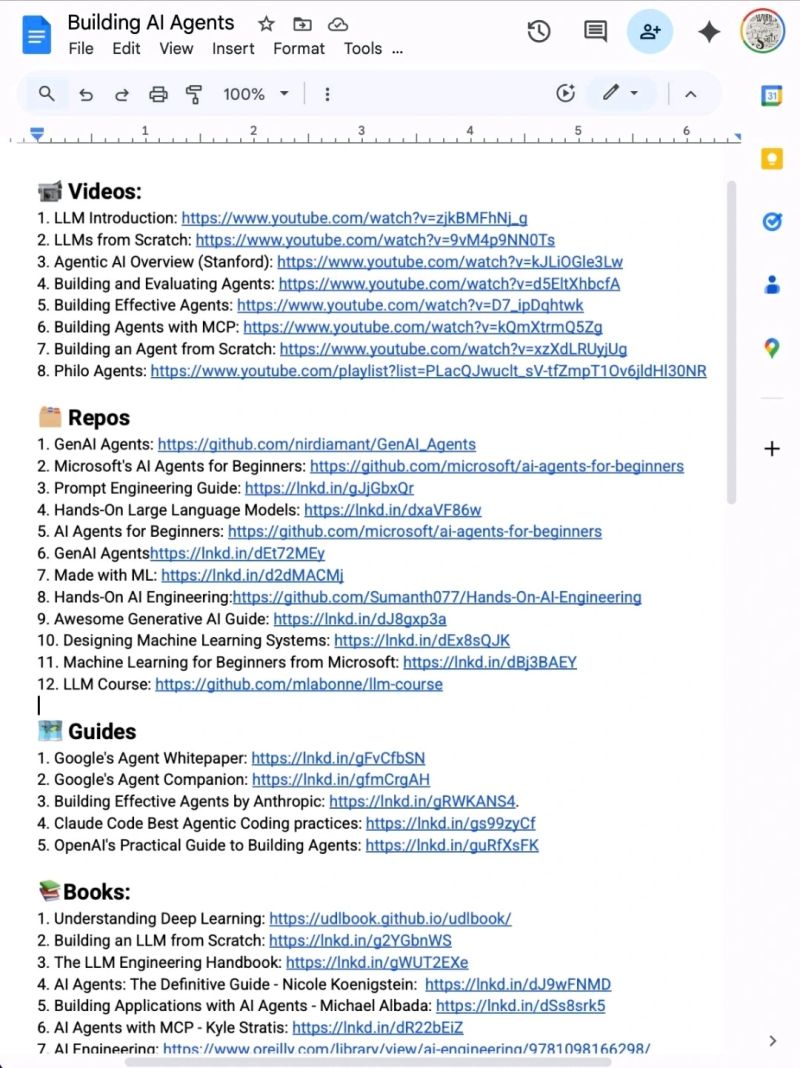
Stop wasting hours trying to learn AI. 📘📚
I have already done it for you.
With one list. Zero confusion. And no fluff
📹 Videos:
1. LLM Introduction: https://t.co/kyDon6qLrb
2. LLMs from Scratch: https://t.co/2hyMhuKoiI
3. Agentic AI Overview (Stanford): https://t.co/FXu6cAqITC
4. Building and Evaluating Agents: https://t.co/ZigR1tdOFL
5. Building Effective Agents: https://t.co/uYwfwO55mO
6. Building Agents with MCP: https://t.co/4arFTW1b3i
7. Building an Agent from Scratch: https://t.co/eOmveyM9Hz
8. Philo Agents: https://t.co/zLu7x1tx9m
🗂️ Repos
1. GenAI Agents: https://t.co/eXCl2YaRPv
2. Microsoft's AI Agents for Beginners: https://t.co/3CSW4zPAwf
3. Prompt Engineering Guide: https://t.co/GVzvxPYDVO
4. Hands-On Large Language Models: https://t.co/0rgDvhx3pI
5. AI Agents for Beginners: https://t.co/3CSW4zPAwf
6. GenAI Agentshttps://lnkd.in/dEt72MEy
7. Made with ML: https://t.co/9z5KHF9DMe
8. Hands-On AI Engineering:https://t.co/dldAj5Xkr6
9. Awesome Generative AI Guide: https://t.co/U2WZhT4ERV
10. Designing Machine Learning Systems: https://t.co/sYAZX34YdQ
11. Machine Learning for Beginners from Microsoft: https://t.co/NjFxHbC9jZ
12. LLM Course: https://t.co/N34YTPu1OK
🗺️ Guides
1. Google's Agent Whitepaper: https://t.co/bW3Ov3vMW0
2. Google's Agent Companion: https://t.co/wredwWAbBA
3. Building Effective Agents by Anthropic: https://t.co/fxtE4alVrJ.
4. Claude Code Best Agentic Coding practices: https://t.co/lLSwJ9pG7C
5. OpenAI's Practical Guide to Building Agents: https://t.co/xgkEIogGfh
📚Books:
1. Understanding Deep Learning: https://t.co/CjcKpTemmV
2. Building an LLM from Scratch: https://t.co/DaWBxOx8o3
3. The LLM Engineering Handbook: https://t.co/ZA1n0N41Mf
4. AI Agents: The Definitive Guide - Nicole Koenigstein: https://t.co/boLkl1VlKb
5. Building Applications with AI Agents - Michael Albada: https://t.co/H1Xf5EkJLL
6. AI Agents with MCP - Kyle Stratis: https://t.co/JI3ELQZE6a
7. AI Engineering: https://t.co/Xk0JzMIf7o
📜 Papers
1. ReAct: https://t.co/QNqE4UU55w
2. Generative Agents: https://t.co/CwEpoJgY1U.
3. Toolformer: https://t.co/5m9xZd5teZ
4. Chain-of-Thought Prompting: https://t.co/KjVlgdWi77.
🧑🏫 Courses:
1. HuggingFace's Agent Course: https://t.co/7FSUYKxIdG
2. MCP with Anthropic: https://t.co/IkZGiWm2yS
3. Building Vector Databases with Pinecone: https://t.co/2YRoMfLdXd
4. Vector Databases from Embeddings to Apps: https://t.co/23A50ixbHJ
5. Agent Memory: https://t.co/uc3L9BrNF7
Repost for your network ♻️
I GAVE GEMINI MY BIRTH DATE AND TIME
It broke down my entire life with unsettling precision.
No horoscopes. No tarot. Just pure artificial intelligence.
Here are 7 prompts you should try:
What is RAG? What is Agentic RAG?
> Retrieval-Augmented Generation (RAG) <
----------------------------------------------
Retrieval-Augmented Generation (RAG) is an architecture that enhances a language model’s outputs by grounding them in external knowledge sources at inference time.
Instead of relying solely on parameters learned during training, RAG systems dynamically retrieve relevant information and inject it into the model’s context before generation.
=> Canonical RAG workflow
> A user submits a query.
> The query is embedded and matched against a pre-indexed corpus (commonly stored in a vector database).
> The top-K most relevant document chunks are retrieved.
> Retrieved context is appended to the original query.
A language model generates a response conditioned on this augmented input.
=> Primary objective
To reduce hallucinations and improve factual accuracy by grounding generation in verifiable, external context.
=> Key limitation
> Traditional RAG is a single-shot pipeline:
> No explicit reasoning or planning
> No validation of retrieved evidence
No iterative refinement if retrieval or generation is suboptimal
The system assumes the first retrieval and generation pass is sufficient, which often breaks down for complex, ambiguous, or multi-hop queries.
> Agentic RAG <
------------------
Agentic RAG extends standard RAG by introducing autonomous decision-making agents that can reason, plan, evaluate, and adapt across multiple steps.
Rather than a static retrieval → generation flow, Agentic RAG operates as a closed-loop, goal-driven system.
=> Core idea
Retrieval and generation are no longer treated as isolated steps, they become actions taken by agents in pursuit of a higher-level objective: producing a correct, complete, and useful answer.
=> Typical Agentic RAG Architecture
1./ Planning Agent
> Interprets the user’s intent
> Decomposes complex queries into sub-tasks
> Determines what information is required and from which sources
2./ Retrieval Agent
> Dynamically reformulates search queries
> Retrieves information from:
- Vector databases
- Structured databases
- APIs
- Tools or live data sources
> Can perform multi-hop retrieval when needed
3./ Generation Agent
> Synthesizes retrieved evidence into a coherent response
> Reasons across multiple sources
> Maintains traceability between claims and evidence
4./ Evaluation (Judge) Agent
> Critically reviews the generated output
> Checks for completeness, correctness, and alignment with the original query
> Decides whether to:
- Accept the answer
- Refine retrieval
- Re-plan and regenerate
This feedback loop can repeat until predefined quality criteria are met.
This is a real Interview report which are sent to clients ....
I was part of this interviewing firm and had access to these reports...
AI summarizes the whole interview , very helpful for clients to see what all was covered in the Interview..
Have attached multiple reports like this in the book.
I appeared for Google interview last year. Dynamic programming is their favourite interview topic.
Here are 10 Must-Know Dynamic Programming patterns for coding interviews
(with LeetCode style examples so people can map easily)
1. 1D DP (Linear DP)
You make decisions based on previous index.
Classic starter problems.
Examples: Climbing Stairs, House Robber, Fibonacci.
2. 2D DP (Grid / Matrix DP)
State depends on row and column.
Very common in interviews.
Examples: Unique Paths, Minimum Path Sum, Dungeon Game.
3. Knapsack Pattern (Pick or Not Pick)
At every step you decide take or skip.
Most DP problems reduce to this mentally.
Examples: 0/1 Knapsack, Subset Sum, Partition Equal Subset Sum.
4. Longest Subsequence / Subarray
You compare past states to build the longest answer.
Tricky transitions, very popular.
Examples: Longest Increasing Subsequence, Longest Common Subsequence.
5. Interval DP
You solve smaller ranges and expand.
Usually O(n³), scary but powerful.
Examples: Burst Balloons, Matrix Chain Multiplication.
6. DP on Strings
State usually based on two indices.
Edit operations, matching, skipping.
Examples: Edit Distance, Regular Expression Matching.
7. DP on Trees
DFS + DP values returned from children.
Very common in system style interviews.
Examples: House Robber III, Diameter of Binary Tree (DP variant).
8. DP on Graphs (DAG DP)
Topological order + DP relaxations.
Only works when no cycles.
Examples: Longest Path in DAG, Course Schedule variants.
9. Bitmask DP
State compressed into bits.
Looks hard, but brute force optimized.
Examples: Traveling Salesman Problem, Assign Tasks to Workers.
10. State Machine DP
You track states like buy/sell, hold/not hold.
Very common in trading style questions.
Examples: Best Time to Buy and Sell Stock I, II, III, with Cooldown.
Most DP questions are not new problems.
They are the same old patterns.
If we can identify the pattern, the solution writes itself slowly but surely.
Consider repost if this saves you hours of confusion before interviews!!








![makakmayum_sid's tweet photo. Saga Pattern for Java/backend interviews:
When a user places an order, you need to withdraw money, reserve the product, and notify the warehouse. All in different services. What to do if one of them crashes?
A regular transaction won't help here. Welcome to Saga.
The idea is simple: break a large distributed transaction into a chain of small local ones. Each step is its own transaction in its own service. If something goes wrong, we launch compensating transactions in reverse order.
[Two approaches]:-
1. Choreography
Services communicate via events. Each one knows what to do next.
OrderService → [OrderCreated] → PaymentService
PaymentService → [PaymentDone] → InventoryService
InventoryService → [Reserved] → NotificationService
- Simple, no single point of failure
- Hard to track the entire flow, spaghetti of events
2. Orchestration
There's a conductor — the Saga Orchestrator. It knows the entire script and commands the services.
(code eg. in the image)
- The flow is visible in one place, easy to debug
- The orchestrator can become a bottleneck
[Important to understand]: a compensating transaction ≠ a DB rollback. This is a business operation. If the money has already been withdrawn, we don't roll back the DB row, we issue a refund.
In the Java ecosystem, Saga is used with:
→ Apache Kafka / RabbitMQ - for events between services
→ Axon Framework - built-in Saga support out of the box
→ Spring State Machine - for managing the orchestrator's state
→ Temporal / Conductor - infrastructure-level workflow orchestration
[When to use] :-
✔️ Microservice architecture
✔️ Multiple DBs, no possibility to use 2PC
✔️ Long-lived business transactions
❌ A monolith with one DB, just use @Transactional
Saga isn't a silver bullet, it's a compromise. You sacrifice isolation for scalability. Data can be temporarily inconsistent, and that's okay if the business is fine with it.](https://pbs.twimg.com/media/HBc6kW1aMAAY-lg.jpg)