Hospice Harpist, Therapeutic musician, Author of “Where the Tree Falls, the Forest Rises: Stories of Death & Renewal”, rural life, persister. Now on Blue Sky
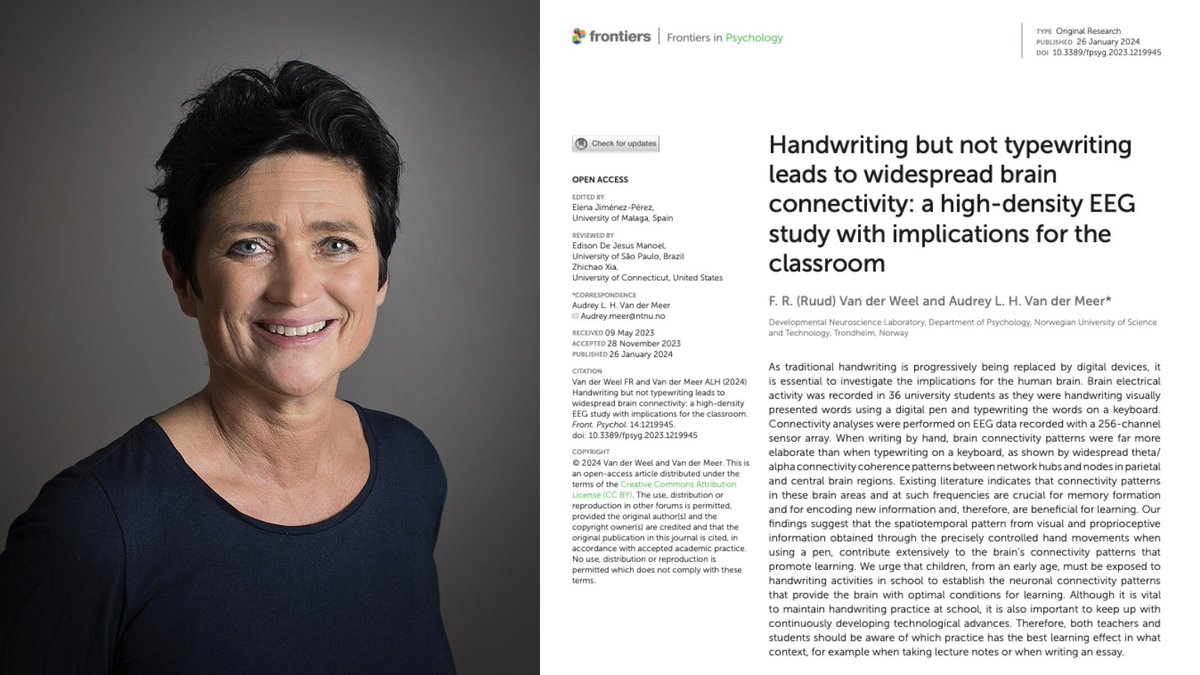
A Norwegian neuroscientist spent 20 years proving that the act of writing by hand changes the human brain in ways typing physically cannot, and almost nobody outside her field has read the paper.
Her name is Audrey van der Meer.
She runs a brain research lab in Trondheim, and the paper that closed the argument was published in 2024 in a journal called Frontiers in Psychology. The finding is brutal enough that it should have changed every classroom on Earth.
The experiment was simple. She recruited 36 university students and put each one in a cap with 256 sensors pressed against their scalp to record brain activity. Words flashed on a screen one at a time.
Sometimes the students wrote the word by hand on a touchscreen using a digital pen, and sometimes they typed the same word on a keyboard. Every neural response was recorded for the full five seconds the word stayed on screen.
Then her team looked at the part of the data most researchers had ignored for years, which is how different parts of the brain were communicating with each other during the task.
When the students wrote by hand, the brain lit up everywhere at once.
The regions responsible for memory, sensory integration, and the encoding of new information were all firing together in a coordinated pattern that spread across the entire cortex. The whole network was awake and connected.
When the same students typed the same word, that pattern collapsed almost completely.
Most of the brain went quiet, and the connections between regions that had been alive seconds earlier were nowhere to be found on the EEG.
Same word, same brain, same person, and two completely different neurological events.
The reason turned out to be something nobody had really paid attention to before her work. Writing by hand is not one motion but a sequence of thousands of tiny micro-movements coordinated with your eyes in real time, where each letter is a different shape that requires the brain to solve a slightly different spatial problem.
Your fingers, wrist, vision, and the parts of your brain that track position in space are all working together to produce one letter, then the next, then the next.
Typing throws all of that away. Every key on a keyboard requires the exact same finger motion regardless of which letter you are pressing, which means the brain has almost nothing to integrate and almost no problem to solve.
Van der Meer said it plainly in her interviews.
Pressing the same key with the same finger over and over does not stimulate the brain in any meaningful way, and she pointed out something that should scare every parent who handed their kid an iPad.
Children who learn to read and write on tablets often cannot tell letters like b and d apart, because they have never physically felt with their bodies what it takes to actually produce those letters on a page.
A decade before her, two researchers at Princeton ran the same fight using a completely different method and ended up at the same answer. Pam Mueller and Daniel Oppenheimer tested 327 students across three experiments, where half took notes on laptops with the internet disabled and half took notes by hand, before testing everyone on what they actually understood from the lectures they had watched.
The handwriting group won by a wide margin on every question that required real understanding rather than surface recall.
The reason was hiding in the transcripts of what the two groups had actually written down.
The laptop students typed almost word for word, capturing more total content but processing almost none of it as they went, while the handwriting students physically could not write fast enough to transcribe a lecture in real time, which forced them to listen carefully, decide what actually mattered, and put it in their own words on the page.
That single act of choosing what to keep was the learning itself, and the keyboard had quietly skipped the choosing and skipped the learning along with it.
Two studies. Two countries. Same answer.
Handwriting makes the brain work. Typing lets it coast.
Every note you have ever typed instead of written went into your brain through a thinner pipe. Every meeting, every book highlight, every idea you captured on your phone instead of on paper was processed at half depth.
You did not forget those things because your memory is bad. You forgot them because typing never woke the part of the brain that would have made them stick.
The fix is the thing your grandmother already knew.
Pick up a pen. Write the thing down. The slower road is the faster one.
David, an African American caregiver, shared a touching story about his 91-year-old client — a naval veteran who marched for civil rights in his youth.
Now, years later, David feels deep joy and fulfillment caring for him. Their bond reflects a beautiful spirit of kindness, mutual respect, and love that transcends generations. ❤️
@Joseph_Fasano_ I carried this in my wallet for yrs, not knowing who Wendell Berry was.
To go in the dark with a light is to know the light.
To know the dark, go dark. Go without sight,
and find that the dark, too, blooms and sings,
and is traveled by dark feet and dark wings.
Wendell Berry
It's 4/20. Do you know where your tax revenue is?
Wisconsin is one of the last states without a real cannabis program, and we're handing our neighbors millions every year because of it.
@VinylAudiophile@kid_riles@WisGOP 15 years of Republican control in the Wisconsin Senate and Assembly and people can't figure out that Republicans forced public schools to use additional property taxes to make up for the shortfall from the state government. The Republican controlled legislature is the blame.
Take a good look folks.
These are the Minnesota boundary waters. Every Republican senator voted to allow a Chilean billionaire to mine it. The minerals will go to China.
This truly enrages me.
It should you as well.
Fuck, and I mean fuck…
The @GOP 🖕
"If we are serious about peace, then we must work for it as ardently, seriously, continuously, carefully, and bravely as we have ever prepared for war."
—Wendell Berry
@Michaeljos92972 💔 Your words here remind me of a Wendell Berry poem I refer to in a book I put together. The poem is called Rising. Here is an excerpt.
https://t.co/zJtVDWmGKG
A CHANGING LIFE
by Michael Whelan
The house has learned a new language this past month.
It speaks in absence.
The quiet isn’t just quiet—it’s instructional. It teaches me where Rebecca used to be. The empty chair at the table isn’t furniture anymore, it’s a headline. The bed isn’t a place to sleep, it’s a question I fail to answer every night.
And yet… in this unbearable stillness, I’ve learned more about love than in the fifty years I was lucky enough to live inside it.
Funny how that works.
You spend a lifetime thinking love is the big things—the anniversaries, the trips, the “I love you’s” said before sleep like a sacred ritual you assume will never end. But it turns out love is much sneakier than that. It hides in the ordinary. It’s in the way she’d remind me to take my pills like I was a stubborn child. It’s in the arguments about absolutely nothing that somehow meant everything. It’s in the dog hair we both swore we’d clean up… tomorrow.
Tomorrow, by the way, is a liar.
I’ve also learned that grief has a strange sense of humor. It lets you laugh at the most inappropriate times. I found myself the other day arguing with Rebecca’s urn—out loud—about where she’d want the damn throw pillows. And I swear, I could feel her winning. Which is infuriating, because she always did.
Some things, it seems, don’t die.
Over the past month, I’ve written pieces of my heart onto these pages. What you’ve read is real, raw, and sometimes a little too close to the bone. But there are also people—good people, important people—whose names you won’t see here. Not because they weren’t there. Not because they didn’t matter. But because they asked, quietly and respectfully, to remain out of the public light. And love—real love—honors that. Always.
Their absence from these essays is not absence from my life. It’s just another form of respect. Another way of saying, “I see you,” without needing the world to.
That’s something else Rebecca taught me.
Not everything sacred needs an audience.
What I’ve come to understand—what has been carved into me over these past thirty days—is this: Love doesn’t end when a heartbeat does. It just changes address. It moves from the room into the air. From the body into memory. From touch into something you carry so deeply it almost breaks you… and somehow holds you together at the same time.
I still talk to her every night.
I tell her what I did. What I tried to do. What I couldn’t do.
And if I’m being honest… I’m still trying to figure out how to be a “me” that doesn’t include “us.”
But here’s the truth—the raw, unpolished, slightly ridiculous truth:
I don’t think I want to figure that out.
Because “us” didn’t die.
It just became invisible.
And if you listen closely—really closely—you can still hear it.
Applauding.
@Joseph_Fasano_ So many think the ultimate sacrifice is death. But isn’t it life? What we give our lives for, who we our lives to? You write this so profoundly. Thank you.