are temporary, and the Judgment Seat of Christ will evaluate Christian service. Grace does not remove seriousness. Grace gives seriousness a proper foundation.
Trials are part of endurance training. James 1 says, “the trying of your faith worketh patience.” Nobody likes resistance while experiencing it, but resistance exposes weakness and produces strength when answered biblically. A comfortable Christianity can become spiritually soft. Then one criticism, delay, disappointment, financial problem, unanswered prayer, or family difficulty sends the believer staggering. Trials teach you whether doctrine still stands when circumstances stop cooperating. The word “patience” in Scripture often carries endurance under pressure. You do not develop that by reading about pressure from an armchair. God sometimes permits hardship not because He has abandoned you but because faith that has never carried weight remains largely untested.
Finally, keep eternity before you. Colossians 3:2 says, “Set your affection on things above, not on things on the earth.” Spiritual health deteriorates when temporal concerns become ultimate concerns. Money, comfort, reputation, possessions, success, health, entertainment, and human praise all have limits. The Christian who lives entirely for what can be lost in one afternoon has built his soul around temporary furniture. Remember Christ is coming. Remember the Judgment Seat. Remember lost people need the gospel. Remember children are watching. Remember time is moving whether you use it or not. A healthy Christian is not obsessed with death; he is simply honest about eternity. The man who knows the finish line exists trains differently from the man decorating the starting block.
Conclusion
So guard your spiritual health with at least as much seriousness as you guard your physical health. Feed the inner man before starvation becomes normal. Exercise obedience before spiritual weakness becomes an excuse. Pray before crisis teaches you how dependent you always were. Avoid sin and distraction before they choke appetite. Examine yourself before drift becomes collapse. Stay connected to faithful believers before isolation convinces you that nobody else can understand you. Build endurance before the heavy trial arrives. None of these practices earns salvation. Jesus Christ finished that work. But the believer saved by grace has every biblical reason to steward the life Christ purchased.
Do not become obsessed with constantly taking your spiritual pulse, either. Health is not measured by endless self-inspection. There is a ditch on both sides of the road. One believer never examines himself; another examines himself so relentlessly that he spends more time staring at his spiritual condition than looking unto Jesus. Hebrews 12:2 says, “Looking unto Jesus the author and finisher of our faith.” The goal is not spiritual hypochondria. The goal is faithful fellowship and usefulness. Examine where necessary, correct what is wrong, then keep walking. You do not dig up a fruit tree every morning to see whether the roots grew overnight. Feed it, water it, guard it, and let life produce fruit in its season.
Proverbs says, “Keep thy heart with all diligence.” That word diligence is the answer. Spiritual health is rarely preserved accidentally. Guard what enters your mind. Feed upon Scripture. Pray. Obey. Confess sin quickly. Remove poisons. Receive correction. Serve others. Endure hardship. Keep eternity visible. A healthy Christian is not one who never feels weak, never faces temptation, never becomes tired, or never needs correction. A healthy Christian is one who keeps returning to the means God has provided and refuses to let neglect become normal. You would not knowingly starve your body, poison your bloodstream, ignore every warning sign, and call the result health. Do not do it to your soul.
The Rapture and the Deliverance Before the Sun Turns to Darkness
Joel 2:31 — “The sun shall be turned into darkness, and the moon into blood, before the great and the terrible day of the LORD come.”
Introduction
Joel did not look into the future and see a pleasant religious sunrise spreading gradually across an improving world. He saw the sun turned into darkness, the moon turned into blood, armies moving, nations trembling, Zion surrounded, and the great and terrible day of the LORD approaching. The prophets never subscribed to the modern fairy tale that mankind will educate, negotiate, and legislate itself into paradise. According to Scripture, civilization does not climb steadily toward enlightenment; it staggers toward judgment while congratulating itself on the progress. Joel’s prophecy describes a coming crisis in which creation itself becomes a witness against human rebellion. The lights placed in the firmament will no longer serve merely as markers of ordinary days and seasons. God will touch them as warning signs that the present order is about to face its rightful King. The darkened sun is not a poetic description of spiritual discouragement. It is a literal prophetic sign connected with the day of the LORD.
Yet Joel 2:31 is not a direct revelation of the Rapture of the Church. Joel ministered to Judah and spoke concerning Zion, Jerusalem, Israel’s enemies, Israel’s repentance, and Israel’s coming deliverance. The catching away of the body of Christ was a mystery later revealed through Paul. Right division therefore refuses to shove the Church into Joel’s prophecy merely because the subject concerns the future. At the same time, the chronology established by the whole Bible is unmistakable. Before Joel’s celestial signs reach their dreadful fulfillment, the Church has already been removed from the earth. The body of Christ is not appointed to endure Daniel’s seventieth week, bow before the beast, or wait for the heavens to go dark before discovering whether the blessed hope was genuine. The Christian is not looking for the sun to disappear. He is looking for the Saviour to descend.
That distinction matters because prophecy becomes confusion when Israel, the Church, the Tribulation, the Rapture, and the Second Advent are poured into the same theological blender. Joel reveals signs associated with the day of the LORD and God’s dealings with Israel. Matthew places the darkening of the sun “immediately after the tribulation of those days” (Matthew 24:29). Revelation shows cosmic disturbances amid divine judgment. Paul, however, reveals that the Lord will descend for His Church, the dead in Christ will rise, the living saints will be changed, and both will be caught up together to meet Him in the air. These passages do not contradict one another. They describe different companies, settings, and stages in God’s prophetic program. The Rapture removes the Church before the dreadful darkness descends. Joel’s sun goes dark because judgment is approaching; the Church goes up because her Deliverer has arrived.
Chapter 1 — Joel’s Prophecy Belongs to Israel’s Day
The opening words of Joel identify the original audience: “Hear this, ye old men, and give ear, all ye inhabitants of the land” (Joel 1:2). The prophet speaks of Judah, Jerusalem, Zion, priests, sacrifices, the house of the LORD, and the land promised to Israel. Joel 2 begins, “Blow ye the trumpet in Zion, and sound an alarm in my holy mountain” (Joel 2:1). That is not language addressed to the spiritual body of Christ seated in heavenly places. It belongs to an earthly nation standing in covenant relationship with God and facing covenant judgment. Israel had a land, a temple, a priesthood, and national promises. The Church has a heavenly calling and is composed of saved Jews and Gentiles made one in Christ. Calling Zion “the Church” does not make it so any more than changing the label on a medicine bottle changes what is inside.
🚨‼️A lot of Christians talk about heaven like getting there is the end of the story. It is not. If you are saved, the blood of Jesus Christ settled your destination, but the Judgment Seat of Christ will settle the question of what you did after you were saved. Paul did not say, “We might appear.” He said, “we must all appear before the judgment seat of Christ” (2 Corinthians 5:10). The Christian life is not a waiting room where you sit around until the Rapture number is called. It is a stewardship, and one day the Owner is going to ask what you did with what belonged to Him.
That ought to make some religious success look mighty cheap. Men count crowds, money, buildings, degrees, followers, conferences, titles, and applause. Christ says the fire will try “every man’s work of what sort it is” (1 Corinthians 3:13). Not how big it was. Not how famous it became. Not how many people reposted it. What sort it was. A barn full of hay can look a whole lot bigger than a handful of diamonds, right up until the match is struck. Heaven is not impressed by size when the material is combustible.
And here is the part people do not like to preach: a saved man can lose something without losing salvation. “If any man’s work shall be burned, he shall suffer loss: but he himself shall be saved” (1 Corinthians 3:15). There is your eternal security, and there is your accountability, standing shoulder to shoulder in the same verse. The man is saved. The work burns. Grace gets him home, but grace does not magically turn forty years of selfishness, wasted opportunity, man-pleasing, and religious vanity into gold when he gets there.
So here is the question worth carrying around today: If Christ put your Christian life into the fire right now, what would still be there when the smoke cleared? Not what would people say. Not what would your church bulletin say. Not what would your résumé say. What would Christ say? One day the applause will stop, the trophies will tarnish, the titles will belong to dead men, and the only thing that will matter is what survived the eyes of the Lord Jesus Christ. Build accordingly.
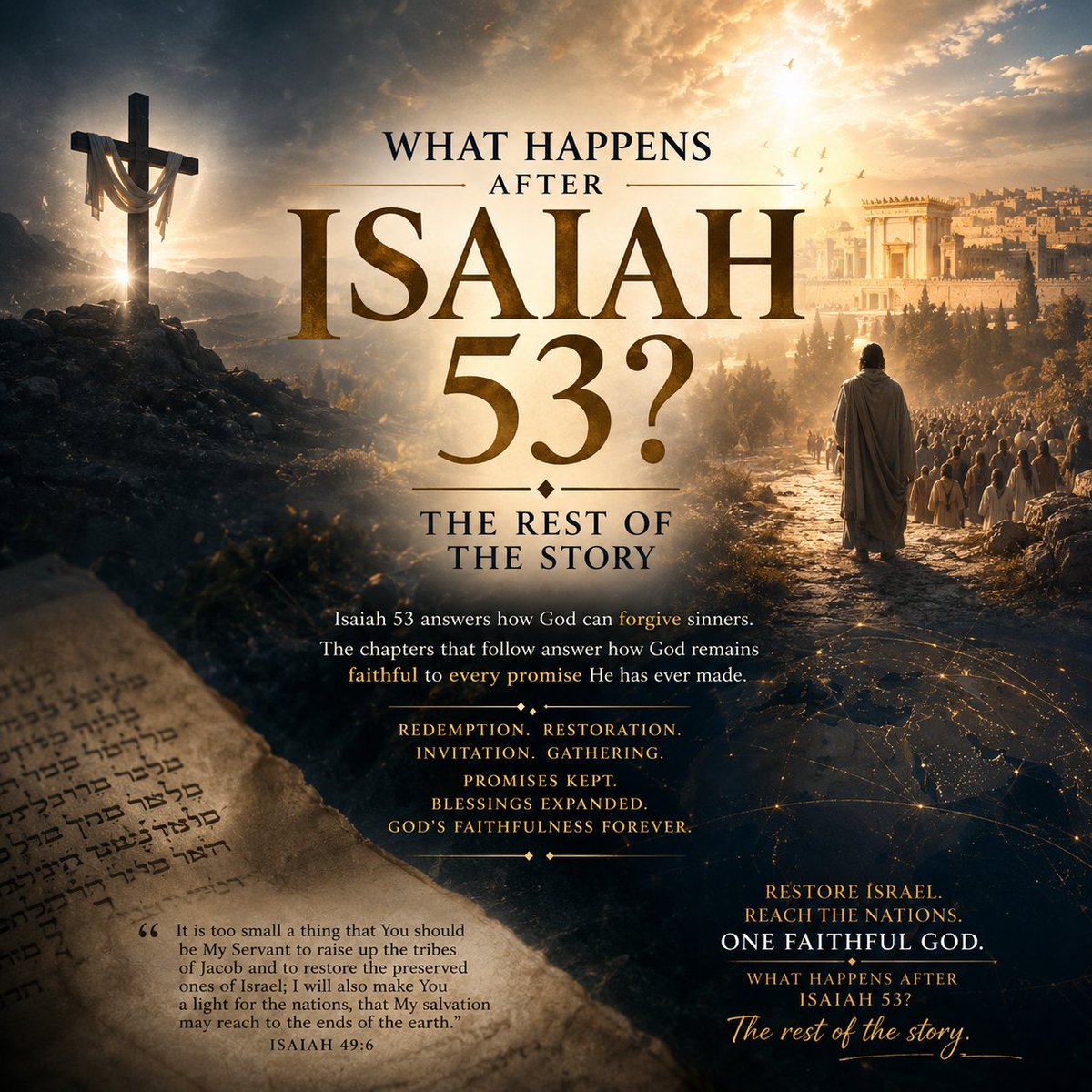
What Happens After Isaiah 53?
Everyone knows Isaiah 53.
The suffering Servant.
The Man of Sorrows.
The One who was "pierced for our transgressions" and "crushed for our iniquities."
But very few people keep reading.
And that's a shame.
Because what happens after Isaiah 53 may be one of the most breathtaking prophetic progressions in all of Scripture.
Isaiah 53 answers how God can forgive sinners.
The chapters that follow answer how God remains faithful to every promise He has ever made.
Rather than jumping from one proof text to another, let's simply keep reading Isaiah.
Watch what happens.
The horizon keeps expanding.
Not away from Israel.
Outward through Israel.
Because God's promises don't disappear.
They unfold.
❖ Isaiah 53 — Redemption
The Servant bears our sins.
"He was pierced for our transgressions..." (53:5)
"My righteous Servant will justify many..." (53:11)
Redemption is accomplished.
But Isaiah isn't finished.
The cross was never God's finish line.
It was His foundation.
❖ Isaiah 54 — Restoration
Immediately, the spotlight turns to Zion.
"With everlasting lovingkindness I will have compassion on you." (54:8)
"My covenant of peace shall not be removed." (54:10)
The nation is restored.
God's covenant faithfulness has not failed.
The promises made to Zion remain the promises made to Zion.
God keeps His word.
❖ Isaiah 55 — Invitation
Then the circle grows wider.
"Come, everyone who thirsts..." (55:1)
"I will make with you an everlasting covenant, My steadfast, sure love for David." (55:3)
The blessings secured by the Servant are now freely offered.
The invitation reaches everyone who will come.
God's grace expands without canceling His promises.
❖ Isaiah 56 — Gathering
Then Isaiah does something remarkable.
Foreigners who join themselves to the LORD are welcomed.
Eunuchs once excluded receive "a name better than sons and daughters."
Then comes one of Scripture's greatest declarations:
"My house shall be called a house of prayer for all peoples." (56:7)
But don't miss the very next verse.
"The Lord GOD, who gathers the outcasts of Israel, declares, 'I will gather yet others to him besides those already gathered.'" (56:8)
The order matters.
First, the outcasts of Israel are gathered.
Then others are gathered alongside them.
Not instead of them.
The circle simply becomes larger.
This was never God's backup plan.
Fourteen centuries before Isaiah, God told Abraham:
"In you all the families of the earth shall be blessed." (Gen. 12:3)
The blessing promised through Abraham was always meant to reach the nations.
Jesus affirmed Isaiah's vision.
When He cleansed the Temple, He did not quote Isaiah 53.
He quoted Isaiah 56.
"My house shall be called a house of prayer for all the nations." (Mark 11:17)
The Court of the Gentiles—the very place where the nations were meant to seek Israel's God—had become a marketplace.
Jesus wasn't abandoning Isaiah's vision.
He was defending it.
Paul later confirms the same pattern:
"Christ became a servant to the circumcised to confirm the promises given to the patriarchs, and in order that the Gentiles might glorify God for His mercy." (Rom. 15:8–9)
Paul doesn't describe God's promises as transferred.
He describes them as confirmed.
If we wanted Isaiah himself to summarize this entire progression in one verse, he already did:
"It is too small a thing that You should be My Servant to raise up the tribes of Jacob and to restore the preserved ones of Israel; I will also make You a light for the nations, that My salvation may reach to the ends of the earth." (Isa. 49:6)
Restore Israel.
Reach the nations.
That is exactly where Isaiah takes us after chapter 53.
Notice the progression.
The Servant.
Zion.
Everyone who thirsts.
Foreigners.
All peoples.
And finally...
"All flesh shall come to worship before Me, declares the LORD." (Isa. 66:23)
Isaiah's vision keeps growing wider.
Nothing is replaced.
Everything expands.
A faithful Servant.
A restored Zion.
An everlasting covenant.
A welcomed world.
A gathering of the nations.
A worshiping creation.
One faithful God.
The New Covenant is not the story of God changing His mind.
It is the story of God keeping His word.
So...
What happens after Isaiah 53?
The rest of the story.
The moment American gospel singer Kirk Franklin surprised the audience by bringing Nigerian gospel singer Mercy Chinwo on stage, and they both performed together.
As a Bible prophecy teacher, I am often asked about the outcome of future elections. Teaching Bible prophecy, however, does not make someone a prophet. In fact, the Bible never reveals the results of future elections in our modern era.
What it does reveal in remarkable detail are the future events surrounding Israel, the nations, and God’s prophetic plan for the world.
Elections are about people’s choices, and those choices reflect their convictions. Voting is not merely a privilege - it is a responsibility. Every vote is a moral decision, and as believers we are called to make those decisions in a way that honors God.
“And let us not grow weary while doing good, for in due season we shall reap if we do not lose heart.”
(Galatians 6:9, NKJV)
God instructed the people of Israel to consider two options - good and evil, life and death - and then commanded them:
“I call heaven and earth as witnesses today against you, that I have set before you life and death, blessing and cursing. Therefore choose life, that both you and your descendants may live.”
(Deuteronomy 30:19, NKJV)
But how do we discern good from evil, or life from death? That is why God gave us His Word.
“Your word is a lamp to my feet
And a light to my path.”
(Psalm 119:105, NKJV)
“All Scripture is given by inspiration of God, and is profitable for doctrine, for reproof, for correction, for instruction in righteousness.”
(2 Timothy 3:16, NKJV)
“Sanctify them by Your truth. Your word is truth.”
(John 17:17, NKJV)
Anything that stands against His Word, His character, or His ways is wrong. His Word is the standard by which we measure everything.
As elections approach in Israel on October 27, 2026, and in the United States on November 3, 2026, I urge the citizens of both nations to choose wisely. Stand firmly against every agenda that is anti-God, anti-biblical, anti-Israel, anti-family, and supportive of the massacre of innocent unborn children. Vote according to biblical convictions rather than cultural pressures or political trends.
“Righteousness exalts a nation,
But sin is a reproach to any people.”
(Proverbs 14:34, NKJV)
“Blessed is the nation whose God is the Lord,
The people He has chosen as His own inheritance.”
(Psalm 33:12, NKJV)
Awaiting His Return,
Amir
God told the prophet Isaiah:
“I am God, and there is no other;
I am God, and there is none like Me,
Declaring the end from the beginning,
And from ancient times things that are not yet done,
Saying, ‘My counsel shall stand,
And I will do all My pleasure.’”
Isaiah 46:9-10 NKJV
Do you understand what that means?
There are things that have not yet come to pass, and God Himself will ensure that every one of them is fulfilled in His perfect timing and for His glory. His counsel will stand, and He will accomplish all His pleasure.
So never doubt that Bible prophecy will be fulfilled with absolute accuracy. And don’t expect God to work according to your timetable. Trust the One who made the promises.
“Let us hold fast the confession of our hope without wavering, for He who promised is faithful.”
Hebrews 10:23 NKJV
Awaiting His Return,
Amir
Ezekiel 37 famously speaks of the dry bones coming to life in two phases.
First, with sinews and flesh, but no breath.
Second, with breath. Breath has the same Hebrew word as spirit (Ruach).
The dry bones are Israel.
v11: Son of man, these bones are the whole house of Israel.
1948 was the first phase. The nation came to life. But not yet with the Spirit.
The second phase is coming. 🇮🇱❤️🙏
Aaron the Priest stopped a plague by running into the assembly and interceding, standing between the dead and the living. (Numbers 16:46-48)
Later, Phinheas, Aaron's grandson, stopped a plague by slaying the sinners with a spear. (Numbers 25:7-8)
Aaron represents the first coming of Yeshua, who interceded on our behalf.
Phinheas represents the second coming of Yeshua, who will slay the wicked at His return.
The story in the Bible that rattled me before I converted to Christianity from Islam:
The two thieves crucified next to Jesus. I never knew about them. Bro. They’re the whole Gospel in one scene.
Two men. Same sin. Same cross. Same dying breath. Same distance from Jesus — mere feet away on either side.
One mocks Him. One turns to Him and says, “Jesus, remember me when you come into your kingdom.”
And Jesus tells the second man: “Today you will be with Me in paradise.” Luke 23:43.
That man did ZERO good works. He couldn’t. His hands were nailed down. He never prayed five times. Never fasted. Never gave to the poor. Never got baptized. He had nothing to offer but a dying glance toward Jesus.
And Jesus saved him... on the spot.
In Islam, that man was doomed. No time to balance the scale. No deeds to weigh. Game over. A horrible life with a horrible punishment ahead.
I wonder if that would be me…
Yet in the Gospel, that man was in paradise the same day — because salvation was never about his works. It was about WHO he turned to in his last moment.
Two criminals. Same cross. One simple difference: which one turned to Jesus.
That’s why the Gospel is offensive.
And Jesus asks everyone: who do you say I am?
Street preacher confronts Pastor partaking in a pride march.
It’s not “love” to not tell someone the truth of the Gospel.
Yes there are ways to do it in love; but supporting the thing opposite to the Bible is not it.
When I was Muslim, I would argue & say we had the same prophets as Christians.
But this one broke me:
Surah 17:101: Allah gave Moses 9 clear signs.
I knew the list. The staff. The shining hand. The drought. The flood. The locusts. The lice. The frogs. The blood.
I held onto those 9 signs like proof I had the real story.
But bro, you know what shook me?
There’s a night missing.
After all nine signs, right before Israel walks out of Egypt, something happens that the Quran goes completely silent on.
A lamb is slaughtered.
Its blood painted on the doorposts.
And death passes over every house covered by that blood.
The Passover.
I grew up hearing the whole Exodus story. But nobody ever told me about the blood on the door.
Islam just skips it.
And here’s what wrecked me.
The Bible, the book I was taught was corrupted, mentions the Passover over 70 times.
Exodus. Leviticus. Numbers. Deuteronomy. The Psalms. The Prophets. The Gospels. Paul.
70 times.
So I had to ask myself the honest question:
If men corrupted this book, why would they obsess over the same story for 1500 years? Across dozens of authors who never met?
You don’t forge a document 70 times.
That’s just not corruption.
That to me is preservation.
And then I read the line that finished me off.
1 Corinthians 5:7.
“Christ our Passover lamb has been sacrificed.”
That’s when it hit me.
The whole story was never just about Moses.
It was always pointing to a King.
The final lamb. Whose blood, when applied to your life, makes death pass over you.
Forever.
The Quran gave me 9 signs but hid the one night that explains why any of them happened.
Because the moment a Muslim understands the Passover…
he’s one step away from the cross.