@santifer Proud to be a part of this project. AI for job seekers is an awesome focus. @santifer’s leadership to make hard decisions (not allowing PRs that enable headless job applications, MIT licensing, etc.) really sets this project apart. #AIforJobSeekers#career-ops
@benln The real hard part becomes making the company legible enough for AI to actually help.
Most companies are full of undocumented decisions, hidden context, and, most importantly, knowledge stuck in people's heads.
@ttorres The hidden product decision is whether the system is allowed to invent structure or only preserve intent. Once capture starts smuggling in planning, people stop speaking naturally and start prompt-engineering the inbox.
@aakashgupta "Security/infra will be [critical]... every vibe-coded feature still needs someone awake at 3am when it hallucinates...More output means more surface area to secure, more [infra] to scale, more edge cases to catch. The ratio of builders to maintainers is inverting." @aakashgupta
Claude Code doesn't show you how many tokens you're using for subscriptions. No breakdown by model. No breakdown by project. Just a progress bar that says "63% used."
So I built a local dashboard that reads the files Claude Code already writes to your machine.
Turns out every session, every turn, every token is logged to ~/.claude/projects/ in JSONL files. Input tokens, output tokens, cache reads, cache creation, model name, timestamp.
It's all there. You just can't see it.
My numbers over the last 30 days: 440 sessions. 18,000 turns. $1,588 in API-equivalent costs. On one day, the cache spiked to 700M tokens - visible cache bug, two days in a row.
The dashboard scans those local files, builds a SQLite database, and serves charts on localhost:8080. Filter by model (Opus, Sonnet, Haiku). Filter by time range (7d, 30d, 90d, all time). Cost estimates based on current Anthropic API pricing.
Works retroactively. First run processes your entire Claude Code history.
Install:
git clone https://t.co/BKyUCxi8Cq
cd claude-usage
python3 https://t.co/O3rvjobdvx dashboard
Windows: use python instead of python3.
Zero dependencies. Python standard library only.
Open source, MIT.
Star it. Fork it. Make it your own.
Great article from @ttorres - "You can't win opinion battles. But you can bring information your stakeholders don't have—insights from customer interviews, data from assumption tests, patterns in the opportunity space that they haven't seen." https://t.co/q49gunJZgk
"All we are doing is shipping the wrong stuff faster." 🚀
With AI features dominating roadmaps, product teams are falling back into feature factory mode. This article shows you how to break the cycle by bringing stakeholders along your discovery journey instead of battling their opinions.
You'll learn how to transform stakeholder relationships from obstacles to partners:
🎯 Start with shared outcomes, not solutions
🗺️ Use your opportunity solution tree as a stakeholder management tool
💬 Invite contribution by asking "did we miss anything?"
📊 Share assumption tests and results, not just conclusions
🔄 Show your work continuously, not in big reveals
⚖️ Tailor communication detail to each stakeholder's needs
Key insight: "You can't win opinion battles. But you can bring information your stakeholders don't have—insights from customer interviews, data from assumption tests, patterns in the opportunity space that they haven't seen."
Check out the article: https://t.co/0PsskfDSXq
🤔 When stakeholders come to you with AI feature requests, how do you typically respond? Share your thoughts in the comments below.
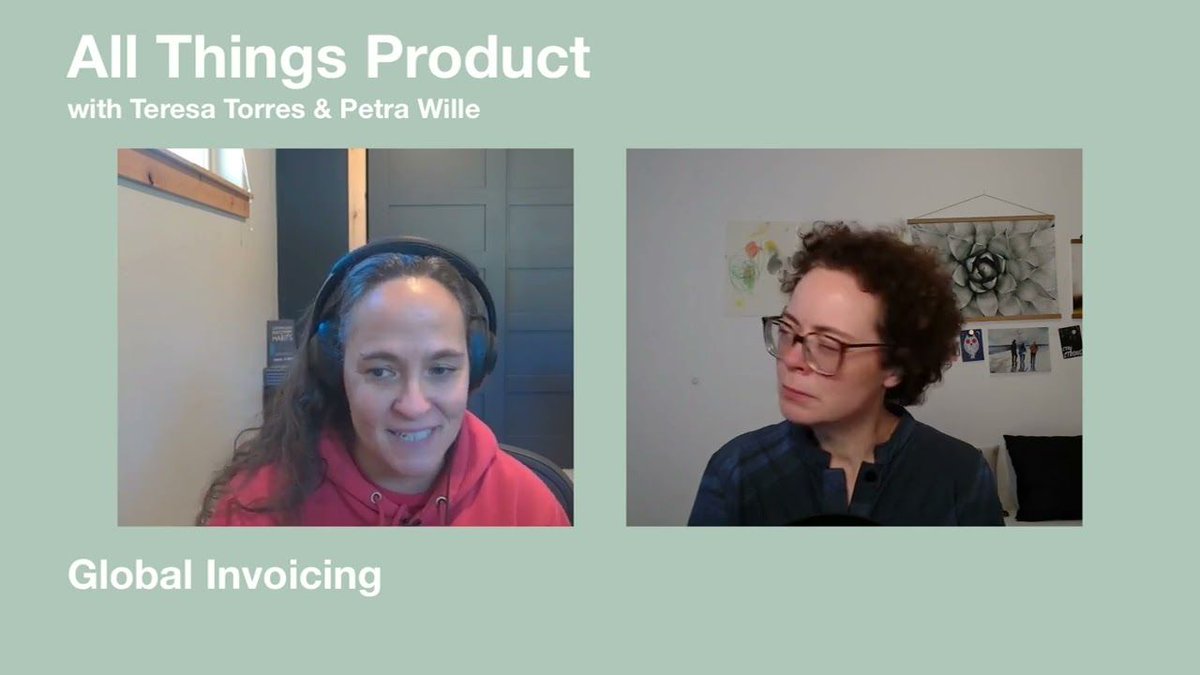
Ever launch a new product feature that seemed solid—until a small, overlooked detail broke everything? In this episode, Teresa Torres and Petra Wille share their real-world experiences wrangling global invoicing and taxes while running small, international businesses.
What starts as a rant about EU tax compliance turns into a sharp product lesson: how failing to map the entire path to customer value—down to the tiniest regulatory requirement—can kill your product’s usefulness.
Whether you’re shipping code or selling courses, this conversation will remind you that sweating the details isn’t about perfectionism—it’s about ensuring your product actually delivers value at the moment that matters.
In this episode:
- The nightmare of global invoicing for small online businesses
- Why even big platforms (like Squarespace and Teachable) miss the mark on EU tax compliance
- How Petra and Teresa navigated invoicing across borders with Ableify and LearnWorlds
- The key difference between meeting regulations and meeting customer needs
- What product teams can learn from regulatory edge cases
- How missing a single detail can block the “moment of value creation”
- Why story mapping is critical for finding gaps between “we shipped it” and “customers got value”
Key takeaways:
- Customers define value, not your compliance checklist.
- Regulatory work still requires discovery—you can’t skip understanding user needs.
- The path to value doesn’t end when your feature works; it ends when your customer succeeds.
- “Sweating the details” isn’t micromanagement—it’s good product management.
Memorable quotes:
“If you don’t sweat the details, people choose other platforms.” — Petra Wille
“It’s not a little detail when your client won’t pay the invoice.” — Teresa Torres
Watch or listen to this episode:
YouTube: https://t.co/WWnmPeT8da
Apple Podcasts: https://t.co/eN2pNWRqyF
Spotify: https://t.co/9wwoOR6jXq
"Discovery doesn't come at the expense of delivery. Both activities should happen in tandem to achieve the best results." 🔄
Explore the 7 most common reasons product teams struggle to make time for discovery:
1. Too focused on delivery activities 📊
2. Excessive stakeholder management 👥
3. Constant cross-team coordination 🤝
4. Overwhelmed by product support tasks 🆘
5. Trapped in endless meetings ⏰
6. Discovery not valued by the organization 🏢
7. Discovery process itself takes too long 🐌
Learn practical tips to overcome these challenges and integrate discovery into your workflow.
Watch the video or read the transcript: https://t.co/LEglJxLKyL
🤔 Which of these reasons resonates most with your team's experience? Share your thoughts in the comments below.
@DanBrownUSA@labsdotgoogle That is a pretty engaging conversation (between two AI personas). Google's #NotebookLM would be really helpful for people who want to learn about topics that haven't been summarized yet.
CapitalOne doesn't offer a chart that shows where I spend my money. Seems weird, because all the purchased are categorized in the transaction list. C'mon @CapitalOne ! You can do better.
@heyandras@mijustin Wow, the breadth of comparability looks huge- many languages/ hosting environments.
What would be the main reason people want this? Controlling costs? (I’ve heard scaling Heroku can get pricey.)
"Make a multiplayer drawing app where the strokes appear on everyone else's screens in realtime. let user pick a name and color. save users to db on login"
2m48s, no bugs:
- users & drawings persist to sqlite
- socket multiplayer
one-shot video (claude 3 opus) demo at end
@jkjenkinney@msabcleek Thank you for producing "Monaea, a 2020 Diary"! I shared a portion of the piece to inspire students about youth podcasting at Bullitt School District's Riverview Opportunity Center (a virtual high school). You rock! https://t.co/FBYGifmsPp
"https://t.co/TYDmZ0LRPX via @TEDTalks "Are you a soldier, prone to defending your viewpoint at all costs -- or a scout, spurred by curiosity? @juliagalef
Calling all podcast-app developers! Please give me your best screenshots of Podcasting 2.0 features displaying in your apps!
(No editing, and device framing is optional.)
NEW: an ideological divide is emerging between young men and women in many countries around the world.
I think this one of the most important social trends unfolding today, and provides the answer to several puzzles.