"The central problem is that Israel has too often and without U.S. approval shared highly classified U.S. national defense information with China. rime Minister Benjamin Netanyahu has been particularly egregious in allowing China ...." https://t.co/MpCdRu4NDP
🚨Breaking: Iranian media: Pakistan handed the United States a version different from the one it received from Iran, and provided Iran with a different version from what it received from Washington.
INDOPACOM bros seeing their critical munitions and interceptors may have been wasted all so a potential precedent of tolls at naval choke points can be established
this is the problem with the US defense industry. They invest millions into some really cool irreplaceable gadget meanwhile the soldier wearing this expensive helmet gets blown up by a soviet artillery shell duct-taped to a DGI or a shahed with a recycled moped engine
Five Eyes was built for another era. We get diminishing value from four partners, and ties with Britain are at a low point. Time to rethink the alliance around those actually delivering intelligence value — Israel, Poland, Ukraine, UAE, Japan, ROK and other serious partners.
CENTCOM told me Shaheds keep eating his KC-135s so I asked how many KC-135s he has and he said he just goes to NORTHCOM and gets a new KC-135 afterwards so I said it sounds like he’s just feeding KC-135s to Shaheds and then INDOPACOM started crying.
Famously (there is a beautiful Works in Progress piece on this) in 2016, Geoffrey Hinton told an audience in Toronto that medical schools should stop training radiologists, since AI would soon outperform them at reading scans. Ten years later, there are more radiologists than ever, and they earn more than they did then.
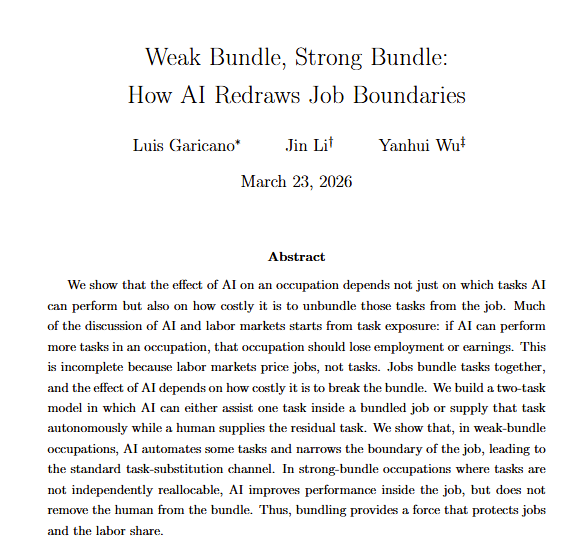
Hinton was right about the task, but he was wrong (so far!) on the future of the radiology profession. Times have never been better for them. The gap between those two claims, the difference between tasks and jobs, is the subject of a paper I have written with Jin Li and Yanhui Wu, and that we release today: "Weak Bundle, Strong Bundle: How AI Redraws Job Boundaries." (Very relatedly we are also finishing the first draft of our book "Messy Jobs" on AI and Jobs!! You will be the first to hear).
We start from the observation that the growing literature on AI and labor markets measures the AI shock by task exposure: people count how many tasks AI can perform in a given occupation AI can perform, and infer that more exposure means more displacement. Eloundou et al. published a paper in Science in 2024 that started this literature, and many follow the same logic. The inference they make is that the more exposed tasks, the worse the outcomes.
This is incomplete, because labor markets price jobs, not tasks. A radiologist does not just sell image classification, but does many other jobs: triages cases, communicates with other physicians, trains residents, makes the difficult decisions, and signs a diagnosis. The market buys a bundled service. The question AI poses is not whether it can do one task inside the bundle. The question is whether that task can be pulled out.
Thread (1/3)
https://t.co/wEYMfjGbeX
When you start reading the word "Jones act" get up and go fill up your car right then. Take your gas can too. As soon as you hear it on TV or see it in print.
Donald Trump: This war is about spreading freedom to Iran.
JD Vance: This war is about destroying Iran's nuclear program.
Marco Rubio: Well, you see, this all goes back to something John Mearsheimer and Stephen Walt observed in their 2007 book...