SecDef Pete Hegseth tried to erode human rights norms by live-streaming a death by firing squad. Instead he eroded his own credibility and show-cased the power of international rules against public executions. Read my take here: https://t.co/K9OSezSpbv
My student-faculty team at @SBS_UMass@umasspolsci@HSecurityLab has done some pathbreaking work on the strength of the cluster munitions treaty of late. Excited to see this work in print soon https://t.co/7Njsckbwpd
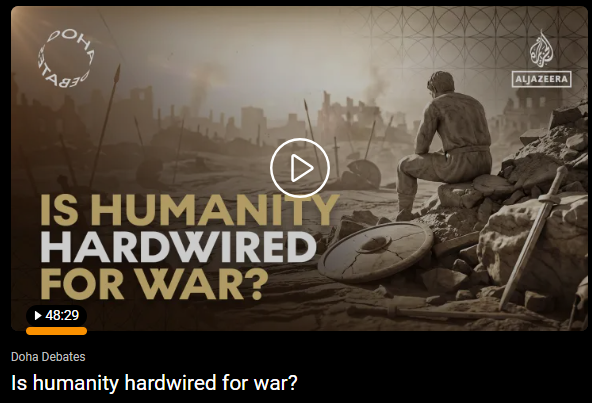
It's always great to explore new perspectives. I shared why I'm still optimistic about the power of international law, despite how it often gets violated, with @DohaDebates. What’s your take?
This week's episode of the Doha Debates Podcast asks: What’s left of international law?
Featuring @charlicarpenter, Victor Gao,@rajonlaw and @curtis_yarvin.
00:00 Does international law still matter?
05:32 How has international law evolved over time?
10:57 How does the UN charter aim to prevent another world war?
19:44 Is international law effective in lower-level conflicts?
30:03 Who is challenging the 1945 international order?
59:20 How deep are international law's colonial roots?
01:07:06 Can international law help solve modern global crises?
01:17:13 Cultural imperialism examined
01:43:19 Analyzing Trump's “Board of Peace” and forms of imperialism
01:57:51 Power vs. justice in conflict
02:06:39 Natural law vs. positive law
02:21:34 Is international law an unfinished project for the next generation?
The first reported battlefield deaths caused by autonomous weapons could give new momentum to a long-stalled effort to ban killer robots, @charlicarpenter writes.
https://t.co/B0mH9Pn5iT
Even while under attack by Israel, Lebanon just signed onto the Landmine Ban Treaty foreswearing the use of these indiscriminate weapons of war. In my @WPReview column this week (and at a great workshop with @Article36 @minefreeworld & @LexIntl_org last week) I explain why that matters, and why the rules of war are surviving and thriving despite the lawlessness of great power politics.
https://t.co/sa8Vyx9u2G
My somewhat more optimistic take on the @UN#NPT Review Conference is out at @WPReview. Champions of the @nuclearban and of peaceful nuclear use may in fact take heart https://t.co/sFQ5gSalCR
Joined the @DohaDebates team this week to chat about the future of international law w/ Chinese foreign policy commentator @VictorGaoZK, UN Special Rapporteur BeloKrishnan Rajagopal and American influencer @curtis_yarvin. Great convos, fascinating thinkers. My thoughts here @WPReview.
https://t.co/yuMkUdnDWd
It was a great honor to meet @TylerPrize laureate @KiersToby at the award gala. At @WPReview, I write about Kiers' fungi research & pathbreaking advocacy - and show how symbioses among social & natural sciences can spur global governance for hidden issues. https://t.co/0cvHTOE17L
This "Future of War" @DohaDebates roundtable, in which I participated, was recorded last November - still relevant?
Give it a listen and tell me what you think:
https://t.co/uCMULZD2Bm
@KiersToby ' keynote speech at the @TylerPrize award ceremony is online now and it's incredible - a light-show of her network data on mychorrhizal fungi. Check it out - what an inspiring speaker, scientist and issue entrepreneur. Am writing my column today about Kiers' vision for global governance of the underground. https://t.co/0hlNNl1LpM
Trump's latest tweet which appears to call not just for war crimes but for all out genocide against the entire Iranian people. Anyone in a position to participate in such crimes should refuse. Here's why and how: please share widely.
https://t.co/qTTVHPfbL7
Iran’s use of cluster munitions against Israel looks like evidence of international law’s irrelevance.
But as WPR columnist @charlicarpenter writes, a closer look suggests the opposite may be true.
https://t.co/MDJH00mqkA