Polémico punto de vista del IPO de SpaceX:
"Use a privately controlled entity as a personal piggy bank, and when the bills come due, find new investors to absorb the losses.
The IPO is structured to keep that game going FOREVER."
This is the most OUTRAGEOUS deal I've seen in my 45 years on Wall Street.
SpaceX just disclosed Musk's new compensation package:
He gets up to 200 million super-voting shares if SpaceX hits a $7.5 trillion valuation, establishes a permanent human settlement of at least ONE MILLION people on Mars, and deploys roughly 100 terawatts of space-based computing power.
Let me put the 100 terawatts in perspective:
The entire electricity generation capacity of the United States is around 1.2 terawatts. The comp plan asks Musk to build more than 80x America's entire power grid... in orbit.
This is a science fiction screenplay that somehow landed in front of the SEC.
But here's why it actually matters for your portfolio...
The S-1 reportedly claims a $28.5 trillion total addressable market, with over 90 percent attributed to AI. CapeFearAdvisors flagged this one cleanly: when Palantir went public, it disclosed a $119 billion TAM and the SEC reviewed and accepted it.
SpaceX is claiming a market roughly 240x BIGGER.
Now let's talk about what is actually being sold here:
Reported 2025 revenue is approximately $15.5 billion. Starlink delivers around $11 billion of that with healthy margins, and the launch business is genuinely dominant. The problem is xAI - the AI piece doing all the heavy lifting in the trillion-dollar valuation pitch.
xAI generated just $210 million of revenue in the first 3 quarters of 2025 while burning through $9.5 billion in cash.
Ben Brey and Rupert Mitchell - a former Fidelity portfolio manager and a former head of equity capital markets at Goldman and Citi between them - ran a serious discounted cash flow on the actual operating businesses and arrived at roughly $400 billion. Lawrence Fossi covered their work recently and the math holds up.
The IPO is being marketed at $1.75 TRILLION.
The gap between what these businesses support and what Musk is asking the public to pay is roughly $1.35 trillion of pure narrative.
Then layer on what we just learned last week...
The New York Times investigation revealed Musk personally borrowed $500 million from SpaceX between 2018 and 2020 at rates as low as 1%, while bank prime rates sat around 5%. The same SpaceX has been used to bail out SolarCity, prop up Tesla during cash crunches, and absorb xAI when the AI losses became unmanageable.
This is the same playbook he's run for two decades.
Use a privately controlled entity as a personal piggy bank, and when the bills come due, find new investors to absorb the losses.
The IPO is structured to keep that game going FOREVER.
The Texas reincorporation strips away Delaware's fiduciary protections. Controlled-company status on the Nasdaq eliminates independent board requirements. And retail is being offered up to 30% of the offering (3x the normal allocation) because the institutions who actually do the math are quietly stepping away.
Here is the part that finishes the case for me:
Roughly $40 billion of the IPO proceeds are already spoken for before a single dollar reaches operations. About $23 billion retires SpaceX debt. Another $17 billion retires the high-interest debt sitting on xAI and X.
This raise is not funding the future. It's just plugging existing holes that retail investors will now own.
In my 45 years I've never seen a deal where the comp hurdle is colonizing another planet.
I've never seen a disclosed TAM that exceeds verified comparables by two orders of magnitude.
I've never seen a company asking the public to fund the retirement of debt incurred by separate private entities controlled by the same individual.
Every red flag I've watched precede a major bust over four decades is sitting in this prospectus, in plain sight.
The Tesla mispricing is being repeated on a far larger scale.
And this time the bag is being handed directly to retail.
Don't be the one holding it.
La izquierda cuando pierde una elección busca incendiar el país.
Lo hicieron en Chile, lo intentaron hacer en Argentina y el presidente Milei los frenó en seco.
Hoy lo hacen en Bolivia. Mano dura contra esos delincuentes.
"#China is restricting overseas travel for top AI professionals in private firms such as Alibaba & DeepSeek, an escalation intended to safeguard technology & catch up to the US. Govt agencies have begun imposing restrictions on individuals involved in advanced AI work...meaning they need approval from authorities before embarking on overseas travel"
https://t.co/9hzEX5TAL7
$META bears say $125 billion AI capex could be the mistake of the decade.
Meanwhile Zuckerberg: "Underspending and losing the AI race is a bigger risk than overspending and losing some money."
Simple.
He estado consultando porque tenía dudas.
Los pilotos están OBLIGADOS a visitar el corralito pero no tienen por qué atender a todas las televisiones allí presentes.
Voy más allá, y cito lo que me dice una persona de prensa del paddock: “Si el piloto tiene algún problema con algún ‘broadcaster’ o con alguna televisión en concreto, puede no hablar con ellos”.
Yo creía que habría multa en ese caso pero parece que no.
🚨 ZONA GEOGRÁFICA: EL INTERIOR SIGUE MOSTRANDO LA MAYOR CONFIANZA EN EL GOBIERNO
🔹 El Interior volvió a registrar el mayor nivel de confianza en el Gobierno: 2,17 puntos, aunque con una baja mensual de 2,3%
🔹 En la Ciudad de Buenos Aires (CABA), el ICG subió 2,1% y alcanzó 1,91 puntos
🔹 El Gran Buenos Aires (GBA) volvió a mostrar el nivel más bajo: 1,65 puntos, con una caída de 1,2% respecto de abril
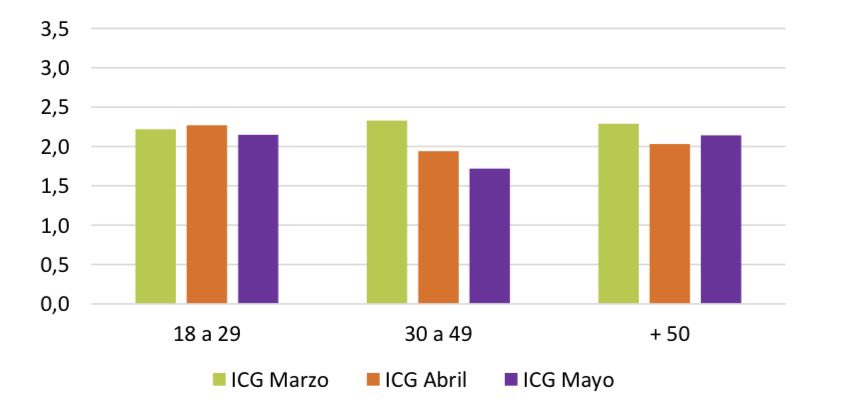
🚨 EDADES: LA MAYOR CAÍDA DE CONFIANZA SE DIO ENTRE 30 Y 49 AÑOS
🔹 El ICG cayó 11,3% entre las personas de 30 a 49 años y quedó en 1,72 puntos.
🔹 Entre los jóvenes de 18 a 29 años, el indicador bajó 5,3% hasta 2,15 puntos.
🔹 En mayores de 50 años, en cambio, el ICG subió 5,4% y alcanzó 2,14 puntos.
🔹 El segmento de 30 a 49 años fue el único que mostró dos caídas consecutivas.
🚨🚨🚨 SEXTA CAÍDA CONSECUTIVA DEL ÍNDICE DE CONFIANZA EN EL GOBIERNO: -1,6% EN MAYO
🔹 El Índice de Confianza en el Gobierno (ICG) de la Universidad Di Tella cayó 1,6% en mayo y se ubicó en 1,99 puntos.
🔹 En términos interanuales, el desplome fue de 18,7%, mientras que la caída acumulada desde diciembre ya llega al 19,2%.
🔹 Se trata de la sexta baja consecutiva del indicador: diciembre (-0,1%), enero (-2,8%), febrero (-0,6%), marzo (-3,5%), abril (-12,1%) y mayo (-1,6%).
🔹 El promedio de la gestión Milei bajó a 2,41 puntos, el menor nivel desde el inicio del mandato.
🔹 El componente “Capacidad para resolver los problemas del país” cayó a 2,36 puntos y marcó un nuevo mínimo de la gestión.
🔹 También tocaron mínimos de 2026 los componentes de “Honestidad” y “Preocupación por el interés general”.
🔹 El ICG sigue en niveles similares a los de Mauricio Macri y Néstor Kirchner a esta altura de sus mandatos, pero por encima de Cristina Kirchner y Alberto Fernández.
🔹 Las mayores caídas del mes se registraron entre mujeres, personas de 30 a 49 años y sectores con menor nivel educativo.
Fuente: @UTDT_Gobierno