Postdoctoral Fellow reconstructing North Atlantic oceanography and climate @UCLgeography University College London | Lover of SST proxies and geochemistry
🚨New paper🚨 out in @frontiers by our team at @UCLgeography
➡️North Atlantic foraminiferal records show that 20th century shifts in deep-sea ecosystems are often exceptional compared to the prior several thousand years
https://t.co/F6IQT4P0rA
Plankton shells provide the key to determining how consistent the Earth's 'engine' for distributing ocean heat has been over the past 95 million years, finds a new @UCLgeography@UCLSocHistSci#climate study with @Yale co-authored by Dr @charlyob https://t.co/FxpxHzDF0M
@ICTA_UAB 😥😥 Toni was so warm, friendly, encouraging and supportive whenever I bumped into him at conferences. I remember first getting to know him when me and @david_naafs travelled with him back to Amsterdam Schiphol after the 2014 GDGT meeting on Texel. I’ll remember him fondly.
🚨New paper🚨 out in @frontiers by our team at @UCLgeography
➡️North Atlantic foraminiferal records show that 20th century shifts in deep-sea ecosystems are often exceptional compared to the prior several thousand years
https://t.co/F6IQT4P0rA
Acknowledged #InternationalWomensDay by catching up with the @UCLgeography Women in Physical Geography group, attended a discussion panel re. ‘Can women have a successful scientific career while having kids?’ and now watching Picture a Scientist. Busy & thoughtful day.
A petrified forest on the Greek island of Lesbos contains a rare example of a fossilised tree with its branches still attached, and may even have been visited by Aristotle, says Professor Chronis Tzedakis @UCLgeography @UCL_AHSHS https://t.co/ZKeO4TD2vF
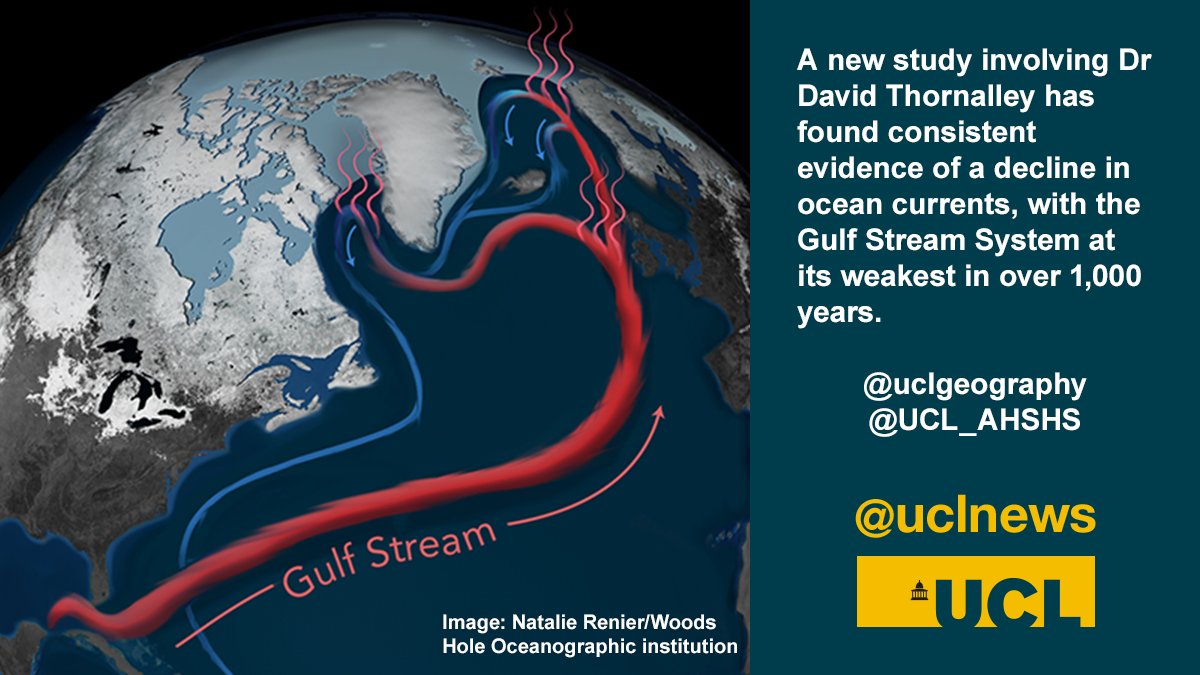
The slowdown of the Earth’s Gulf Stream since the mid-20th century is unprecedented - and is likely linked to human-induced climate change, finds a new study involving Dr David Thornalley @UCLgeography @UCL_AHSHS and @PIK_climate#ClimateUCL https://t.co/nJx6Uz7Yxf
@david_naafs@Kate_Littler UCL yday: 'under the latest Gov. guidance, University staff are considered critical workers and are therefore eligible to send their children to school as usual. This is because we are being asked to keep universities open, and to continue to deliver learning (even if remotely).'
Reconstructed sea surface temperatures and climate modeling suggest that the Oligocene climate was warm, with relatively low atmospheric CO2 and a highly dynamic Antarctic ice sheet. In PNAS: https://t.co/dm3O6OSkvE