▫️Quantum threat to bitcoin seen as social challenge
▪️Grayscale’s head of research, Zach Pandl, suggested that the real risk posed by quantum computing to Bitcoin is more social than technical. He noted that the network remains...
Read full post here: https://t.co/aSUrjHOGty
@sertexityinc Interesting angle if quantum risk is more social than technical, then Bitcoin’s real test will be coordination, not code. The tech can evolve, but will the community move fast enough when it matters?
@sertexity RWA is quickly becoming one of crypto’s strongest narratives rising volume, growing holders, and capital concentration in key projects signal real traction beyond speculation.
▫️RWA market activity surges in March
▪️Activity in the real-world assets (RWA) segment выросла на 80% over the past month, with total volume reaching a record $2.87 billion by the end of March. This growth reflects increasing interest in tokenized real-world assets within the crypto ecosystem.
▪️The total value of RWA securities rose to $942 million (+2.65%), while the number of holders exceeded 200,000 (+16%). Most of the segment’s assets are concentrated in the Ondo project with $560.9 million, followed by xStocks at $243.5 million and Securitize at $58.4 million.
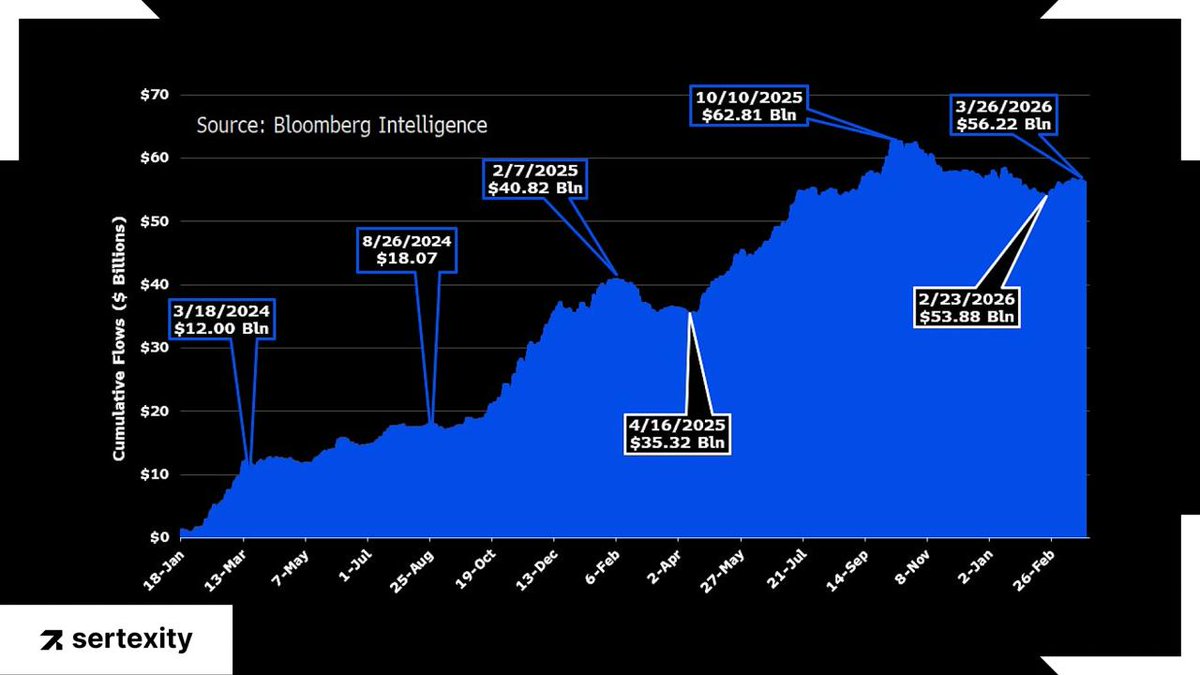
📍Bitcoin ETFs recover part of losses
▪️Since the end of February, spot Bitcoin ETFs regained nearly $3 billion from $9 billion outflow that followed the market crash on October 11. This recovery suggests that investor interest is returning...
Read here: https://t.co/9USfrue1f5
@sertexity Pure efficiency play
Arbitrage isn’t about guessing direction it’s about capturing mispricing across markets. Small gaps, consistent profits if executed well
📍What Is Cryptocurrency Arbitrage?
▪️Сryptocurrency arbitrage is a strategy that exploits price discrepancies of the same asset across different markets or trading pairs. unlike speculative trading, arbitrage does not attempt to predict market movements - instead, it capitalizes on temporary inefficiencies in pricing.
▪️In the crypto market, the same asset may trade at slightly different prices on different exchanges, or across various trading pairs within a single exchange. These discrepancies arise from differences in liquidity, demand, quote update speeds, and participant composition. An arbitrage system buys the asset where it is temporarily undervalued and sells it where it is overvalued, capturing the price difference as profit, net of fees and slippage.