💰 Africa holds several trillion dollars of savings accumulated on the continent. And yet the African risk premium continues to be priced at more than 150 basis points above countries displaying strictly comparable fundamentals elsewhere in the world.
It was through that paradox that Dr Sidi Ould Tah, ninth President of the African Development Bank, opened his intervention at the Africa CEO Forum Annual Summit in Kigali.
📊 His diagnosis rests on three observations. First, the pricing of African risk is objectively unfair. Second, the continent does not suffer from a shortage of capital, its natural, human and financial resources match the level of its stated ambitions. Third, those potentialities remain largely untapped not for want of attractiveness, but for want of architecture.
🧱 Three links are still missing for those resources to translate into productive investment.
1/ The fragmentation of markets and institutions calls for a determined push towards consolidation.
2/ The harmonisation of regulations across countries and financial institutions remains unfinished business, indispensable to fluidify intra-African capital flows and lift standards to international benchmarks.
3/ Arguably the most strategic piece, the continent must build its own intermediation layer. International investors do not invest in projects, they invest in instruments. It is precisely that financial engineering that is currently lacking.
🏛️ This is the very logic of the New African Financial Architecture (NAFA), championed by the African Development Bank Group and now backed by a continental mandate. Not a new institution, but a framework for bringing Africa's existing financial institutions into coherent alignment, anchored in four founding principles: subsidiarity, complementarity, coordination and risk transformation.
🇷🇼 The message sent from Kigali could not be clearer. Africa's financial sovereignty will not be decreed, it will be built brick by brick, drawing on African resources, mobilised by African institutions, and channelled into African projects.
#ACF2026 #AfricaCEOForum
China is replacing Australian iron ore with Guinean ore, as it builds a railway in Guinea to transport iron ore from the Simandou mine, opening the door to importing high-quality African iron ore as a major alternative to Australia.
A strategic move to strengthen resource security and diversify supply chains.
BREAKING: Anthropic just released a study showing which jobs its own AI is already replacing—right now.
And the workers most at risk aren’t who anyone expected: they’re older, more educated, and higher paid. They earn 47% more than average—and they’re nearly four times more likely to hold a graduate degree than workers AI isn’t touching.
The case is simple. Anthropic built a new metric called “observed exposure”—not what AI might do in theory, but what it’s actually doing today on the job—measured across millions of real Claude conversations from enterprise users.
For computer and math workers, AI could theoretically handle 94% of their tasks. Today, it’s doing 33%. In office and administrative roles, the ceiling is 90%, and current usage is 40%. The gap between what AI can do and what it’s actually doing is massive—and the researchers don’t mince words about what happens next: as capability improves and adoption spreads, the red area expands until it swallows the blue.
What makes the paper unsettling is the demographic twist. The most AI-exposed workers earn 47% more, on average, than the least exposed. They’re more likely to be women. More likely to be college educated. This isn’t a story about warehouse floors or long-haul routes. It’s about lawyers, financial analysts, market researchers, and software developers—the very people who were told their education would protect them.
Computer programmers show the highest measured AI exposure: 74.5%. Customer service reps: 70.1%. Data entry: 67.1%. Medical records: 66.7%. Marketing and market research: 64.8%. These aren’t forecasts. They’re measurements of work already being done on AI platforms today.
Then there’s the pipeline problem—still not getting nearly enough attention.
Anthropic researchers found a 14% drop in the job‑finding rate for 22–25‑year‑olds in highly exposed occupations since ChatGPT launched. No comparable effect for workers over 25. Entry-level roles were never “just jobs.” They were the apprenticeship layer: where junior analysts became senior analysts, where junior lawyers learned how arguments actually
PDF: https://t.co/tnk5Ri7CoP
Aliko Dangote: I applaud President Museveni for his bold decision to ban the export of unprocessed minerals. I also want to commit to the two presidents here that, with their support for the refinery, we will build a similar one in East Africa like the one we have in Nigeria.
DANS QUELQUES INSTANT : Lancement du rapport 2026 sur les Performances et perspectives macroéconomiques de l’Afrique (MEO) du @Groupe_AfDB.
Plus d’informations sur #AfricaMEO2026 : https://t.co/elCMkLgu71
🔴Embrasement dans le Golfe : les 24 heures qui font basculer la guerre ? Pour la première fois depuis le début du conflit, l’Iran a frappé le plus important site de gaz naturel liquéfié du monde au Qatar, provoquant des dommages considérables. Va-t-on vers un basculement dans une guerre énergétique totale ? #JT20h
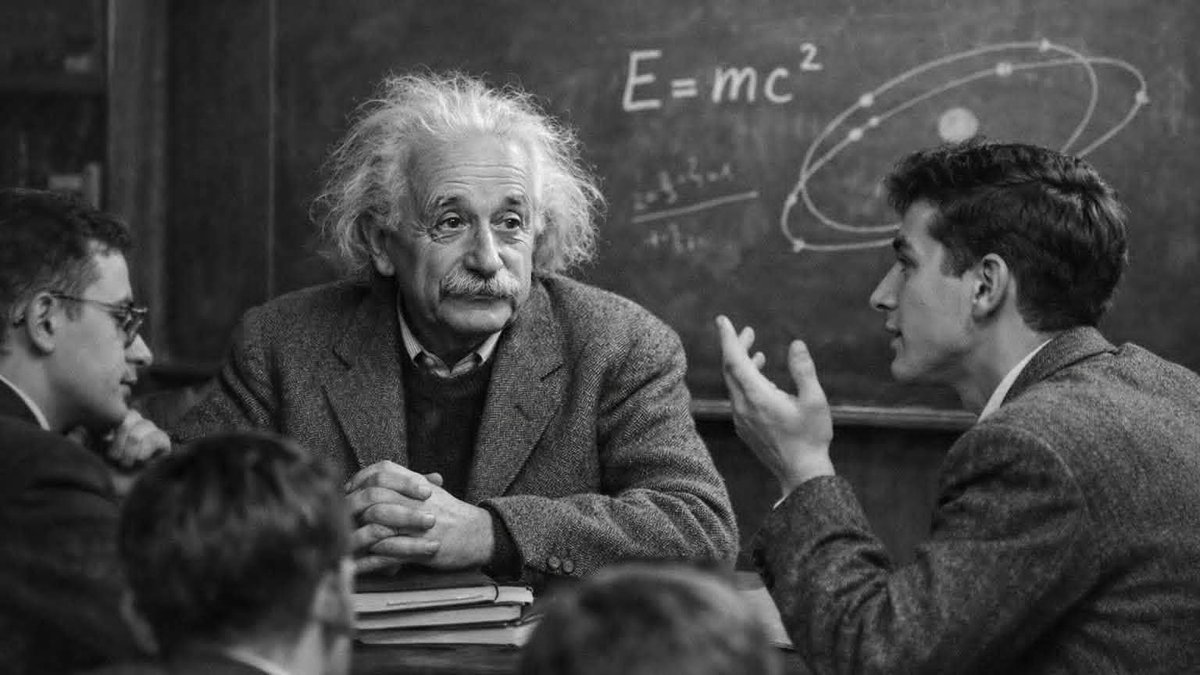
L’un des étudiants d’Einstein lui demanda :
« Que signifie la logique ? »
Einstein répondit :
« Je vais te répondre par une question. »
« Supposons que deux ouvriers entrent dans une cheminée pour la nettoyer. L’un en sort avec le visage sale et l’autre avec le visage propre. Lequel des deux ira se laver le visage ? »
L’étudiant répondit immédiatement, sans hésiter :
« Bien sûr, celui qui a le visage sale. »
Einstein dit :
« Ta réponse est incorrecte. Celui qui ira se laver le visage est celui qui a le visage propre, car il a regardé le visage de son collègue et a supposé que le sien était tout aussi sale. Celui qui a le visage sale, en voyant le visage propre de l’autre, pensera que le sien est propre et n’ira donc pas se laver. »
L’étudiant dit :
« C’est juste et logique. »
Einstein répondit :
« Non, ce n’est pas correct, car la question elle-même est illogique. Il n’est pas logique que deux hommes entrent en même temps dans la même cheminée et que l’un en sorte propre tandis que l’autre en sorte sale. »
En quelques mots, la logique elle-même peut s’effondrer : parfois, le problème ne vient pas de la réponse, mais de la question mal posée.
We've signed an MOU with the Government of Rwanda—the first partnership of its kind in Africa—to bring AI to health, education, and other public sectors.
Read more: https://t.co/txgEScvKtP
🎤 Mohammed Qahtani, a Saudi engineer, delivered one of the most impactful speeches ever, winning the Toastmasters World Championship. He showcased the strength found in words...
🎤 Mohammed Qahtani, a Saudi engineer, delivered one of the most impactful speeches ever, winning the Toastmasters World Championship. He showcased the strength found in words...
Unlocking Nature's Secrets: Bio-Inspired Sensors for a Healthier Future
Imagine rats sniffing out tuberculosis in seconds, or bears detecting scents miles away—these aren't just animal tricks; they're blueprints for revolutionizing medicine. By reverse-engineering volatile organic compounds (VOCs) like methyl nicotinate that signal diseases, we can build sensors detecting TB, cancer, and more from a single sweat drop. Peer-reviewed studies in PLOS ONE show rats achieve 81-88% sensitivity; scaling this with AI could push accuracy higher.
elonmusk, let's fund this: It saves lives by catching illnesses early, cuts healthcare costs, and deepens our grasp of biology's role in the cosmos. Nature has perfected it—time we do too.