excited to share what i've been up to lately.
most ai training is generic and frankly just checks a box. i heard over and over that it isn't helpful because it's not grounded in anyone's day-to-day. to top it off most trainings don't even use the methods they teach.
this is causing people to fall behind. no one's showing them how to use ai in a way that connects it to their work.
meanwhile, the people it's clicked for are lapping everyone else.
i built chasing next to help everyone have that aha moment. the whole goal is to learn ai by doing, with personalized lessons that show you how to get the most out of ai in your work. you walk away creating tools that help you and start spotting larger opportunities because you see how ai fits.
i understand ai (i'm in the tools every day) and i understand corporate (spent 10+ years on marketing teams).
this approach works. i ran a pilot for a fortune 500 marketing team where they built tools and their confidence moved. they even came together as a team to work on bigger opportunities.
this is just the start for chasing next. i'm updating the site daily with the latest ai platform releases. you can request interactive lessons on what you want to learn.
i also customize interactive and measured programs for teams, happy to chat.
come learn ai by doing. sign up below.
In the last 6 months at @Ahrefs, we analyzed over 1 billion data points across 14 studies. Here's what we learned about AI search optimization:
1) "Best X" blog listicles are the single most prominent content format cited by AI chatbots. They make up 43.8% of all page types cited by ChatGPT specifically.
2) 67% of ChatGPT's top 1,000 citations come from sources marketers can't influence: Wikipedia (29.7%), homepages (23.8%), app stores (6.6%). Only 32.3% are influenceable content like educational pages, reviews, news, and blog posts.
3) 28.3% of ChatGPT's most-cited pages have zero Google organic visibility. These pages get cited repeatedly by ChatGPT despite not ranking in Google at all. A completely separate discovery layer.
4) ChatGPT only cites about 50% of the URLs it retrieves. It fetches dozens of pages per query but uses half as background context without attribution. This means that being retrieved and being cited are very different things.
5) Adding schema markup had zero meaningful impact on AI citations. AI Overviews actually dipped −4.6%, while AI Mode (+2.4%) and ChatGPT (+2.2%) showed changes indistinguishable from zero.
6) YouTube mentions have the highest correlation (0.737) with AI brand visibility out of all the factors we studied (including all the conventional SEO metrics like backlinks, page count, DR, etc). This held true for both Google-owned and OpenAI products.
7) AI Overviews reduce clicks to the #1 result by 58%. That’s up from 34.5% just 10 months earlier. The trend is accelerating.
8) 99.9% of AI Overviews appear on informational intent queries. Transactional, navigational, and local searches are almost entirely AIO-free. Shopping triggers AIOs just 3.2% of the time.
9) For a given search query, Google’s AI Mode and AI Overviews reach the same conclusions 86% of the time — but cite almost entirely different sources (only 13.7% citation overlap).
10) AI Overviews change every 2.15 days on average, with 70% of content differing between consecutive observations. But semantic similarity stays at 0.95. The words, sources, and entities constantly shuffle, but the actual meaning barely moves.
here's my take on how ai will impact marketing jobs:
if the work is measurable or volume based, ai will take it over. things like real-time optimization, performance analysis, creative iteration, and pulling out signals from research are at risk. they can all be done quicker, at greater volume, and cheaper by ai.
the stuff that isn't as black and white will be what people continue to own. this is primarily strategic work, process design, program management, taste and judgement calls. this is where the soul and personality of a company lives. still with people. their decisions will steer the measured stuff that ai executes and oversee the bigger direction an org is moving.
my recommendation is two-fold:
1. be part of the team shifting work towards automation
it's easy to resist this because it feels like youre automating your job, but it's naive to think the stuff ai can do better wont migrate that way in time. my bet is companies will value the people who helped set up these new systems over those who passively watched the transformation happen.
2. get closer to the strategy side of your work
if you do #1, you'll naturally start moving in this direction. have a voice and make a point to show value in intangibles: where the company should be headed, taste, judgement calls, and big picture thinking ai struggles with paired with your expertise.
as for the argument that ai isn't replacing work, but expanding it: true to an extent. the new opportunity will only reach people in areas ai doesn't excel at. as ai takes more operational work, the strategic work will continue to grow.
a lot of personal agent set ups seem like they produce the equivalent of a sloppy employee to look after.
setting up routines, scheduled tasks, or chron jobs can get you far without the headache of unpredictability, steering, token burn and oversight.
lots of talk about geo being a traffic opportunity for small businesses, but its a trap in established markets.
ai results are heavily based on search ranking, so you still have to play by old seo rules to break through.
yes, there are little geo pockets that may be untapped like setup, faqs, and niche long-tail question searches (i've done this), but a quicker win is leaning into reddit.
it's become my #1 traffic driver because it's not rigged by who's been around longest.
here's what i do:
1. find communities where my audience hangs out
2. follow the rules and read the sub before i post
3. lead with value heavily in posts
4. link subtly at the end of posts to give more value if allowed (additional info, images, a free resource, etc.)
you can slip into seo rankings much easier with reddit's credibility and existing search demand.
best part is that you only need a few articles that hit to get sustained traffic to your site.
lots of new vibecoded projects up on @vibecuterie
see them live, learn how they were made, and vote which have taste.
→ vibecuterie .com ←
happy tasting!
@Nicolascole77 simple one - but tactiq to capture meeting transcripts, then pairing it with with claude code for processing in the context of your business and goals is a huge W.
@bentossell nailed it. not there yet, but this feels like a precursor to lower staffing needs once tech is implemented. it'll also force teams to figure it out.
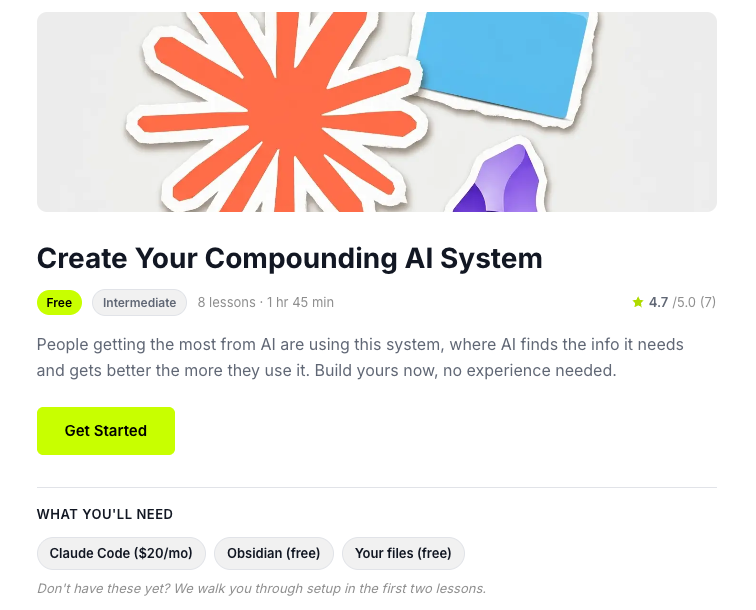
want to run claude + obsidian but dont know where to start? this is for you.
walks through set up, structure, & processes to create an ai system that gets better the more you use it.
get the setup top ai users have, interactive & personalized.
free. link below ↓
@TTrimoreau grit. you have to research, iterate, network, learn to ride highs and lows and push through discomfort.
building is instant and rewarding, but getting people to use your thing is still slow and hard.