Back to Canada after years expatriated; learning the system
Macro Econ buff
I'll speak my mind and feedback is welcome.. seems to me the fastest way to learn!
John F. Kennedy could not do one sit-up on the day he became the most powerful man on earth, and the corset his doctors kept him in is why the bullet that killed him found its mark.
He had been in pain since Harvard. In 1954 surgeons bolted a metal plate to his spine. The wound went septic and a priest was called to give him the last rites. A second operation took the plate back out. After that came the anaesthetic needles, sometimes several a day, a rocking chair, crutches kept out of the photographs, and a stiff canvas corset he laced on every morning like a second shirt.
That was the settled treatment for a bad back. Cut it, numb it, strap it up and keep it still.
In October 1961 an Austrian called Hans Kraus was shown into the White House. Kraus was a rock climber who had mended his own fractures by moving them, and he examined the President the way he would a recruit. Kennedy could not sit up from the floor. Asked to touch his toes, he could not reach his knees. The most photographed torso in America had been rested for 20 years and there was very little of it left.
Kraus told him the back was weak, and that weak things are loaded until they are strong. He gave him exercises and then weights, in the little gym beside the White House pool, and said he would walk out if the needles carried on.
It worked almost at once. Within a year Kennedy was picking up his children, which he had not been able to do, and playing golf again. Kraus's notes, handed to the Kennedy Library by his widow in 2006, record a lifelong complaint that was very nearly gone by the autumn of 1963.
The corset was the one thing Kraus could not get off him. He told the President he no longer needed it. Kennedy kept lacing it on.
He was wearing it in the open car in Dallas on 22 November. The first bullet went through the base of his neck. A man with nothing round his middle folds forward at that point, down below the line of the seat. Kennedy stayed bolt upright, held there by canvas and laces, with his head exactly where it had been.
His back was the strongest it had been in 20 years, and he died sitting up straight in the last piece of the old treatment.
𝗜𝗡𝗦𝗜𝗗𝗘𝗥 𝗕𝗢𝗠𝗕𝗦𝗛𝗘𝗟𝗟 🚨🇮🇱
Ex-Israeli soldiers and intelligence officers BROKE THEIR SILENCE, describing an ICE-COLD SYSTEM where strikes were calculated to kill as many people as possible in Gaza.
Their testimony is now a film at the Venice Film Festival.
i never knew there was an actual term for this:
epistemic loneliness is a cognitive form of isolation that happens when you cannot share complex ideas, inner thoughts, or meaningful perspectives because you lack a willing, able, or understanding conversational partner.
Nassim Taleb, hedge fund manager who lost money three years straight, 8.39%, 13.81%, 3.92%, right before the strategy would have paid off 3,600%:
"We will not lose everything overnight. We will slowly bleed to death."
That is what Taleb told his own traders. This is the Kelly problem inverted. The position was sized correctly. The capital simply was not his to keep sizing with.
Empirica bought deep out-of-the-money options, betting on the kind of extreme event nobody prices correctly. In 2000, that bet paid 56.86 percent while the dot-com crash destroyed everyone else. Then came 2001: negative 8.39 percent. 2002: negative 13.81 percent. 2003: negative 3.92 percent. Three years of small, steady losses, exactly as the strategy was designed to produce. Assets under management peaked near $375 million, then investors started pulling out during the bleed, unable to distinguish a correctly sized position from a failing one.
By 2005, Empirica wound down. Taleb stepped away.
Same point as my article: sizing determines whether you survive long enough for the edge to pay off, but sizing assumes the capital stays put. Taleb's own money could absorb the bleed. His investors' money could not, because their patience was never part of the Kelly calculation. The formula sizes your position. It does not size your client's nerve.
Here is the trap. Three years after Empirica closed, in 2008, the exact kind of extreme event the strategy was built for arrived. Investors who left in 2002 and 2003 to avoid the small losses missed the payoff entirely. The fund that eventually captured it, Universa, launched in 2007, one year before the crash it was positioned for.
The lecture is free, on Cambridge's own channel, where Taleb explains exactly why average outcomes and single-path outcomes are not the same number. Almost nobody watching it changes how long they are willing to hold a losing position that was never actually losing.
Ten million people have watched an MIT professor accidentally destroy the executive coaching industry.
He filmed the lecture once in January 2018 and died eighteen months later.
Executive coaches charge fifteen thousand dollars a session to teach a third of what he covered in one hour for free.
His name was Patrick Winston. He ran the MIT Artificial Intelligence Laboratory from 1972 to 1997 and wrote the AI textbook every computer science major in the world read for thirty years.
Every January for four decades, he gave a lecture called "How to Speak."
His entire framework fits on a napkin.
Do not read. Be in the image. Keep images simple. Eliminate clutter. Start with an empathetic connection. End with a punch line the audience can repeat over dinner. Never open with a joke. Never end with "thank you."
That last rule alone has probably cost the executive coaching industry a hundred million dollars.
"Your success in life will be determined largely by your ability to speak, your ability to write, and the quality of your ideas. In that order."
That is the actual opening line of the lecture. Winston believed it strongly enough to spend fifty years teaching computer scientists how to talk.
Founders spend $80,000 on an MBA and then hire a communications coach to teach them the same material Winston filmed once for free. Engineers write brilliant code and lose promotions to teammates who watched this lecture on the train.
The lecture is free on MIT OpenCourseWare. The textbook is free on his page.
Winston died in 2019. Almost none of the ten million viewers have actually implemented the four rules on the napkin.
The napkin is free. The willingness to actually use it in your next meeting is the entire edge.
THE COBRA EFFECT 🐍
During the British Raj, officials grew concerned about the rising number of venomous cobras in Delhi. To tackle the issue, they introduced a bounty for every dead snake.
At first, the policy seemed successful, many cobras were killed.
لماذا نحب إسبانيا؟
لأنها لا تكتفي بلعب كرة القدم، بل تتقن فن احترام المنافس. تمريراتها تشبه قصيدة، وأهدافها تبدو كأنها نهاية منطقية لحكاية جميلة.
ثم جاء الموقف الإسباني ليقترب من الرؤية الخليجية الداعية إلى حل السلام والعدل، والرافضة للاعتداء على المدنيين العزل في أرض الرباط، فازداد احترام الناس لإسبانيا خارج الملعب كما احترموها داخله.
مبروك لإسبانيا على كأس العالم للمرة الثانية… فالكرة الجميلة تكسب الكأس، والموقف الجميل يكسب القلوب.
أما حزب الفيفا، فله التعازي.
The Chinese president stood on a stage in Shanghai and laid out China's entire AI playbook in one speech.
It was his first-ever in-person appearance at the World AI Conference. I went through the whole thing and pulled out everything that matters.
- he opened with his signature maxim that great changes unseen in a century are unfolding across the world.
- he said AI development should not be a solo performance by a single country but a symphony of international cooperation.
- he reaffirmed China's commitment to open source AI in the name of openness and shared benefit.
- he warned against overstretching the concept of national security in AI, where one country puts its own security above everyone else's.
- he said China opposes the emergence of new historical injustices in AI, one of the strongest-worded lines in the speech.
- he pledged 5,000 AI training opportunities for developing countries over the next five years, naming ASEAN, the Arab League, the African Union, CELAC, the SCO, and BRICS.
- he committed to giving 30 countries access to a Chinese AI weather system that provides early disaster warnings.
- a day before the speech, 29 countries signed the agreement creating a new World AI Cooperation Organization headquartered in Shanghai.
strip away the politics and one thing stands out to me. he didn't pitch benchmarks or chatbots. he pitched AI as infrastructure, weather warnings for countries that lose thousands of lives to storms they never saw coming, and training programs for regions the AI boom has skipped.
meanwhile most of the Western AI conversation revolves around which lab ships the next frontier model.
I don't care who wins the race. I care whether the computing power reaches the people who need it.
The full speech is below, and it's worth your time.
An asymmetry: a majority of Chinese would be able to name 3 living Americans (e.g., Elon Musk, Donald Trump, Joe Biden), while a majority of Americans can hardly name 1 living Chinese (Xi Jingping).
People keep telling me that Africa can't develop because of foreign meddling.
The West interferes, they say. The colonizers won't let us rise.
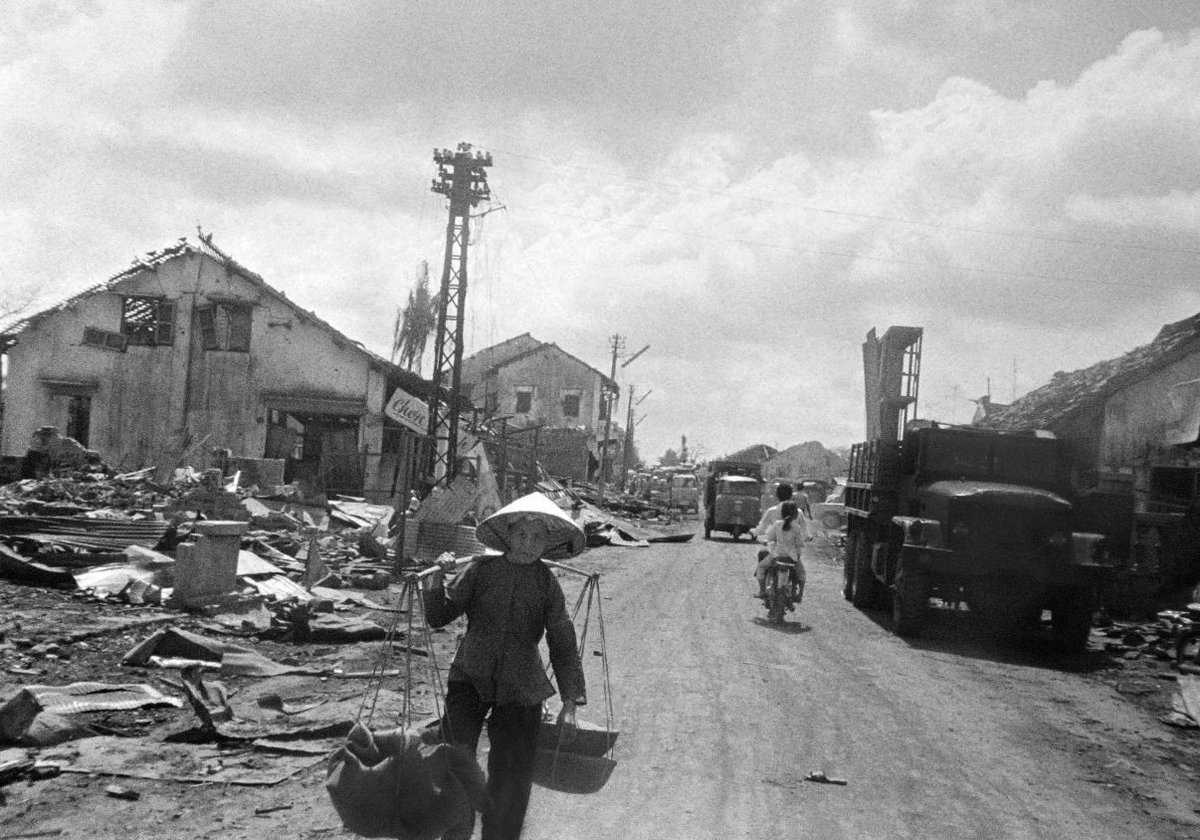
Let me tell you about Vietnam.
The United States bombed Vietnam for nearly a decade.
They dropped 7.5 million tons of bombs, which is more than three times what was dropped during all of World War II. Entire provinces were flattened.
They sprayed millions of gallons of Agent Orange that poisoned the land and the people for generations.
After the war, America broke its promise to provide reconstruction aid and pressured international institutions to deny Vietnam any loans or assistance.
The country was left isolated, embargoed, and devastated. In 1986, Vietnam was on the brink of collapse.
Inflation had hit 700 percent and farmers were starving.
If any nation had the right to blame foreign powers for its misery and give up, it was Vietnam.
Instead, they changed their policies.
They launched reforms called Doi Moi that legalized private enterprise, welcomed foreign investment, gave farmers land rights, and opened up to global trade.
Within a decade, the economy was growing at 7 percent per year and poverty was cut in half.
Today, Vietnam's GDP per capita has grown from under $100 in 1990 to over $4,000. Poverty dropped from 60 percent to under 5 percent. Major companies are now moving their factories from China to Vietnam.
This is a country that was literally bombed flat by a superpower, poisoned, and abandoned.
And they still found a way to prosper because they were willing to change their economic system.
So when I hear Africans say we can't develop because of meddling, I want to ask: what meddling post-colonialism compares to what Vietnam went through? We weren't bombed like that. We weren't poisoned like that. We weren't embargoed like that.
What we have for the most part are governments that refuse to create the conditions for entrepreneurs to thrive, and leaders who benefit from keeping us poor and dependent.
Foreign meddling is real, and it happens to every poor country on earth.
It's not unique to Africa.
It's what the powerful do to the weak, and every major power plays that game.
The only escape is to become prosperous enough that you can stand on your own feet, and that requires economic freedom.
Wake up Africa!
Nassim Taleb on a bet most people would take: 70% chance to win $1, 30% chance to lose $1 - should you bet?
His answer: in most cases no. Not because of risk aversion. Because it's a bad strategy in multi-period reality
Same Kelly Criterion math that powers Shannon's information theory - there's a sweet spot, and most behavioral finance papers ignore it
Bet too much and the law of large numbers ruins you. Bet too little and you leave returns on the table
this is what every quant learns before they touch capital
I strongly believe there are entire companies right now under heavy AI psychosis and its impossible to have rational conversations about it with them. I can't name any specific people because they include personal friends I deeply respect, but I worry about how this plays out.
I lived through the great MTBF vs MTTR (mean-time-between-failure vs. mean-time-to-recovery) reckoning of infrastructure during the transition to cloud and cloud automation. All those arguments are rearing their ugly heads again but now its... the whole software development industry (maybe the whole world, really).
It's frightening, because the psychosis folks operate under an almost absolute "MTTR is all you need" mentality: "its fine to ship bugs because the agents will fix them so quickly and at a scale humans can't do!" We learned in infrastructure that MTTR is great but you can't yeet resilient systems entirely.
The main issue is I don't even know how to bring this up to people I know personally, because bringing this topic up leads to immediately dismissals like "no no, it has full test coverage" or "bug reports are going down" or something, which just don't paint the whole picture.
We already learned this lesson once in infrastructure: you can automate yourself into a very resilient catastrophe machine. Systems can appear healthy by local metrics while globally becoming incomprehensible. Bug reports can go down while latent risk explodes. Test coverage can rise while semantic understanding falls. Changes happens so fast that nobody notices the underlying architecture decaying.
I worry.
@brian_armstrong@moo9000 >Non technical teams are now shipping production code
genuinely terrifying lol, already had my data leaked enough before this
No one can be blamed asking for charity. Even if from the historically uncharitable. Nevertheless, without a bargaining chip a good bargain shouldn't be expected. Acquire that chip, one way or another!
Perhaps the equilibrium in Lebanon is the best play. Resistance on one side and diplomacy on the other. All the while there is an open airport and opportunity to learn and rise and come back stronger. Fight the fight of the erudite if means available, to reinforce the sacrifices
Perhaps the equilibrium in Lebanon is the best play. Resistance on one side and diplomacy on the other. All the while there is an open airport and opportunity to learn and rise and come back stronger. Fight the fight of the erudite if means available, to reinforce the sacrifices
Resistance is never futile, but there are other ways to win. Ways that might feel slower, but carry more upside. Historically if a greater power attacks us, we either die or get enslaved or run away. If we decide that our home is worth our lives, then the tradeoff is clear