Chatter is officially LIVE on @ponsdotfamily.
CA : 0x2d4c06d58507f58188060e1741fc7b0a58756f90
AI development should be easier to build, test, and improve. Chatter brings these workflows together, helping developers explore ideas, compare model outputs, evaluate results, and refine their AI applications in one place.
From experimenting with prompts to building more reliable LLM workflows, Chatter is designed to make the development process more practical and efficient.
We’re excited to bring Chatter to the Ponsdot community. This is another step forward in making AI development easier to explore and work with.
Explore Chatter: https://t.co/gy6zAGOlmA
Now that Chatter is live on @ponsdotfamily, it’s time to show what we’re building.
AI development involves more than just generating responses. Testing prompts, comparing model outputs, and improving workflows are all part of creating better AI applications.
That’s where Chatter comes in. One place to experiment, evaluate, and make AI workflows easier to manage.
Explore Chatter: https://t.co/gy6zAGOlmA
Chatter is coming to Ponsdot.
A new step for Chatter as we bring our AI testing platform to the community. Stay tuned for the launch and follow along as we build.
https://t.co/ZGGF0V9kKW
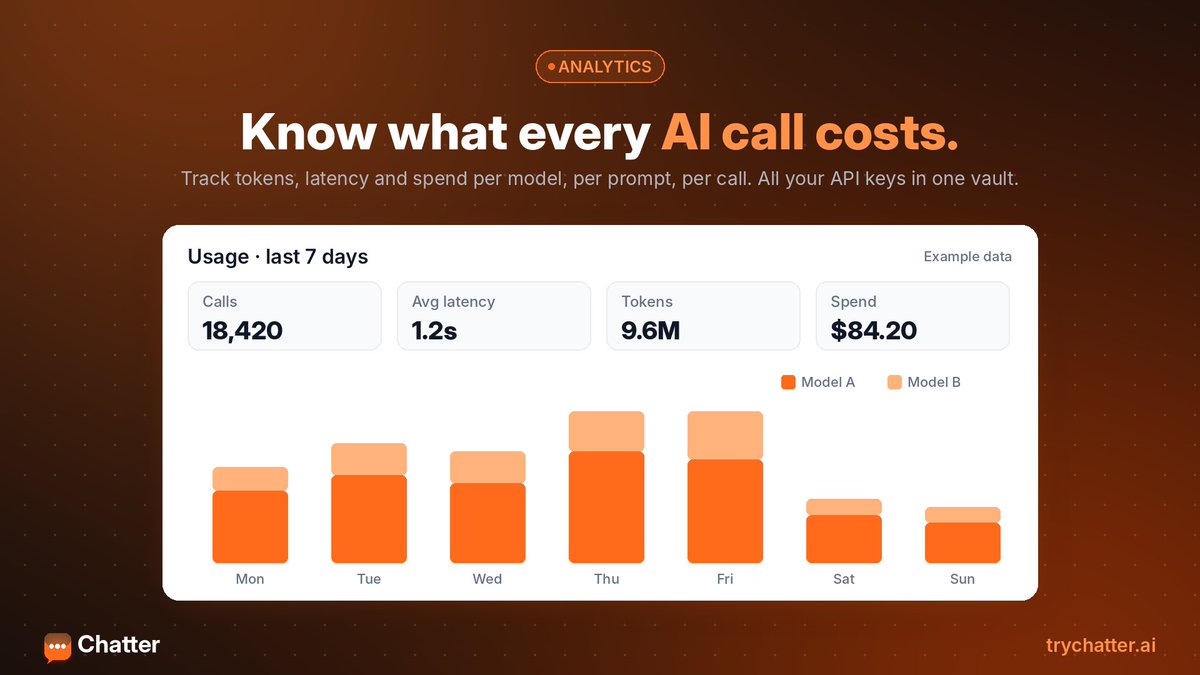
Know exactly what every AI call costs.
Track tokens, latency, and spend per model and per prompt, with all your API keys in one vault.
Try it free: https://t.co/cn7ZSvruXp
Hot take: if you can't measure your prompt, you can't improve it.
Most teams are still shipping AI on vibes. The ones that win will be the ones that test.
3 checks every LLM team should run before shipping:
1. Does it answer correctly?
2. Does it follow your rules and tone?
3. Did the last change break anything?
Chatter runs all three automatically.
This is what shipping an AI change should look like.
You edit a single line in your prompt, run your test suite, and see exactly how every case performs compared to the previous version, all in a few seconds. No guessing and no crossing your fingers after you deploy.
Build, test, and version your LLM products in one place, and ship every change with confidence.
Try it free: https://t.co/tmcaQkx8Uc
The most expensive bug in an AI product is the one nobody notices.
A prompt gets tweaked to fix one issue, and quietly breaks three other answers that used to work. There is no error message and no failed build. Users just start getting worse responses, and the team finds out weeks later from support tickets and churn.
This is why testing LLMs cannot be an afterthought. Every prompt change should be evaluated against real test cases before it ships, the same way code goes through tests before it is deployed. That is the standard Chatter is built to make easy
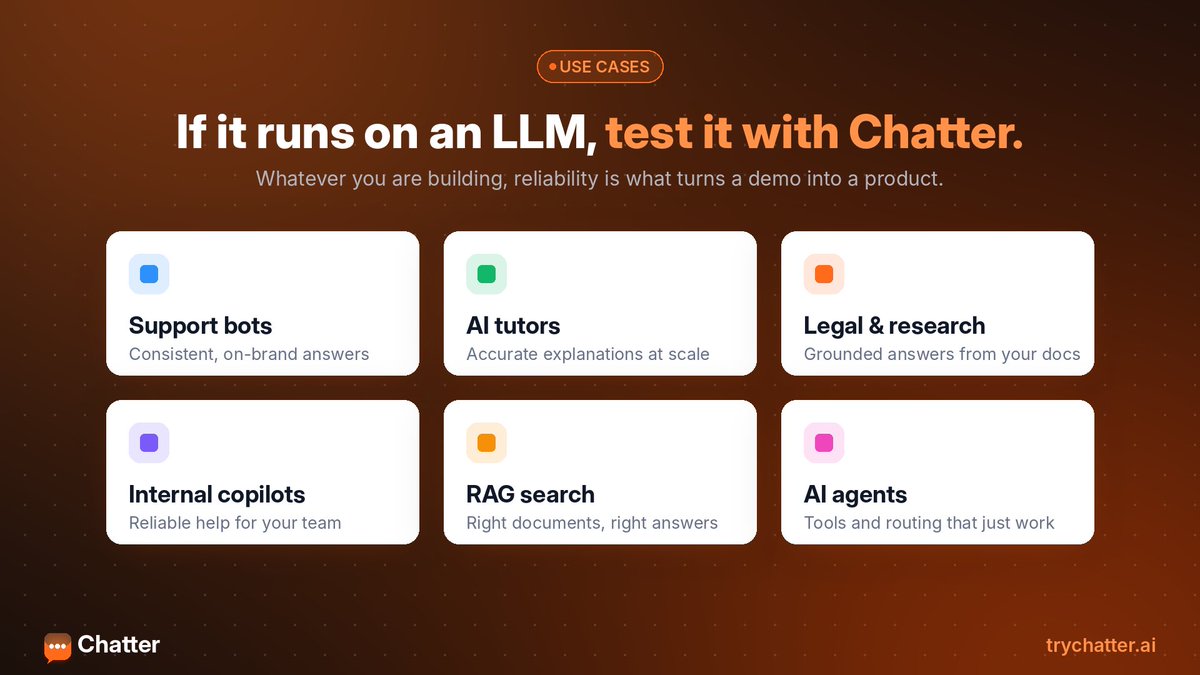
If your product runs on an LLM, it needs to be tested like any other critical part of your stack.
Support bots need consistent, on-brand answers. AI tutors need accurate explanations. Legal and research tools need answers grounded in the right documents. Internal copilots, RAG search, and AI agents all need tools and routing that work every single time.
Whatever you are building, reliability is what turns a demo into a real product. Chatter helps you get there.
Going from a prompt idea to a production-ready AI feature should not take weeks of copy-pasting between docs, notebooks, and code.
With Chatter it comes down to three steps. Build your prompts and chains with any model, function calling, RAG, and Jinja2 templates. Test them with automatic evaluations and compare every version side by side. Then ship them to your codebase with the SDK and monitor every call in production.
One platform, one workflow, from the first draft to the final release.
Every major shift in software created a must-have tooling layer. Web apps needed analytics. Code needed CI/CD. Cloud needed monitoring.
LLM applications need a testing and evaluation layer, and that is what we are building with Chatter: one platform to build, evaluate, version, and observe AI products.
We are just getting started. If you are an investor, partner, or team building with LLMs and want to talk, reach out or book a meeting here:
https://t.co/n60pp2oOPU
Chatter is backed by Y Combinator and already trusted by teams at Coursera, Thomson Reuters, and Casetext.
These are teams that cannot afford unreliable AI. Education platforms serving millions of learners, information services where accuracy is everything, and legal AI where one wrong answer matters.
They use Chatter to build, evaluate, and version their LLM products in one place, and to bring engineers, PMs, and domain experts into the same workflow.
Every company is racing to ship AI features. Very few of them can actually test what they ship.
LLMs are non-deterministic. The same prompt can give different answers, and a small tweak can quietly break things that worked yesterday. Most teams still manage prompts across scattered docs and code, test by eyeballing a few outputs, and find bugs only when users complain.
Chatter changes that. One versioned home for every prompt, automatic evaluations on every change, and side-by-side comparisons, so teams catch problems before they reach production.
Honest question for anyone shipping products with LLMs:
How do you actually test a prompt change before it goes live?
A) Vibes and a few manual tries
B) A spreadsheet of test cases
C) Custom eval scripts
D) A dedicated testing tool
Most teams we talk to are still stuck on A. One small tweak to a prompt can quietly break answers that used to work, and nobody notices until a user complains. That's exactly why we built Chatter: automatic evals, prompt versioning, and side-by-side comparisons, so every change is tested before it ships.
When your LLM chain gives a bad answer, the hardest part isn't fixing it, it's figuring out where it went wrong. Was it the retrieval pulling the wrong docs, the prompt template, the model itself, or the function call at the end?
Chatter traces every single step of your chain and shows you the latency, token usage, and cost of each call side by side. You can see exactly how information flows from one step to the next, spot the slow or expensive parts, and pinpoint the step that broke.
No more guessing and no more digging through logs. Debug in seconds, not hours.
Shipping an LLM feature usually looks like this:
PM writes the prompt in a Google Doc.
Engineer copies it into code.
Someone tweaks it in Slack.
Nobody knows which version is live.
Chatter gives everyone one place to edit, version, and approve prompts.