🔴WTF
March and March criminals looting and stealing from South African hawkers who are trying to make a living by selling fruits and veg on the streets. These people are unruly 🤧🤧
Zimbabwe kuitwa komboni takatarisa, Mkanya Chiwenga mati vanhu vatambure mbavha yamakaisa Emmerson Dambudzo Mnangagwa ichiita zvainoda nenyika? Haunga rambeka waka nyarara muMbire, are you proud of all this evil? Mugabe was not a saint, but this is beyond demonic and satanic🤢🤮
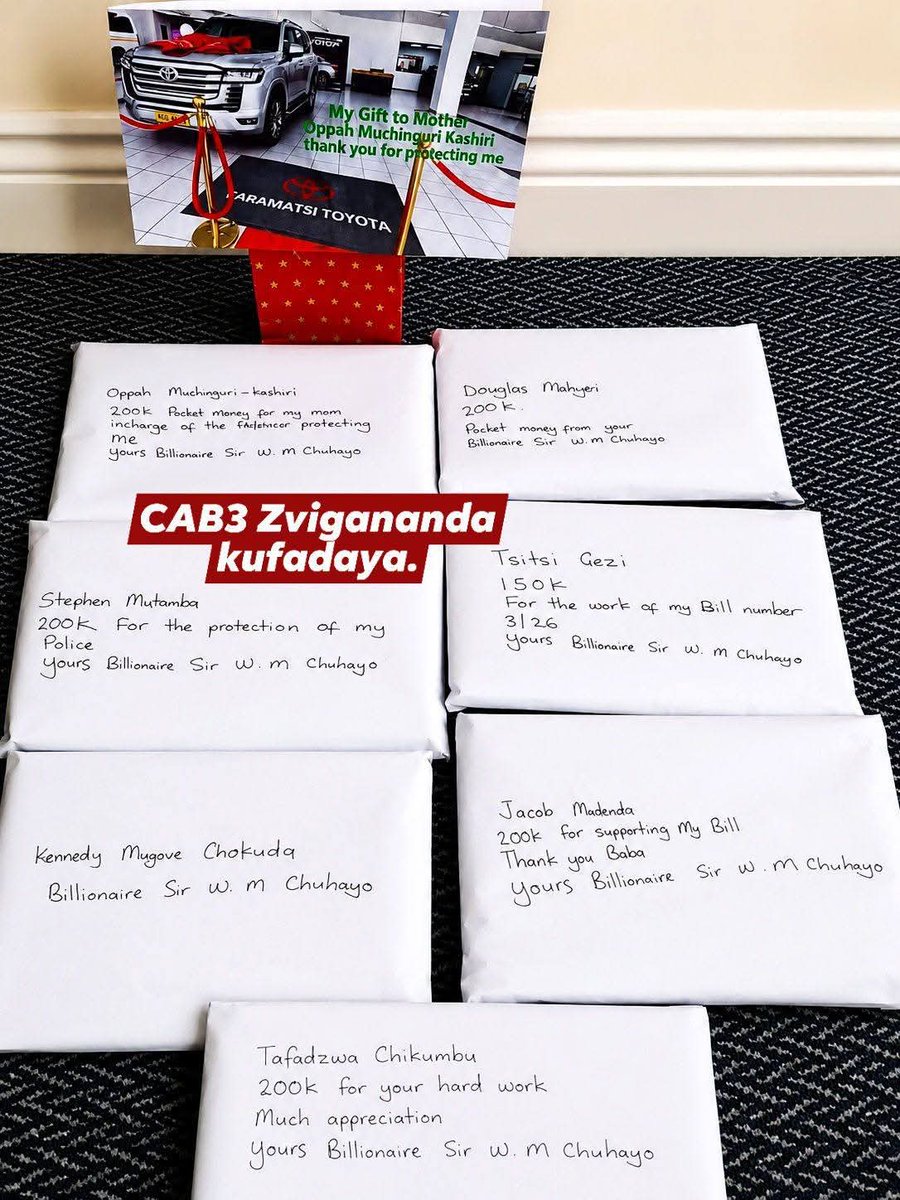
Commissioner General Stephen Mutamba intends to accept a bribe of US 200 000 from Wicknell Chivhayo tomorrow . Meanwhile, junior police officers carry out all the difficult, dirty work while they themselves live in abject poverty.
Wicknell Chivhayo hands Oppah Muchinguri US$200 000 + a 2025 Land Cruiser.
Our hospitals have no drugs, schools have no books, families have no food yet this thug and his elite friends feast on our country. Silence is complicity. Speak up.
Tsitsi Gezi, the notorious Deputy Speaker of the Parliament of Zimbabwe, is set to receive US 150 000 from Wicknell Chivhayo. Once you are aware of this, you will fully understand exactly why she was heavily biased against the opposition during parliamentary debates.
Christopher Mutsvangwa: "We have become spectators while arrivistes are devouring our party & it is frustrating that neither state apparatus from the liberation struggle can do anything about it. The biggest mischief has been the principal who is harbouring such elements"
For months I’ve sounded the alarm on Chivhayo. We intercepted messages and videos showing $1.2 million in cash bribe money meant for Parliament and Minister Muchinguri. With his brother Joachim reveal they plan to remove all war veterans from the Army and CIO once CAB3 passes.
NEWS | Landlords face new tax burden as ZIMRA rolls out presumptive rental income tax
HARARE - Zimbabwean property owners, including those living in the diaspora, are set to feel the impact of another tax measure after the Zimbabwe Revenue Authority (ZIMRA) announced the implementation of a new Presumptive Rental Income Tax targeting commercial property rentals.
The tax, introduced under the Finance Act of 2025 and effective from January 1, 2026, imposes a 15 percent levy on gross rental income earned from premises used for business, trade, or professional activities.
Under the new regime, landlords, property owners, lessees, and sub-lessees who receive rent from tenants operating businesses will be required to register with ZIMRA and remit the tax monthly. The tax is charged on gross rental income, meaning no deductions or allowances will be permitted before calculating the amount due.
The move significantly broadens Zimbabwe’s tax base and brings commercial property rentals under tighter scrutiny as authorities seek to boost revenue collections.
Importantly, the tax does not apply to residential rentals. However, mixed-use buildings containing both commercial and residential units will have the commercial rental portion subjected to the new levy.
Diaspora property owners have not been spared. Zimbabwean citizens living abroad who own commercial properties in Zimbabwe will be required to register and comply with the tax. Non-resident landlords must appoint a local representative to handle their tax obligations.
In another notable provision, estate agents and other intermediaries handling rental payments have been designated as statutory agents and may be held responsible for ensuring the tax is paid before rental proceeds are disbursed to landlords.
ZIMRA has also empowered itself to recover unpaid taxes directly from tenants where landlords fail to comply. In such cases, tenants can be instructed to remit the tax directly to the tax authority, with legal protections against eviction or rent increases for three months as a result of complying with the directive.
The new tax operates separately from other existing taxes. Commercial rentals that are already subject to Value Added Tax (VAT) will continue attracting VAT at 15.5 percent in addition to the new presumptive rental tax. Landlords must also continue collecting the 10 percent informal traders’ tax from qualifying tenants.
Property owners who fail to comply face severe penalties. ZIMRA says non-payment could attract a penalty equivalent to 100 percent of the unpaid tax, effectively doubling the amount owed.
Landlords who were already registered under the self-assessment income tax system before December 31, 2025, will continue declaring rental income through that framework. However, those who were not previously registered must now enroll for the presumptive rental income tax system and begin making monthly submissions.
The latest measure signals government’s continued push to widen revenue collection channels amid growing fiscal pressures, with commercial property owners becoming the newest target in Zimbabwe’s expanding tax landscape.
Reporting by Chengetai Murimwa
—
ZiFM Stereo News continues to provide dependable, fact-based reporting from Zimbabwe and beyond. Our newsroom remains committed to accuracy, objectivity, and timely updates, ensuring the public is informed with verified and relevant news as it happens.
Follow the ZiFM Stereo News WhatsApp Channel: https://t.co/O9g7Xpckcw
It is clear from today's judgements that term extension is illegal, what is also clear is that judiciary is lacking tenacity to tell ED 'Go go Baba'.
If we are afraid to take to the streets then we also should not expect the judges to do it for us.
Very uncomfortable, very dividing but we now need to call on the retired Generals, the opposition, the CDF, the teachers and you (yes iwewe) to take to the streets. To Chiwenga, don't speak at funerals, church events etc but come join the streets after all you too created this beasts.
We are likely to end up with the cases being dismissed on useless technicalities.
Constitutional Amendment Bill (N0.3) unanimously passes to committee stage
The contentious Constitutional Amendment Bill (N0.3) unanimously passed to the committee stage in the National Assembly earlier in the afternoon after the opposition neglected or failed to call for a critical division of the house for MPs opposed to the legislative changes to vote against it.
About 30 MPs were opposed to the bill in its entirety after a record-breaking fierce debate.
The failure by the opposition to call for division of the house let the bill, which has far-reaching political implications, pass to the committee stage unanimously, without formal opposition.
In terms of process, the presiding officer first judges the will of the house using a voice vote ("Ayes" vs. "Nays").
If an MP challenges the presiding officer's ruling, they then can call for a division of the house.
Bells are rung to summon all lawmakers to the chamber, the doors are locked, and MPs must physically move to opposite sides of the house (or have their names recorded) to provide an exact, verified tally of votes.
A minimum simple majority was required to pass the bill to the committee stage.
The committee stage of the bill is the third step in the legislative process.
It is a detailed, clause-by-clause examination of the proposals that takes place after the second reading and general debate.
During the committee stage, the house resolves into a committee of the whole house rather than meeting as the standard legislative body, allowing for more conversational and repeated speaking opportunities.
Members meticulously scrutinise each section or clause of the bill.
The committee goes through the bill clause-by-clause sequentially, voting on each clause or block of clauses.
MPs and ministers can propose specific alterations, additions, or removals to individual clauses.
Any proposed amendment is debated, and the committee votes on whether to accept or reject the change.
Once the committee finishes reviewing all clauses and finalising amendments, the bill moves to the report stage, where the committee officially reports its work back to the house for final confirmation before the third reading.
Because it is where the exact wording of the proposed law or amendment is finalised, this phase is often heavily debated.
For example, this bill required intense, late-night debate in the National Assembly last night before advancing to the committee stage.
After the amendments have been adopted, another vote is called in the house to pass the bill by a two-thirds majority before the same process is repeated in the upper house, senate.
If senate makes some changes to the bill, it then goes back to the lower house, National Assembly, for voting before being to sent to the President for assent.
By signing CAB3 into law, Emmerson Mnangagwa signs his own political resignation. Progressive forces will never let him trample on our nation. His rule is over Mnangagwa will soon be history. Bookmark this tweet.
JACOB ZUMA
On the election day, we will write down names of those supporters and members who didnt vote and chase them out of KZN
When we take over, every child will fo to school
Any child found not in school will be be beaten up and dragged to school
After matric, we will force everyone to take a gap year and go serve in a compulsory military training.
Only after military training can you go do your course of your choice
WATCH: Marondera Central MP Caston Matewu was ejected from the National Assembly during the Constitutional Amendment Bill No.3 (CAB3) debate. The heated altercation began when Deputy Speaker Tsitsi Gezi informed him that his allocated speaking time had expired, leading @cmatewu to protest and throw a copy of the Constitution.