SOURCES: SuryaKumar Yadav will no longer remain India’s T20 Captain. BCCI secretary will inform the Apex Council during an online meeting tomorrow
@ndtv@CricketNDTV
With or without an Olympic medal, @Phogat_Vinesh will remain a hero. And that’s why I decided to headline the column of this week- Vinesh Phogat vs The Will Of The Universe
@ndtv
It’s now official that FIFA World Cup in India will be broadcast on Zee. Under the agreement, Zee will bring 39 FIFA events to Indian audiences between 2026 and 2034, including the FIFA World Cup 2026, FIFA Women's World Cup 2027 and FIFA World Cup 2030
#FIFA@ndtv
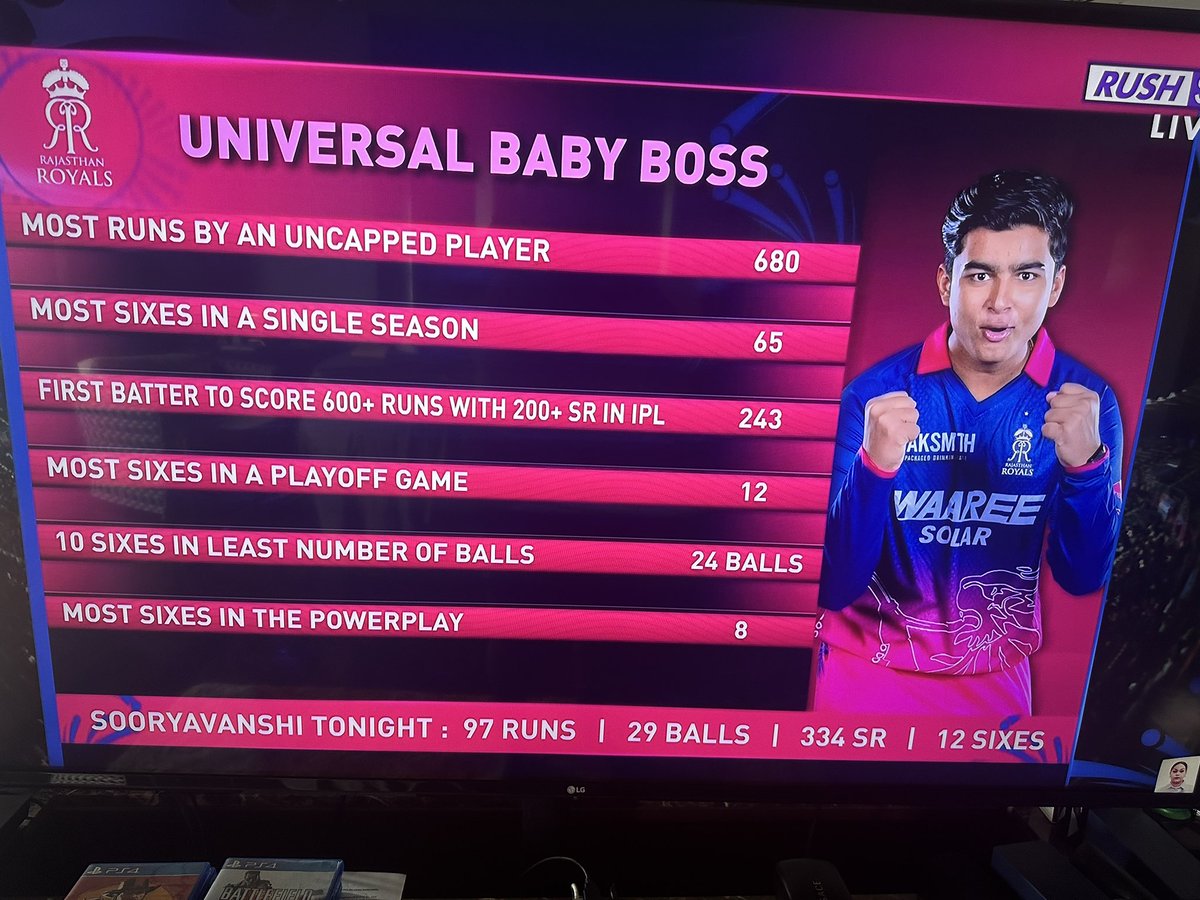
Vaibhav Sooryavanshi’s bat swing has been outstanding. What’s even more remarkable is how beautifully he clears his front foot to create room for balls aimed at his legs. This freedom allows him to play the way he does.
That innings was nothing short of spectacular!
In today’s Punjab, the crack of a gunshot doesn’t launch an athlete into a sprint. It scatters a crowd. It sends people diving into the very soil that was just churned up by the thick, muscled feet of kabaddi players.
But in Ranchi, far away from that heavy, fractured atmosphere, the crack of the starter’s gun did something different for Gurindervir. It freed him. He didn’t fear the sound; he welcomed it. He embraced it. This wasn’t the messy, blood-soaked soil of home, and Guri wasn’t a kabaddi raider. Though, in a way, maybe he was - attacking a time, a record, we all once thought was unchartered territory. In a country where life moves slow, Guri pushed us into interstellar territory, promising a journey that’s practically galactic.
That starter’s gun cleared the air for him. In just ten seconds, that boy did more for Punjab’s youth than decades of governments, bureaucrats, and those self-proclaimed NRI sympathizers spinning tall tales from the comfort of their Western homes.
Back home, a young man inherits a completely different soundtrack. It’s the low, constant thrum of anxiety as he stares at maps and visa forms. It’s the generator humming in the background while steroid-pumped boys defend and raid in kabaddi circles, a sport now held hostage by slick promoters and gang lords. All while the state grieves, watching its future slip right through its fingers.
Without even knowing it, Guri has guided the youth toward the synthetic rubber lanes. Just four feet wide, where the only real violence happens against the starting blocks. If your transition at the forty-meter mark is fluid enough, you win. Think about it: maybe life can be solved by these straight, white lines. They bring these kids into focus, letting them release all that raw energy. These lanes have become a sanctuary.
Punjab’s youth are running from a landscape that is actively devouring them. It’s feasting on their ambitions and tearing apart their dreams. It pushes them into corners until, out of sheer despair, some pick up a gun, and the broken ones pick up a needle. All while the people in power treat the state like a stand-up comedy gig.
But when Guri ran, exploding out of those blocks, he was running both toward and away from time. He ran with a fury. The lane held him steady, while everything fracturing outside of it just couldn’t keep up.
In a state that has always measured athletic glory by the width of a shot-putter’s shoulders or the heavy, muddy grip of village tradition, Guri isn’t just holding his ground. Every single stride away from that block is a stubborn refusal to let the streets of Punjab drag him down.
In that single, fluid act of vanishing into speed, he isn’t running away from reality. He’s running toward a new horizon. And he’s showing Punjab and the whole damn country that sometimes, just running in a straight line pays the highest dividends.
#punjab #punjabification #Punjabi #athleticsindia #Gurindervir #fedcup2026
#fedcup
FIFA's India broadcast deal is almost done, with price negotiations going on with the broadcaster. Sources say the deal could be worth between 30-35 million USD.
@cheerica shares more details about the deal.
‘Ringside View’- my weekly column on https://t.co/hHKHPj1ohI dropped today. This week I have delved deep into what has made #RCB into a mean winning machine. An interplay of Virat Kohli energies+culture shift+adoption of smart tech have led them to become the first to qualify for playoffs this season.
@ndtv@CricketNDTV
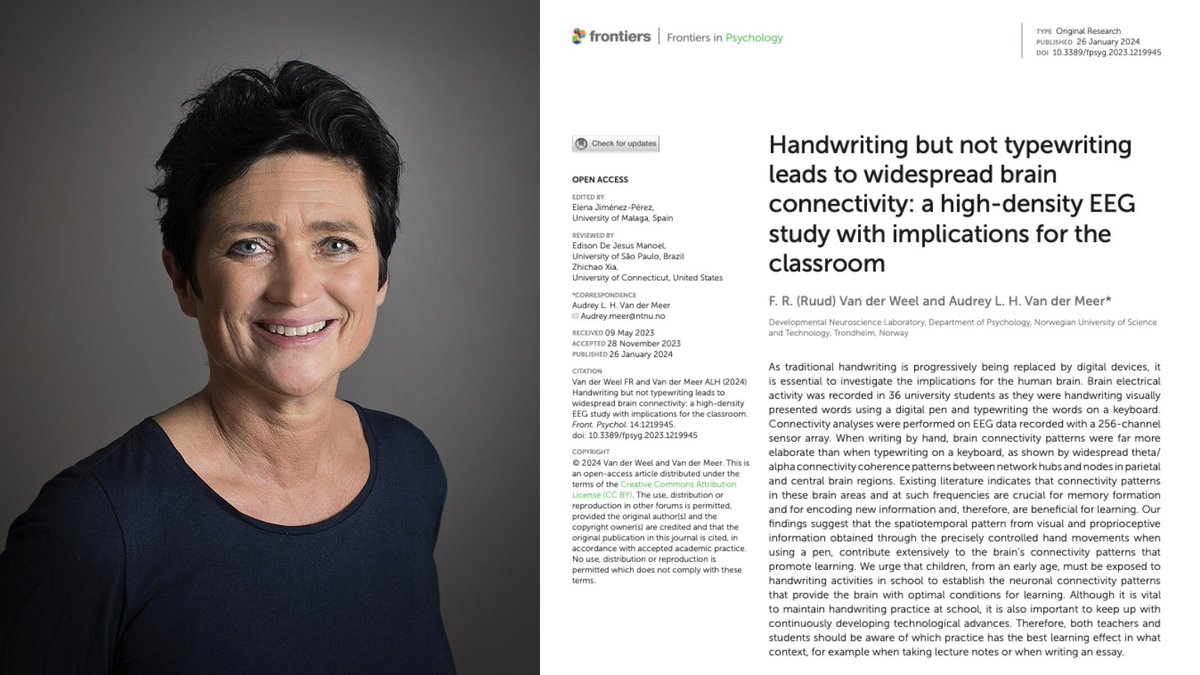
A Norwegian neuroscientist spent 20 years proving that the act of writing by hand changes the human brain in ways typing physically cannot, and almost nobody outside her field has read the paper.
Her name is Audrey van der Meer.
She runs a brain research lab in Trondheim, and the paper that closed the argument was published in 2024 in a journal called Frontiers in Psychology. The finding is brutal enough that it should have changed every classroom on Earth.
The experiment was simple. She recruited 36 university students and put each one in a cap with 256 sensors pressed against their scalp to record brain activity. Words flashed on a screen one at a time.
Sometimes the students wrote the word by hand on a touchscreen using a digital pen, and sometimes they typed the same word on a keyboard. Every neural response was recorded for the full five seconds the word stayed on screen.
Then her team looked at the part of the data most researchers had ignored for years, which is how different parts of the brain were communicating with each other during the task.
When the students wrote by hand, the brain lit up everywhere at once.
The regions responsible for memory, sensory integration, and the encoding of new information were all firing together in a coordinated pattern that spread across the entire cortex. The whole network was awake and connected.
When the same students typed the same word, that pattern collapsed almost completely.
Most of the brain went quiet, and the connections between regions that had been alive seconds earlier were nowhere to be found on the EEG.
Same word, same brain, same person, and two completely different neurological events.
The reason turned out to be something nobody had really paid attention to before her work. Writing by hand is not one motion but a sequence of thousands of tiny micro-movements coordinated with your eyes in real time, where each letter is a different shape that requires the brain to solve a slightly different spatial problem.
Your fingers, wrist, vision, and the parts of your brain that track position in space are all working together to produce one letter, then the next, then the next.
Typing throws all of that away. Every key on a keyboard requires the exact same finger motion regardless of which letter you are pressing, which means the brain has almost nothing to integrate and almost no problem to solve.
Van der Meer said it plainly in her interviews.
Pressing the same key with the same finger over and over does not stimulate the brain in any meaningful way, and she pointed out something that should scare every parent who handed their kid an iPad.
Children who learn to read and write on tablets often cannot tell letters like b and d apart, because they have never physically felt with their bodies what it takes to actually produce those letters on a page.
A decade before her, two researchers at Princeton ran the same fight using a completely different method and ended up at the same answer. Pam Mueller and Daniel Oppenheimer tested 327 students across three experiments, where half took notes on laptops with the internet disabled and half took notes by hand, before testing everyone on what they actually understood from the lectures they had watched.
The handwriting group won by a wide margin on every question that required real understanding rather than surface recall.
The reason was hiding in the transcripts of what the two groups had actually written down.
The laptop students typed almost word for word, capturing more total content but processing almost none of it as they went, while the handwriting students physically could not write fast enough to transcribe a lecture in real time, which forced them to listen carefully, decide what actually mattered, and put it in their own words on the page.
That single act of choosing what to keep was the learning itself, and the keyboard had quietly skipped the choosing and skipped the learning along with it.
Two studies. Two countries. Same answer.
Handwriting makes the brain work. Typing lets it coast.
Every note you have ever typed instead of written went into your brain through a thinner pipe. Every meeting, every book highlight, every idea you captured on your phone instead of on paper was processed at half depth.
You did not forget those things because your memory is bad. You forgot them because typing never woke the part of the brain that would have made them stick.
The fix is the thing your grandmother already knew.
Pick up a pen. Write the thing down. The slower road is the faster one.
Kohli was busy walking out of the airport while talking to his bodyguard. Suddenly an old man screamed his name but he didn’t hear him as he was wearing AirPods. Old man screamed again and this time Kohli heard him, immediately stopped, apologised for not hearing him the first time and called him over for a handshake. I stan the right guy ❤️
It’s a brilliant piece of investigative journalism by @mihirsv. Now that the facility is in place, hopefully the country will see lot many like @suhas_ly who will win medals for India
Express Investigation:
A fund meant for India’s top athletes was used to upgrade sports facilities for bureaucrats - by bureaucrats.
🏊 Heated swimming pools
🎾 Tennis courts
🏸 Officers’ clubs
All funded through National Sports Development Fund (NSDF).
https://t.co/kZRYaLa6ug
Nikhat Zareen suffered a shock exit from the Commonwealth Games and Asian Games trials 🫣
The 2022 Commonwealth Games champion and 2023 Asian Games bronze medallist went down 1-4 via split decision to Sakshi Chaudhary in the 51kg semifinals in the opening bout of the day.
The Boxing Federation of India was forced to revert to the trial-based selection process after the Sports Authority of India suspended its earlier assessment-based evaluation system on Sunday, calling it “opaque”.
Read more: https://t.co/DaEPEPcFSL
📸: Sushil Kumar Verma
मिलिए प्रसिद्ध बैडमिंटन प्लेयर ज्वाला गुट्टा से, उनके द्वारा किया गया ब्रेस्ट मिल्क डोनेशन खूब चर्चा में है l
अपने दूसरे बच्चे (मीरा) के जन्म के बाद, ज्वाला गुट्टा ने महसूस किया कि उनके शरीर में उनकी अपनी बच्ची की जरूरत से कहीं अधिक दूध बन रहा था,
उन्होंने डॉक्टर और बहन की सलाह पर अतिरिक्त ब्रेस्ट दूध को बर्बाद करने के बजाय नवजात बच्चों के लिए दान देना शुरू कर दिया,
उन्होंन��� सरकारी अस्पतालों और मिल्क बैंकों को कुल मिलाकर 30 से 50 लीटर तक ब्रेस्ट मिल्क दान किया है,
वह इस डोनर मिल्क ड्राइव के तहत रोजाना लगभग 600 मिलीलीटर दूध निकाल कर अस्पताल में देती थीं,
उन्होंने चेन्नई के Egmore के NICU में भर्ती बच्चों के लिए Amirtham Foundation के माध्यम से भी 14,500 मिलीलीटर (70 पैकेट) दूध पहुंचाया,
उनका यह योगदान उन मासूम बच्चों के लिए साक्षात जीवनदान साबित हुआ,
जो जीवन और मौत के बीच आईसीयू (NICU) में जूझ रहे होते हैं,
जिनकी माताएं ना रही या उनके शरीर में बीमारी या कुपोषण के कारण पर्याप्त दूध नहीं बन पाता,
ज्वाला गुट्टा के इस 'लिक्विड गोल्ड' ने न जाने कितने मासूमों को संक्रमण से बचाया और उन्हें एक नया जीवन दिया है।