Turn hidden loss into assigned action.
Hidden loss is not the only problem.
Unassigned loss is.
Capture.
Classify.
Review.
Assign.
Reduce the repeat.
The goal is not another dashboard.
The goal is loss clear enough to act on.
Start with one focused visibility loop.
The system should fit the factory.
Not the other way around.
Use available signals.
Keep input simple.
Define the loss model.
Support the review loop.
The goal is not complete software.
The goal is visible loss that can be acted on.
Next: hidden loss -> visible action.
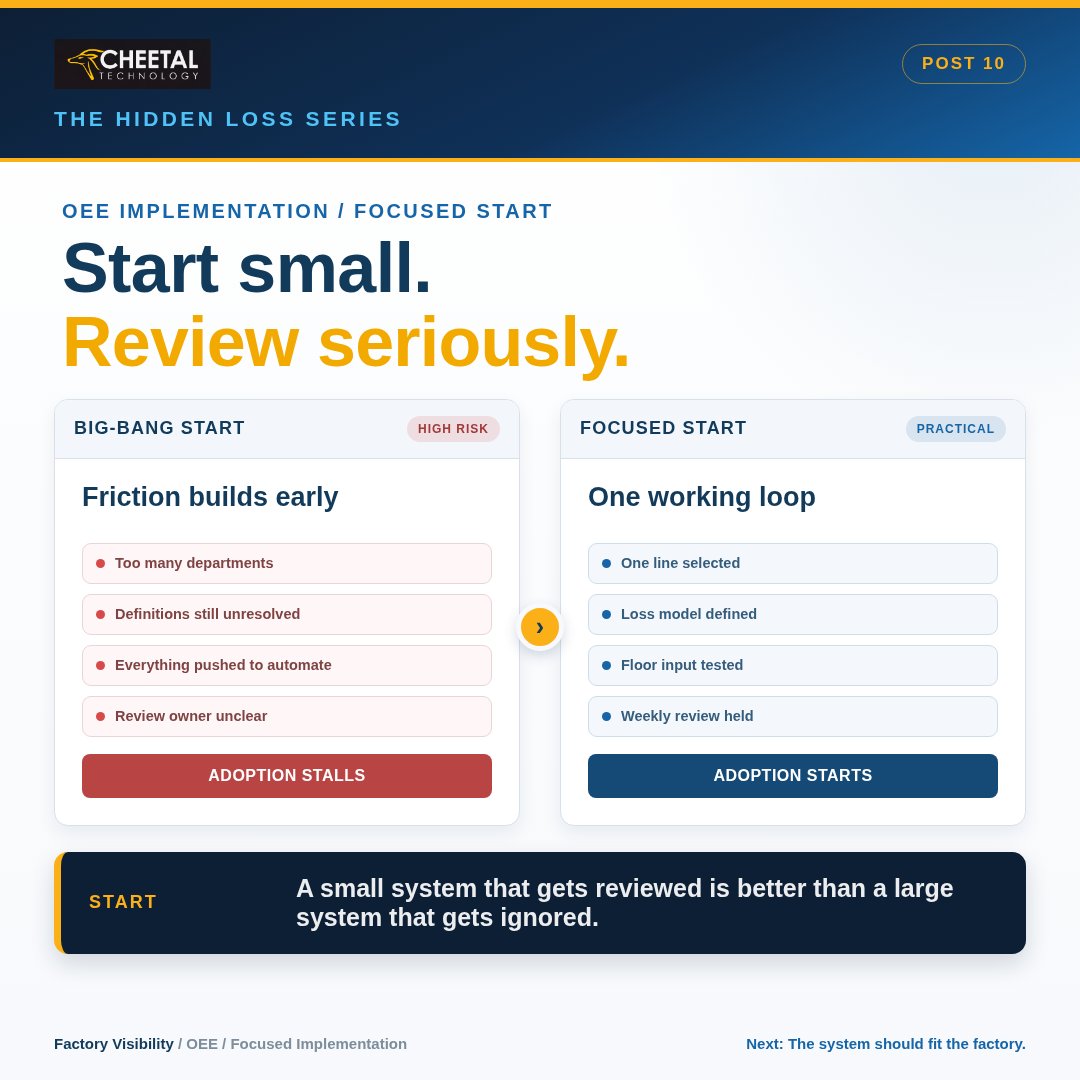
Start small.
Review seriously.
OEE does not need to begin with the whole factory.
Start with:
One line.
One loss model.
One review rhythm.
A small system that gets reviewed is better than a large system that gets
ignored.
Next: fit the factory.
Before the OEE number, define the model.
OEE depends on practical production rules:
Planned time.
Expected speed.
Good output.
Rejects and rework.
Changeovers.
Downtime threshold.
If the rules are unclear, the number gets disputed.
Next: start small.
Same OEE.
Different problems.
Machine A: frequent stops.
Machine B: running slow.
Machine C: rejected output.
The percentage may be the same.
The action required is not.
The number is the starting point.
The loss pattern is the diagnosis.
Next: OEE depends on the model.
OEE is not just a score.
It is a loss framework.
A percentage is not enough.
The question is:
Where is the loss coming from?
Availability.
Performance.
Quality.
OEE creates value when it separates loss behind the number.
Next: same OEE, different problems.
Recording downtime is the start.
Value comes from review.
Which reasons repeated?
Which line lost time?
Which small stoppages kept returning?
Which issue needs follow-up?
Data in a report changes little.
Review changes the prod conversation.
Next: OEE is not a score.
Reduce friction.
Make data reviewable.
Slow input, missed data, weaker reviews.
Late entries.
Guessed reasons.
"Other" choices.
Missed small stops.
Less friction, fewer misses, fewer guessed reasons.
Better capture makes patterns visible.
Next: review, not just recording.
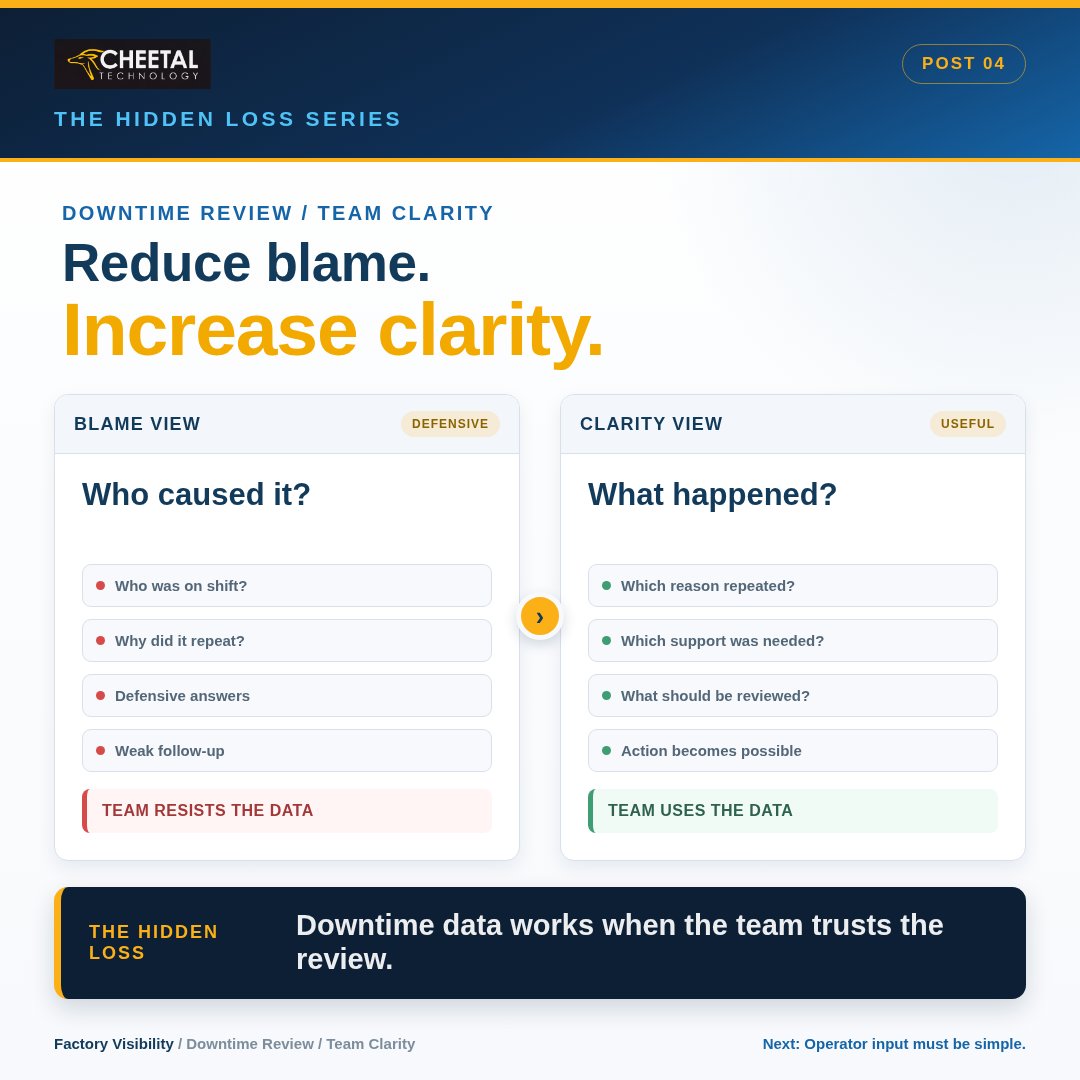
Downtime data should reduce blame, not increase it.
Weak:
Who caused this?
Useful:
What happened?
Which reason repeated?
Which support was needed?
What should be reviewed?
Data improves when the team trusts the review.
Next: operator input must be simple.
“Machine stopped” is not a reason.
It confirms time was lost.
It does not explain why.
Material delay. Changeover. Mechanical fault. Electrical fault. Utility issue. Quality hold.
Downtime becomes useful when the reason can be reviewed.
Next: reduce blame, add clarity.
A machine stops for 18 minutes.
Production restarts. By shift end, only a verbal explanation or rough memory
may remain.
That is invisible downtime: the loss happened, but it left no structured trace for review.
Next: “Machine stopped” is not a reason.
A busy shift can still hide loss.
Output shows what was produced.
Time breakdown shows where time went:
Planned.
Useful running.
Slow running.
Stoppages.
Quality loss.
Before improving production, separate busy time from useful time.
Next: invisible downtime.
@raythewarchief We build industrial monitoring systems — hardware + SCADA + IoT.
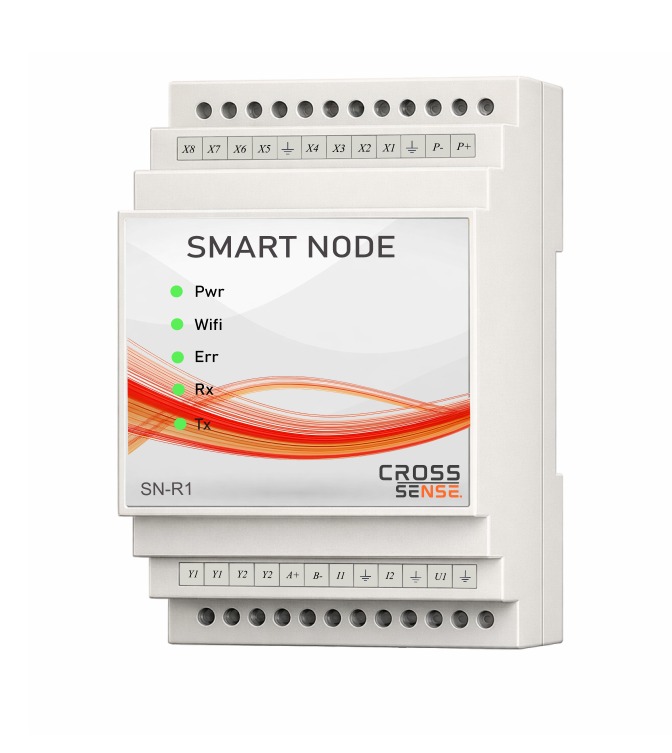
SmartNode: industrial device — plug sensors and meters, get real-time data online instantly, through web app.
FMS: web SCADA platform for monitoring, alerts & AI-assisted analysis & configuration.
Don't loose it, take control of your power systems
- Made in Italy-Power Meters
- Reduce operation cost
- Detailed cost analysis & consumption calculation
- Accurate monitoring of electrical parameters
- Reali time analysis of grid conditions
- Free remote management software
📷
@industrialoid Thank you so much for the cocnern, prayers and help.
AlHamduLillah Karachi, has been safe from major harms.
It has been a pleasure to see people in Karachi, getting together to help.
The amazing Adeel Ahmed at @Cheetaltech in Karachi in Pakistan 🇵🇰 has now revealed that the engine is likely to have been named after the spotted chital deer, known for its speed and agility - just like Adeel’s company!
(Image CC 4.0 BY S.A. T.R. Shankar Raman)