मोदी जी ने जो एक बार अमेरिका से वादा कर दिया - फिर वो अपनी भी नहीं सुनते 🤣😂
वैसे इन झुट्ठों की किस बात का भरोसा?
11 जून, 2025 को UPI पर MDR लगाने वाली ख़बर को झूठ बताया
14 सितंबर, 2026 को ठीक वही किया
@manoj_216@sanjayuvacha This seems strategical step. The attractiveness of the FD is 3 years or more which is incidentally after next LS elections. It means the current government under the umbrella of RBI is playing with fire.
This is such an outright lie.
In 2008, the Lehman Brothers collapse created a crisis in the entire world causing a worldwide economic fallout.
While the entire world was reeling under the crisis, Manmohan Singh, the then PM of India deployed a multi-pronged strategy.
The UPA Govt, between 2008-2009 rolled out three distinct stimulus packages totalling to approximately 1.86 lakh Crores which was around 3.5% of India's GDP then.
The Govt slashed the Central Excise Duty across board by 4% and cut service taxes to boost domestic consumption.
Govt spending was made to focus on rural development and infrastructure to keep a stable employment.
Extra subsidies and credit line extensions were given to export oriented sectors.
From a Banking POV, upon instructions of the Govt, the RBI aggressively cut the repo rate down to 4.75% to ease borrowing and encourage investments in the private sector.
CRR and SLR were heavily slashed for all banks encouraging smaller banks to extend and improve their lending.
These efforts injected Rs. 5.6 lakh crore liquidity (almost 9% of the GDP) into the banking system.
Owing to these smart and aggressive measures, especially in the banking system, by 2010, the Indian GDP showed a quick rebound to an 8.5% growth rate.
As a short term measure the repo rate cut down along with the CRR and SLR slash ensured that the domestic economy thrived even as the global crisis continued.
Disclaimer: Anyone who blamed MMS's strategies during the 2008 crisis, either has no clue about economy or is lying through his teeth.
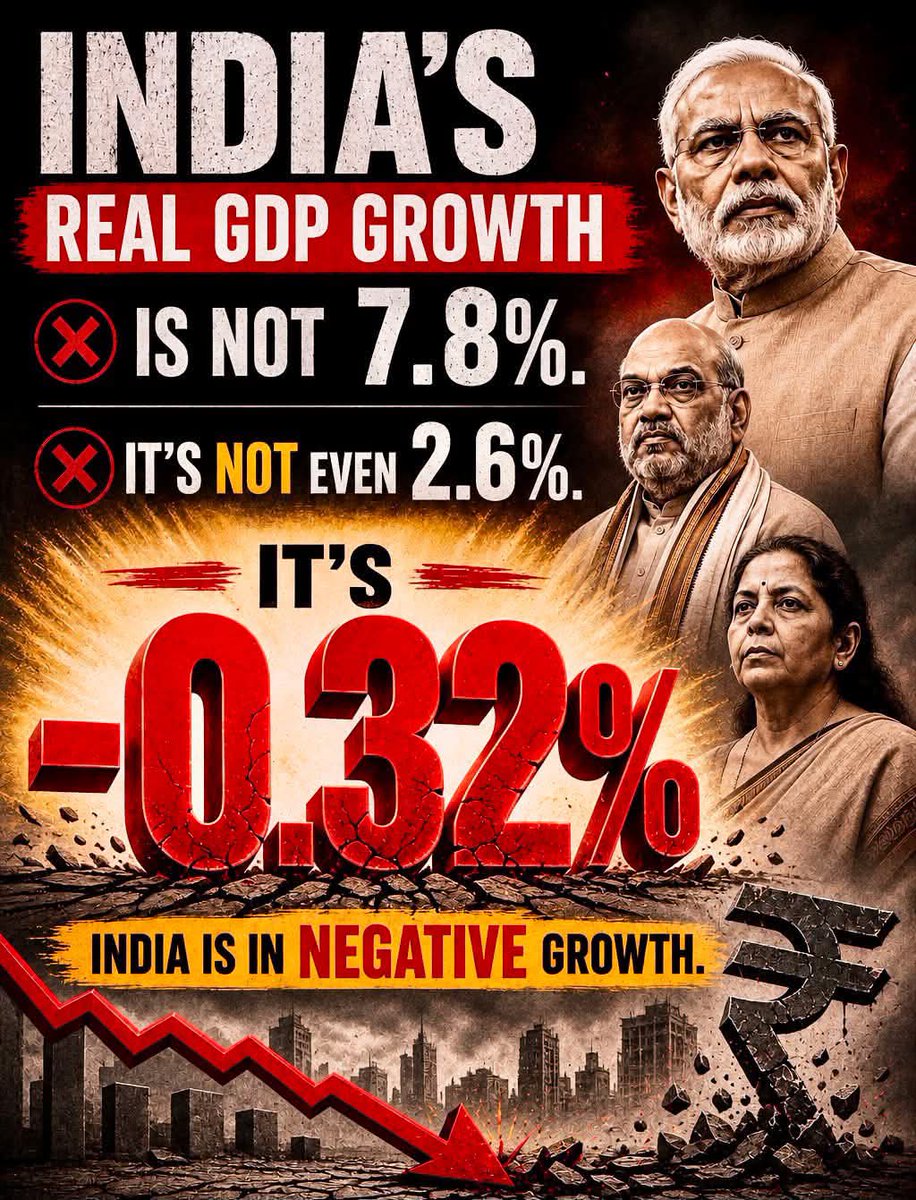
If the GDP figures calculated using the new formula are converted into dollars, the result is as follows:
First Quarter, 2025–26
GDP — ₹80 lakh crore
Average dollar exchange rate, April–June 2025 — ₹85.60
GDP — $935 billion Or $0.935 trillion
First Quarter, 2026–27
GDP — ₹88.27 lakh crore Average US dollar exchange rate,
April–June 2026 — ₹94.71 GDP — $932 billion Or $0.932 trillion
In other words, the GDP growth rate achieved by the country in this financial year is −0.32%.
WAR OF TITANS……..
“Mr. Mukesh Ambani, in January '19, crashed #ZeeGroup's shares by 40% through his thousands of shell companies.
Within a year, I offered to sell Zee. On a condition that, paying off my debts first.
In response, he said ‘WHY PAY BANKS MONEY ALONG WITH THE INTEREST?? NOBODY PAYS IT BACK.’
Later, teaming up with an investor named ‘Invesco’, he tried to seize Zee using another unethical route.
They made an offer that was beneficial to my family, but, bad for minority shareholders, which I rejected.”
- #ShubashChandra
KAPIL SIBAL PUTS TURNCOATS ON A LEGAL TIME BOMB 🚨
The courtroom heavyweight called it a dangerous proposition of law.
If later political events decide the party symbol, the leader who should have faced disqualification gets time to enjoy power and gather support.
That turns power itself into a weapon.
Send an ED notice, send a CBI notice, and legislators start running toward the ruling side.
The anti-defection law was made to stop this sin, not reward it.
This is not how Speakers or Commissions should function in a country built on rule of law. 🔥
This Subhash Chandra insolvency case does not look like a normal commercial haircut to me. The deeper you read the NCLT record, the more uncomfortable the questions become.
Let’s understand the Maths.
The easiest defence being circulated in the Subhash Chandra insolvency case is that he was “only a guarantor.” That description is legally misleading.
Under Section 128 of the Indian Contract Act, the liability of a surety is ordinarily coextensive with that of the principal debtor unless the contract provides otherwise. In simple words, a personal guarantee is not a ceremonial signature. If the borrower defaults, the creditor can proceed against the guarantor for the guaranteed liability. That is precisely why claims of around ₹22,006 crore were admitted against Subhash Chandra in his personal insolvency proceeding.
And there is another important point. He was not a man worth ₹31 crore when these guarantees were being given. The NCLT record itself refers to net worth certificates showing approximately ₹45,888 crore in 2017 and ₹40,562 crore in 2018. So the story is not that a person worth ₹31 crore somehow guaranteed ₹22,000 crore. The real story is that a promoter who had represented personal wealth of more than ₹40,000 crore gave massive guarantees, and years later, when those guarantees became enforceable, his disclosed net worth had fallen to around ₹31.79 crore.
That immediately creates the first serious question.
Where did the wealth go?
If assets worth tens of thousands of crores disappeared from the personal balance sheet, then before granting an almost complete discharge of personal liability, the natural thing should have been to trace those assets properly. Which assets were sold, to whom, for what price, where did the consideration go, whether any assets moved to relatives, group entities, LLPs, trusts or connected companies, whether those transactions were at market value and what ultimately happened to the money.
This was not merely an outside suspicion. The Technical Member herself considered the fall in net worth serious enough to call for an independent forensic audit and asset tracing exercise.
Then comes the part which, to me, makes the case even more extraordinary.
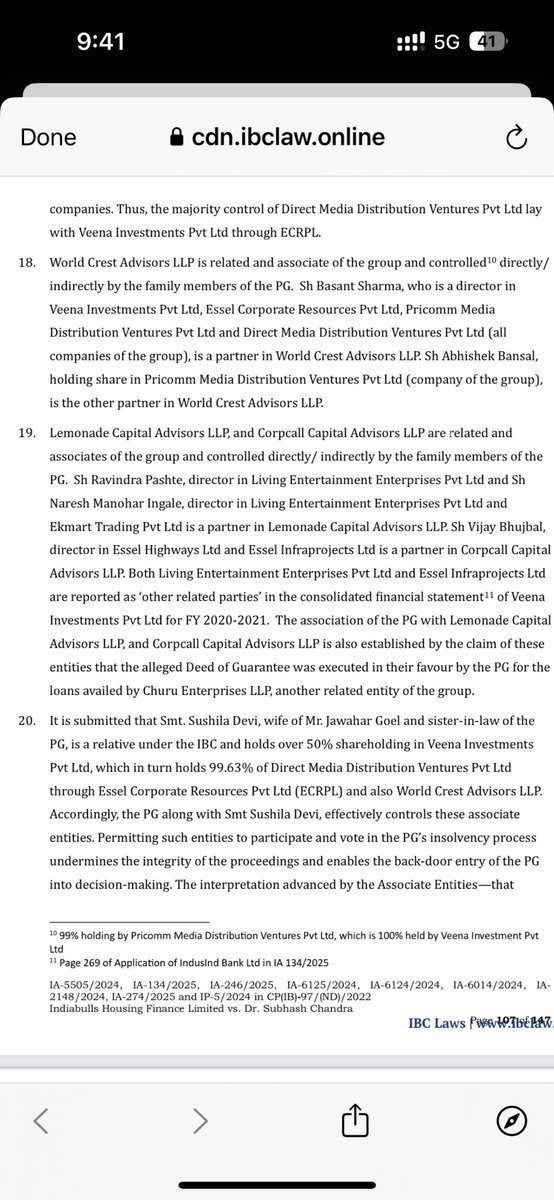
Five disputed creditors, World Crest, Lemonade, Corpcall, Veena Investments and Direct Media, together controlled around 61.78 percent of the total voting power. Their links with the Chandra and Essel ecosystem through family relationships, directorships, shareholding and corporate connections were argued before the NCLT. The Technical Member found these connections serious enough to question their voting rights. The Third Member took a narrower statutory view and said the legal test to disqualify them as associates had not been fully satisfied.
But the mathematics does not disappear.
Around 77.48 percent of the total voting share supported the plan. Remove these five disputed creditors and the support falls to around 15.70 percent, while around 18.42 percent had voted against it.
So these five were not minor creditors sitting on the side.
Their votes were decisive.
Now understand why this matters economically.
Suppose a promoter has ₹10,000 crore of personal liability. A company within the same economic ecosystem holds a ₹6,000 crore claim and an outside bank holds a ₹4,000 crore claim. The connected company accepts almost nothing on its ₹6,000 crore claim and uses its voting strength to approve the plan.
On paper it looks like that company suffered a massive loss.
But if both sides are really part of the same economic pocket, then the internal claim is only being sacrificed on paper, while the same vote helps reduce or extinguish the outside bank’s ability to recover ₹4,000 crore personally from the promoter.
That is why the real question is not who took the biggest haircut on paper.
The real question is whose money was actually lost.
If these five creditors were genuinely independent and commercially separate, then their decision is one thing. But if their economic interests were aligned with Chandra or the Essel ecosystem, then their huge nominal claims could have supplied exactly the voting power needed to cut down the personal recovery rights of outside banks.
That possibility is exactly why beneficial ownership and real economic control should have been forensically examined before approving such a massive discharge.
And there is one more fact which makes it impossible to casually say that the entire process was flawless. Claims of more than ₹185 crore on behalf of 1,260 people were admitted without proper supporting documents and later had to be excluded by the Third Member.
So no, the real issue is not simply that ₹22,006 crore became ₹6.25 crore.
The deeper issue is this.
A person once represented as worth more than ₹40,000 crore came into personal insolvency with a disclosed net worth of around ₹31.79 crore. Five disputed creditors with documented links to the wider Chandra and Essel ecosystem held 61.78 percent of the voting power. Their votes were mathematically decisive. No complete independent forensic asset tracing was done before the plan was approved.
That is why “he was only a guarantor” is not an answer.
The two questions that must be answered are very simple.
Where did the wealth go?
And who really controlled the 61.78 percent voting block?
Until these two questions are answered through a proper forensic investigation, this will not look like an ordinary commercial haircut. It will remain a serious test of whether our insolvency system can actually deal with powerful promoters, connected entities and enormous financial claims without allowing form to defeat substance.
@FinMinIndia@RBI @IBBIIndia @narendramodi@RahulGandhi@khurpenchh@NaukarshahiGems
#SubhashChandra #NCLT #NCLAT #IBC #Banking #ForensicAudit #CorporateGovernance #FinancialSystem #Accountability #BankingFraud
If this is true, Gyanesh Kumar may be committing the biggest offence against India.
This is why bjp amended for ECI’s impunity,,
And this is also why, India will witness a Tsunami of Justice against every last perpetrator after everything they’ve done to this country.
A tale of two Asian billionaires this week.
Hui Ka Yan. Jailed for life by a Chinese court. All his assets seized. For swindling public money.
Subhash Chandra. Court approved a plan to forgive a massive $2.3B loan amount. Lenders, including public-run ones, look on helplessly.
In the #IndiaFix this week: How India's softness on billionaires is not only unfair, it's harming her economy.
https://t.co/MBXRdPWdvR
Dear Madhu Chopra, we know you your daughter Priyanka Chopra & extended family’s political inclinations so please quit publicly shaming @kritisanon on her attire choices. Why not join the BJP openly. This pic is merely representative
Officially from INDIAN IITs 🇮🇳
No fees. No entrance exam. No catch.
Here are 19 courses that are better than most paid bootcamps:
1. Artificial Intelligence: Foundations and Algorithms
🔗 https://t.co/oSYHBy2CAo
2. Introduction to Large Language Models (LLMs)
🔗 https://t.co/cb50yjV59U
3. Digital Marketing in the AI era
🔗 https://t.co/cY4BAnSMKI
4. Ethical Hacking
🔗 https://t.co/Vt6zK7tKzl
5. Generative AI for Computer Vision
🔗 https://t.co/GoFZOqhaOm
6. Cloud Computing
🔗 https://t.co/s3eKQ4kO5I
7. Data Science for Engineers
🔗 https://t.co/bc2P6F5Jsd
8. Computer Vision
🔗 https://t.co/sw0ODnKZkb
9. Cyber Security and Privacy
🔗 https://t.co/iqFHf8TPii
10. Corporate Finance
🔗 https://t.co/AMT78OsBlw
11. Database Management System
🔗 https://t.co/dFPgDFun9i
12. Data Structures and Algorithms using Java
🔗 https://t.co/X8UsoouHO6
13. Data Structures and Algorithms Design
🔗 https://t.co/kuixtbaTCD
14. Introduction To Operating Systems
🔗https://t.co/yq2e4gr2S9
15. Natural Language Processing
🔗https://t.co/NW57eofXXt
16. Programming In Java
🔗https://t.co/OAyT6kLYAz
17. Programming in Modern C++
🔗https://t.co/0E3lquqUpM
18. Programming with Generative AI
🔗https://t.co/MItYoWr2bF
19. Python for Data Science
🔗https://t.co/mCcMpCOsA3