I think ETH is one of the cleanest “nobody loves it, but money is coming back” trades in the market right now.
I like these kinds of setups because the crowd is not fully convinced yet.
The timeline is still talking about Solana, and to be fair, it deserves a lot of that attention.
New L1s look sexier, perp DEX tokens feel more exciting, and AI coins are easier to market.
But ETH is quietly starting to get bid again.
To me, that usually says one thing.
The market may not be buying the narrative yet, but capital may be starting to buy the possibility.
There is a big difference.
The good thing about ETH is this.
It is not trying to convince anyone.
The liquidity is already there.
The institutional access is already there.
A large part of the stablecoin economy is already there.
The main memory of DeFi is already there.
Sometimes, while the market is looking for something new, the biggest opportunity is in an old thing getting repriced.
ETH feels a bit like that to me here.
Boring.
But boring things sometimes give the best multiples.
This week was a good reminder that crypto can change regime faster than the narrative does.
BTC started the week by ripping above $87K.
U.S. spot BTC ETFs took in ~$999M on Monday alone, their biggest day in 11 months, and roughly $2.25B from Monday through Thursday.
ETH ETFs added another ~$603M over the same period.
But the interesting part is what happened underneath price.
• Stablecoin market cap: ~$307B, +~1% over 7d
• DEX volume: +9.4% WoW
• Perps volume: +19.8% WoW
Liquidity expanded.
Leverage expanded much faster.
That distinction matters. The demand was real, but traders became aggressive faster than the underlying liquidity base grew.
Meanwhile, another shift was happening in DeFi.
Aave V4 on Base went live with seven Coinbase-tokenized U.S. tech stocks usable as collateral to borrow USDC.
Ondo also launched onchain portfolio tokens based on strategies developed by BlackRock.
To me, there are three lessons from this week:
→ Follow capital flows before narratives.
→ A rally can have genuine spot demand and still become leverage-heavy very quickly.
→ Tokenization gets much more interesting when assets become usable collateral and financial primitives, rather than simply tokens that track something.
Price tells you what happened.
Flows, leverage and utility tell you what may actually persist.
Two tokenized assets can track the exact same thing and still carry very different risks.
That’s why I think looking at RWAs by issuer matters as much as looking at the asset itself.
@coingecko 3M chart makes this pretty visible.
The market is split across issuers like Tether, Paxos, Ondo, xStocks, BTech, Kinesis and Robinhood Europe, and their share of the market has been changing over time.
When you buy an onchain representation of a stock, commodity or ETF, you’re not only choosing the underlying exposure.
You’re also choosing who issued the token, how that structure works, and where the liquidity sits.
A useful distinction as tokenization expands.
“RWA” describes the category, but it doesn’t make every wrapper interchangeable.
CoinGecko’s RWA Charts lets you compare the market by issuer, asset type, market cap, volume and timeframe.
🔗 Worth exploring the breakdown yourself: https://t.co/CMfhcNdJEt
Aave is starting to look less like just a DeFi lending protocol and more like a crypto-native credit institution.
Yesterday, Aave Labs proposed “Aave Institutional.”
The DAO would authorize two funding routes:
→ 25M GHO through a new facilitator
→ up to $25M USDC/USDT borrowed against DAO balance-sheet assets
That capital would fund overcollateralized loans to institutions posting BTC or ETH with qualified custodians, typically at 60–75% LTV.
The economics are interesting.
Borrower rate: 6–8%
Funding cost: ~4.5%
Net margin to the DAO: 1.5–3.5%
At $50M fully deployed, that’s roughly $750K–$1.75M in annualized net interest.
But I think the bigger shift is where the yield comes from.
It isn’t another DeFi loop recycling the same onchain leverage and incentives.
GHO becomes funding capital for institutional credit outside DeFi.
There is a tradeoff.
The proposed 25M GHO capacity is ~42% of the $59.9M currently available in GHO Stability Module redemption inventory, so peg liquidity has to be managed carefully. Every funding authorization would require GHO Steward approval.
And this is still an ARFC proposal, not something already live.
But if governance approves it, Aave starts exporting DeFi liquidity into offchain credit markets.
That’s a much bigger business than simply waiting for more people to borrow stablecoins onchain.
Crypto cards are getting interesting again.
But cashback alone doesn’t tell you much. FX spread, reward caps, stablecoin conversion and day-to-day reliability probably matter more.
I’m thinking about getting one.
Which crypto card are you actually using right now?
Would you recommend it?
I never realized how high the entry point for exchange VIP programs actually was until I compared them.
Binance VIP1: $100K assets or $1M 30D spot volume*
Bybit VIP1: $100K assets or $1M 30D spot volum
OKX VIP1: $100K assets or $1M 30D spot volume
Bitget VIP1: $30K assets or $500K 30D spot volume
Then there’s @MEXC.
The new VVIP system starts users at 350 M-Score and Standard status, with no specified asset or trading-volume requirement to enter.
And, under the current Global/APAC Card promo, Standard includes 4% cashback up to 100 USDT/month, alongside member vouchers.
Your M-Score can then move with trading, assets, account activity and security setup, with Premier starting at 600 and Elite at 800.
I think that’s the more useful comparison here.
The benefits themselves aren’t radically different from what exchanges already offer VIP users.
The unusual part is who gets access to the first tier in the first place.
➡️ Check your M-Score: https://t.co/UnC0oG4Y3e
Bitcoin doesn’t care about US unemployment.
So why does crypto sometimes move violently because a few thousand more or fewer Americans got a job?
Because Bitcoin didn’t change.
The capital pricing Bitcoin did.
In 2017–19, the correlation between Bitcoin and S&P 500 returns was basically zero: 0.01.
By 2020–21, it had climbed to 0.36.
That’s a pretty important structural shift.
Back then, crypto was much more dominated by its own flows:
new users, ICOs, spot demand, exchange listings, crypto-native speculation.
Then crypto became increasingly plugged into the same liquidity machine as every other risk asset.
So today the chain looks something like this:
weak employment data
→ Fed expectations change
→ rates / dollar liquidity expectations change
→ risk gets repriced
→ BTC moves
→ leverage and liquidations amplify it
Which is pretty funny for an asset built around decentralization.
And I don’t think the explanation is simply “there aren’t enough real users anymore.”
That’s part of it when organic spot demand is weak.
The bigger change is financialization.
Institutions, ETFs, market makers and macro-driven capital now have far more influence over price discovery.
Even after spot ETFs launched, US trading hours became disproportionately important for crypto liquidity and volatility.
So maybe the distinction is:
Bitcoin is decentralized at the settlement layer.
Bitcoin’s price discovery absolutely isn’t.
2017 crypto could largely trade its own cycle.
Today, crypto-native liquidity often has to compete with the entire dollar liquidity cycle.
Crypto traders learn pretty quickly that being good at one market doesn’t automatically make you good at another.
You can understand funding, unlocks, onchain flows and perp positioning inside out…
Then open an equity and suddenly you’re reading earnings, trying to understand valuation and realizing the market closes every day lol
Similar chart but a very different game.
I actually think learning TradFi makes you a better crypto trader too.
You start understanding where some of the macro moves affecting your bags are coming from in the first place.
@MEXC dropped an Investor Handbook as part of their Opportunity Compass stuff.
If stocks are still a bit foreign to you, probably not a bad place to start.
Knowing how to trade crypto is useful but
knowing which parts of that knowledge don’t transfer is probably even more useful!
Crypto trader eyeing Wall Street? Start with what you already know. 👀
The MEXC Stock Trading Handbook is now live.
Swipe to see what’s inside 👉
Want the full handbook? Join https://t.co/pOqIjE2QvG and type handbook.
#MEXCTradFi#MEXC0FEE
The ECB quietly removed one of the biggest bottlenecks in tokenized finance yesterday.
Not issuance.
Settlement.
Pontes is now live, letting wholesale tokenized assets settle in central bank money while the asset itself can remain on a DLT platform.
And this isn't another CBDC pilot.
13 market participants are already onboarded, including Deutsche Bank, Santander, Société Générale, KfW and the EIB, alongside 4 DLT operators: Clearstream, SWIAT, Cashlink and Axiology.
The ECB is going one step further too.
It has started preparing to invest a portion of its own funds into tokenized euro-denominated public-sector securities, with those transactions settling through Pontes.
I think this changes the RWA discussion a bit.
Tokenizing a bond was never the hard part.
The hard part was connecting the tokenized asset to settlement money institutions actually trust, without forcing the entire financial system onto one blockchain.
Pontes basically says:
→ assets can live on different DLT rails
→ settlement can still happen in central bank euros
→ existing financial institutions don't have to abandon TARGET infrastructure
Stablecoins aren't disappearing from that equation either. The ECB itself expects private settlement assets to coexist with central bank money.
So the next RWA competition probably isn't just who tokenizes the most assets.
It's who controls the rails connecting assets, liquidity and settlement.
That market is starting to look a lot more serious.
The calendar is lighter this week.
The setup isn’t.
After last week’s 25bp Fed hike, US 10Y yields pushing above 5% and $BTC reclaiming $80K, this week is mostly about whether that rebound can actually hold.
What I’m watching ↓
→ Tue: US Treasury Market Conference: Fed, Treasury, SEC, CFTC + stablecoins/tokenized deposits on the agenda
→ Wed: US Flash Manufacturing + Services PMI
→ Thu: Trump–Xi meeting: trade, AI and broader US–China relations back in focus
→ Thu: Initial Jobless Claims + New Home Sales
→ Fri: Durable Goods + final Michigan Consumer Sentiment
→ Fri: ~1.76B $XPL scheduled to unlock, equal to roughly 63% of current circulating supply
No CPI.
No FOMC.
And August PCE doesn’t arrive until Sep 30.
So this feels less like a “wait for the big announcement” week and more like a confirmation week.
BTC already absorbed a failed CLARITY vote, a Fed hike and 5% Treasury yields.
Now I want to see whether spot demand keeps showing up without a major catalyst forcing it.
And on the alt side, $XPL is probably the cleanest supply event to watch.
Quiet calendar ≠ quiet market.
$746M left spot Bitcoin ETFs on Sept 15 and 16. $BTC is up ~7% since.
That is the entire argument against news-based forecasting, in two lines.
What those two days actually looked like ↓
- Sept 15: CLARITY Act cloture fails 49-50, 60 needed. $BTC -4.2%
- Sept 15 ETF flow: -$450.4M
- Sept 16: Fed hikes 25bps to 3.75-4.00%, first since July 2023, unanimous
- Sept 16 ETF flow: -$295.9M
- Sept 16 low: $74,913
Then it reversed ↓
- Sept 17-18 ETF flow: +$484.1M
- 24h liquidations: $547M, $469M of it shorts, 107K traders
- $BTC now: ~$81,100, +25% on the month
- $ETH: +37% on the month
Backdrop: the US 10Y just tagged 5%, highest since July 2007. Rates at a 19 year high, the industry's main bill dead, and crypto up 25%.
The analogs said the opposite. March 2022, Fed's first hike, $BTC sitting 40% under its ATH, rallied 18% over 12 days and then fell 50%. That is the exact chart everyone posted this week.
Jan 2024 was the mirror image. Most bullish headline crypto has ever had, spot ETFs approved, and $BTC lost 16.6% over the next 12 days.
Imo the analogs are worse than useless now, because they are public. If you and I can both pull up the 2022 overlay, so can the funding rate. It gets positioned into before it resolves.
The single biggest day of this month proves it. Aug 20, $BTC +8%, $2.74B of shorts liquidated, a record. Not new demand. Forced buying.
What still works: measuring the gap between what is priced and what prints. @Polymarket had CLARITY at 12% in early September, ~30% the day before it died. The outcome was already known. That 4.2% drop was positioning unwinding, not information.
News plus history gives you a volatility map, not a price target. Different products.
Change my mind.
DeFi lending is growing while fewer wallets are showing up.
Aave’s August numbers are a pretty good example:
• TVL: $27.4B, +13.7% MoM
• Active loans: $11.7B, +12.9%
• Fees: $33.9M, +15.2%
• Monthly active users: 68.9K, -3.8%
That’s the fourth straight month of declining users, while capital, borrowing and fees are all moving higher. Aave also now holds 47.8% of the tracked onchain lending loan book.
And V4 makes the pattern even clearer.
Average V4 TVL grew 53.4% MoM, while active loans grew 62.9%. Aave Labs separately reported V4 deposits passing $800M by month-end.
To me, this is a more interesting DeFi signal than another TVL ATH.
Growth doesn’t necessarily need millions of new wallets anymore.
It can come from fewer, larger and more capital-efficient balance sheets doing more onchain.
That looks a lot more like financial infrastructure than the old “farm → dump → move to the next protocol” version of DeFi.
One thing the market has taught everyone over the last few years:
You can’t understand crypto by only following crypto.
Rates, Nvidia, equities, earnings, liquidity, regulation… half the move can start somewhere else entirely.
That’s why I actually like seeing Binance Square add a dedicated Stocks tab.
Because having the equity conversation, macro context and crypto reaction in the same place makes more sense than pretending these are separate markets.
Especially now that the overlap keeps getting bigger.
Curious what @heyibinance and @cz_binance think the line between a “crypto” and “TradFi” audience even looks like a few years from now.
If you want to follow that overlap in real time, the Stocks tab on Binance Square is worth keeping an eye on:
https://t.co/iyCtaCwgP6
New chains usually have the same problem: trading activity shows up before deep liquidity.
Arc went live today, with @1inch and Aqua live from day one.
That makes the early LP side interesting.
Aqua lets assets stay in your wallet while the same capital can support multiple liquidity strategies, so you’re not locking funds into separate pools.
And on a chain this new, LP competition is still thin.
No guarantee that means better returns obviously… flow still has to show up.
But this is usually the window I watch: demand is there, liquidity is still catching up.
Arc being built around stablecoins and RWAs makes that even more interesting.
🔗 If you wanna give a closer look:
https://t.co/Fi2jSa4gjG
I went deeper on the liquidity gap, Aqua and what I’m watching next here:
https://t.co/N31xNRt1RN
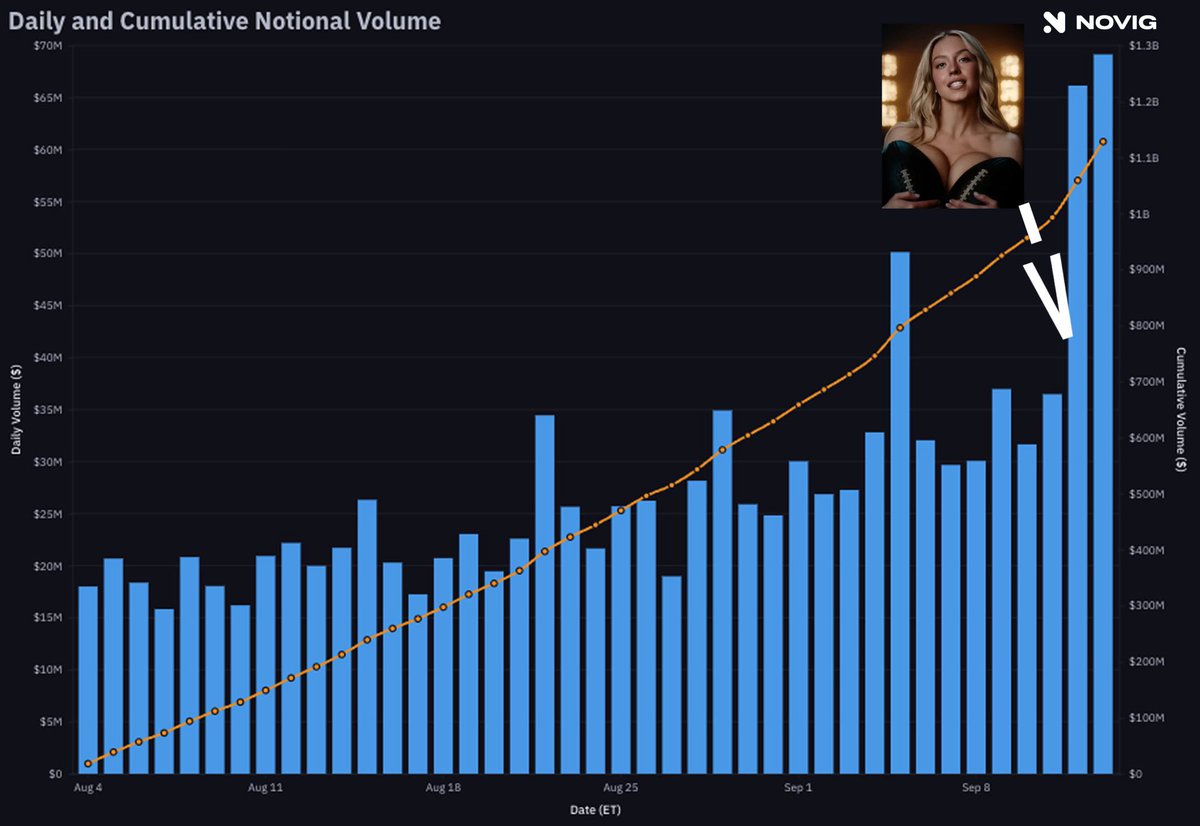
$1B in trading volume in five weeks is impressive.
And if you scratch the surface of this number is even more interesting how that volume is being traded.
@Novig it’s a sports prediction market, not a sportsbook.
There’s no house setting the line.
Prices live on an order book, and users trade against each other.
You can take the best price available, post your own, or exit before settlement.
Same sports people already speculate on. Very different market structure.
Sports-only seems to be finding its lane!