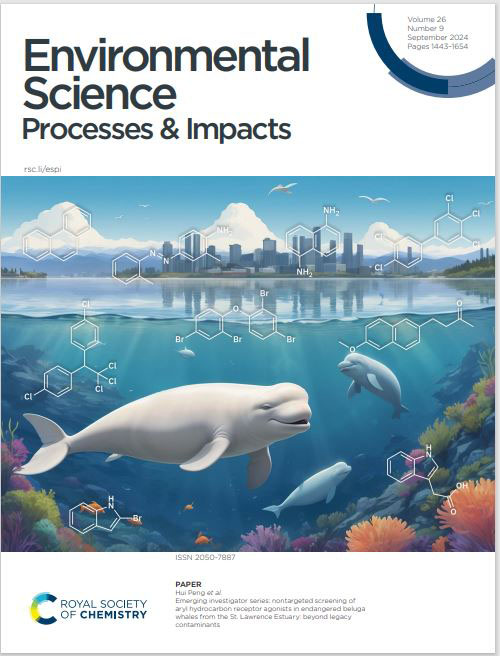
My new paper it out in @EnvSciRSC#ESPI as part of the Emerging Investigator Series!
This study discovered that many polar, bioactive #contaminants may explain the #AhR-related #toxic effects in an endangered #beluga whale population. (1/8)
Read it here: https://t.co/tGmCtVBkCg
@EnvSciRSC Special thanks to all our amazing co-authors for all their contributions to this work: Jianxian Sun, Yuhao Chen, Diwen Yang, Jonathan Verreault, @Houde_Magali, and Frank Wania. (7/8)
Disclosing Environmental Ligands of L-FABP and PPARγ: Should We Re-evaluate the Chemical Safety of Hydrocarbon Surfactants? | Environmental Science & Technology https://t.co/koJGCuPhXp
Attention #ecotox 🐟and #6PPDQ researchers: the pre-print of our very exciting new study (lead by Pranav Nair) is out! We reported the highly selective #toxicity of tire-related 6PPD-Q and identified possible safe replacements for #6PPD. (1/5)
We are currently working on follow-up studies to hopefully identify the enzyme and protein involved to better elucidate the #mechanism of selective toxicity of 6PPDQ! Check out the pre-print on @ChemRxiv : https://t.co/FmUOFhQjK6 (5/5)
This ambitious #screening effort will require a lot of collaboration within the ##environmentalchemistry and #toxicology communities. If you are interested, please check out our perspective paper, and feel free to contact the #PengGroup! 🙌https://t.co/4p391ngb2l (4/4)
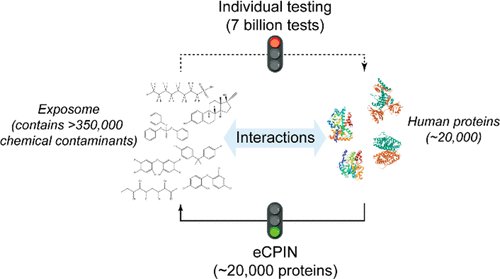
Exciting news: Our new perspective paper, led by @gong_yufeng, is out now in @EnvSciTech! We outline our group's framework for screening bioactive #contaminants at the #exposome-wide level ('eCPIN') using 'bait' #proteins. 🎣🧫(1/4)
https://t.co/kkf8nfGUWY
We have big plans for #eCPIN! Our aim is to use it to map🗺️the whole exposome of protein-contaminant interactions. Check out our freely accessible online #database https://t.co/cldQnanPlI where we will be depositing all of the bioactive contaminants we find. 🔎 (3/4)