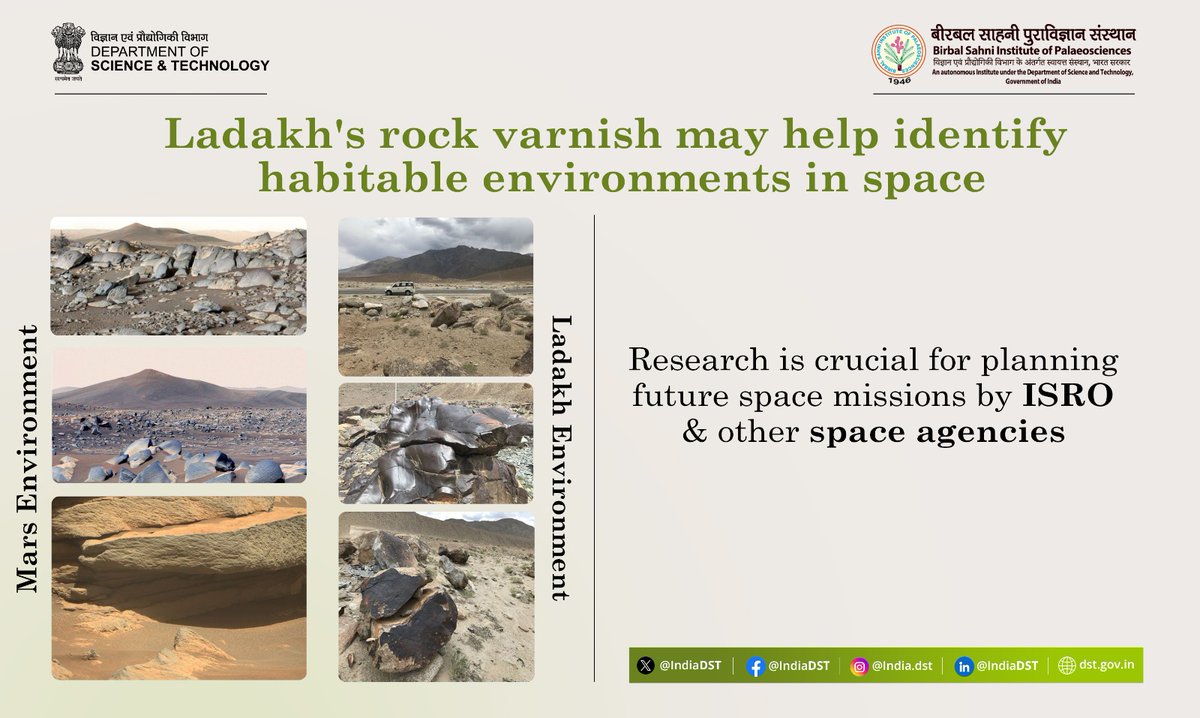
By identifying biotic signatures in rock varnish, scientists @BSIP_official can better target potential biosignatures on Mars & other planetary bodies, aiding the search for extraterrestrial life.
@DrJitendraSingh@karandi65
🔗https://t.co/dQy7O3wZJi
Please to share my new article , throwing new perspective on role of organics in primitive asteroids in emergence of life. https://t.co/BfRmzOFlCY
@StudyatUSTC@astrobiology
When asked about India's contributions to science, many go back thousands of years and speak about zero, ancient universities, metallurgy, or Ayurveda.
While those achievements are undoubtedly important, India's contributions to modern science are equally remarkable and far less appreciated.
What is fascinating is that many of these contributions emerged during the late nineteenth and early twentieth centuries, when India was under colonial rule and had very limited scientific infrastructure.
Consider a few examples.
Jagadish Chandra Bose demonstrated millimetre wave wireless communication and developed one of the earliest semiconductor detectors. More than a century later, millimetre waves are at the heart of modern 5G and future 6G communication systems, while semiconductor devices underpin the entire digital economy.
Meghnad Saha developed the ionization equation, which made it possible to determine the temperature and chemical composition of stars from their spectra. Modern astrophysics, stellar evolution studies, plasma science, and even fusion research continue to rely on principles that emerged from his work.
Satyendra Nath Bose developed the statistical framework governing an entire class of particles now known as bosons. Lasers, superconductors, Bose-Einstein condensates, photonic technologies, and many emerging quantum computing platforms trace their origins to ideas he developed in a few pages written in Dhaka.
Upendranath Brahmachari developed Urea Stibamine, one of the first successful targeted treatments for a major infectious disease. Beyond saving countless lives from Kala Azar, his work helped establish the foundations of modern antiparasitic chemotherapy and drug discovery for neglected tropical diseases.
Prafulla Chandra Ray's contribution went far beyond discovering new chemical compounds. He demonstrated that scientific research could be translated into indigenous industrial capability. Through Bengal Chemicals, he laid some of the earliest foundations for science-driven manufacturing in India, a legacy that can be seen today in India's globally significant pharmaceutical industry.
These were not incremental advances. These were foundational contributions that shaped entire scientific disciplines and industries worth trillions of dollars today.
These foundational works also helped many receive Nobel Prizes later.
India has never lacked talent. Even under colonial rule, Indian scientists produced ideas that changed the world.
The challenge now is to build institutions that trust scientists, reduce bureaucratic friction, invest consistently in research, protect academic freedom, and create environments where transformative ideas can flourish.
If a colonized nation with limited resources could produce all this great science, one can only imagine what India can achieve if we fully unleash the talent that exists today.
We just need to empower 'real' scientists.
https://t.co/DsttYZc9Ld
My first co-authored paper on revesiting the role of Mn-oxides as oxygen barometers on Early Earth like conditions. Kudos to whole research team. @StudyatUSTC@astrobiology
The presence of manganese oxides has been used as a proxy for oxygenation on early Earth, but experiments show that manganese-bearing carbonates can photo-oxidize under the UV wavelengths present on early Earth and Mars—even without oxygen. In PNAS: https://t.co/Wzx1TooDBW
Many congratulations to Prof. Abhay Karandikar, Faculty in Dept. Of Electrical Engineering and present Secretary, DST, for being selected as a full time member of NITI AYOG.
It's a proud moment for @IITBombay@IndiaDST.
This announcement marks a significant step in bringing Prof. Karandikar's deep technological insights into national decision-making and strengthening innovation-led governance.
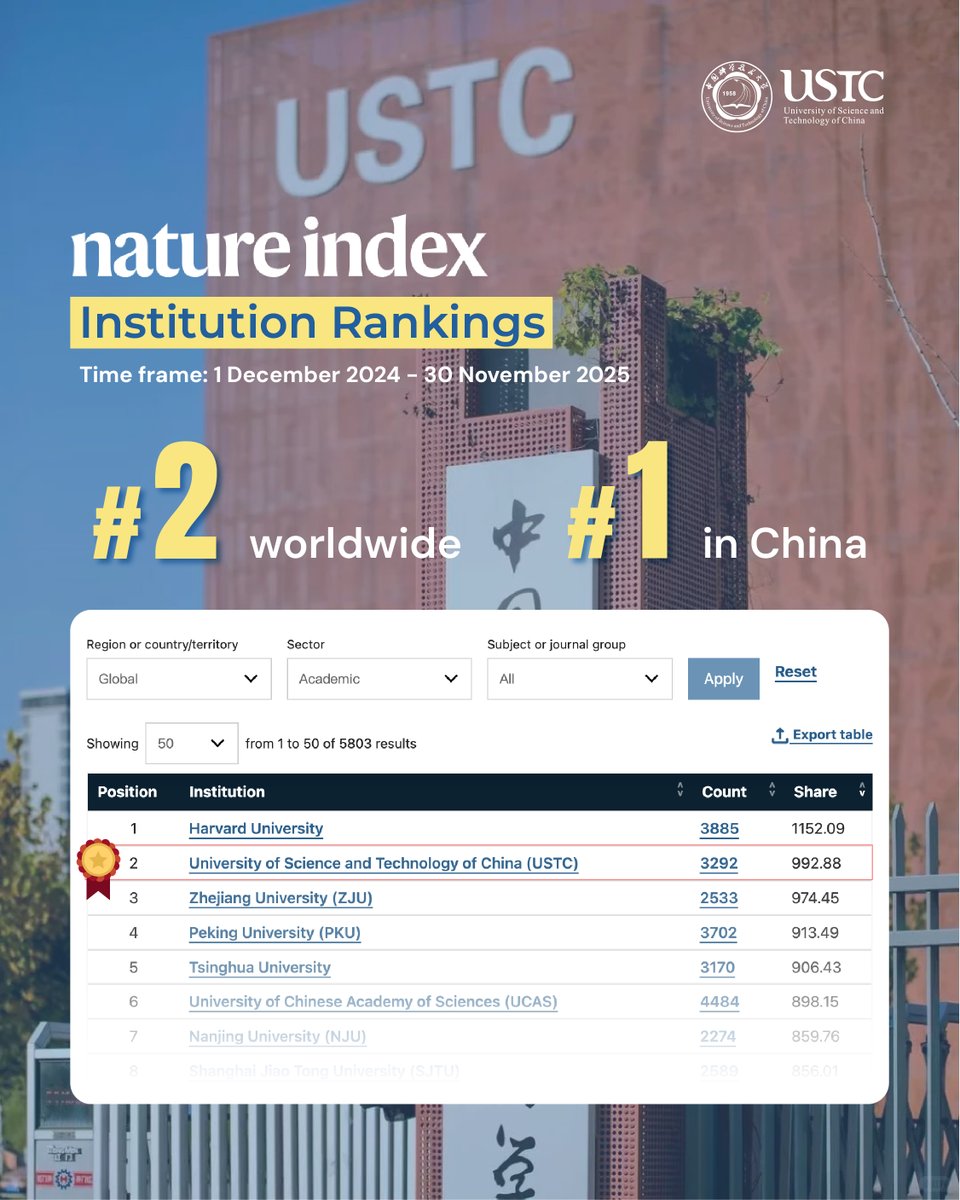
We are delighted to share that in the latest Nature Index (tracking December 2024 to November 2025), #USTC ranks 2nd globally and 1st in China among academic institutions. Furthermore, within specific subject areas, USTC claims the #1 spot worldwide in both Chemistry and Physical Sciences.
These achievements reflect our continued commitment to advancing high-quality research and pushing the frontiers of scientific innovation.
https://t.co/IJE5gfQjcO
#NatureIndex #ScientificResearch #ResearchExcellence #StudyInChina #StudyAtUSTC #中国科学技术大学 #中国科大
Today is the first day of the Spring Festival in China. Happy Chinese New Year! Wishing every friend strength, prosperity, and every success in the Year of the Horse. 🐎
George Rossman (PhD '71), professor of mineralogy, emeritus, passed away on February 6, 2026. He was 81. Rossman will be remembered for his contributions to education at Caltech, which spanned 55 years and impacted thousands of students.
https://t.co/mbscjFowR8
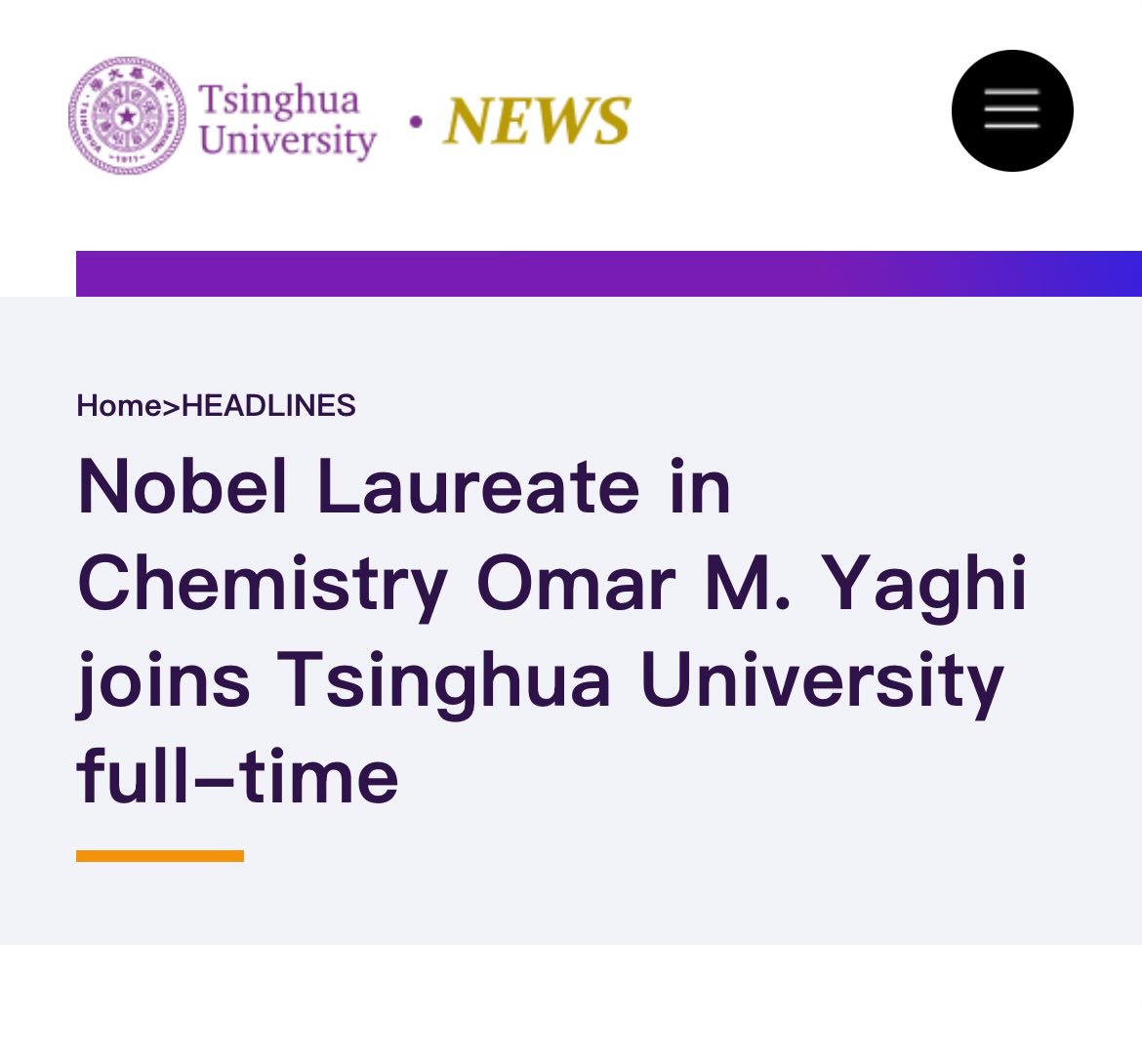
A fellow with excellent CV, applied for Assist Prof in comput chem. While people were busy in shortlisting candidates based their alma mater, he got a full prof position in China. Today, I saw he published Nature Chem as main corresponding author.
This is hw we r losing talents.
BCCI has taken an incredibly loose stance and now the entire nation is ready to GIVE UP watching cricket. As someone rightly said, it’s not Team INDIA, it’s just a private BCCI team.
Bid farewell to Prime Minister @narendramodi at the airport today.
Appreciated his insights and constructive engagement with #SCOsummit.
Looking forward to closer ties between China and India. 🇨🇳🤝🇮🇳
✈
credit:@sidhant