Professor of Finance, co-director of Ctr for Fin. Tech., Imperial Business School; visiting scholar, Harvard Uni; research director, CNRS; research fellow, CEPR
@ARosencher Bravo! Sans parler du fait que se glorifier de ne pas savoir compter vous met en position de faiblesse au marche, a la banque, avec vos proches qui pourraient ne pas vouloir que votre bien et dans bien des interactions de la vie courante
@renegoupillaud@sc_cath Research takes forever publishing is slow the entire process and risky so incentives tend to be to not add risk to risk. Tenure is an insurance that allows researchers to take risk. And if they stop doing research extra teaching and admin kick in.
@babgi Il n y a la pas grand chose de nouveau. Si vous lisez the Great Reversals de @ThomasPHI2 ou the Profit Paradox de @janeeck vous y trouverez du grain a moudre. :)
Quel que soit le parti pour lequel vous voterez en 2027, si vous voulez offrir un avenir aux entreprises tech en France et en Europe, écoutez le fondateur de Mistral ou Total Énergies et non des politiciens en seul quête de pouvoir.
Ne tuons pas l'UE, faisons-la accélérer ! 🇪🇺🚀
Does PE create value? How? How do AI and tokenization transform PE? As public invstment dries out and large firms buy PE-backed innovation and sell poorly performing business lines to PE, what is the impact of PE on patients and other stakeholders? 2/3
https://t.co/AJd1HMbUHS
Private equity already manages 5 to 10% of global corporate equity and keeps rising. Nearly all new large innovative firms are funded with PE. Healthcare is one of the most heavily impacted sectors. #privateequity#healthcare#healthcarefinance
1/2
https://t.co/AJd1HMbUHS
This 2 hour Stanford lecture will teach you more about how LLMs like ChatGPT & Claude are built than most people working at top AI companies learn in their entire careers.
Bookmark this & give 2 hours today, no matter what. It'll be the most productive thing you do this week.
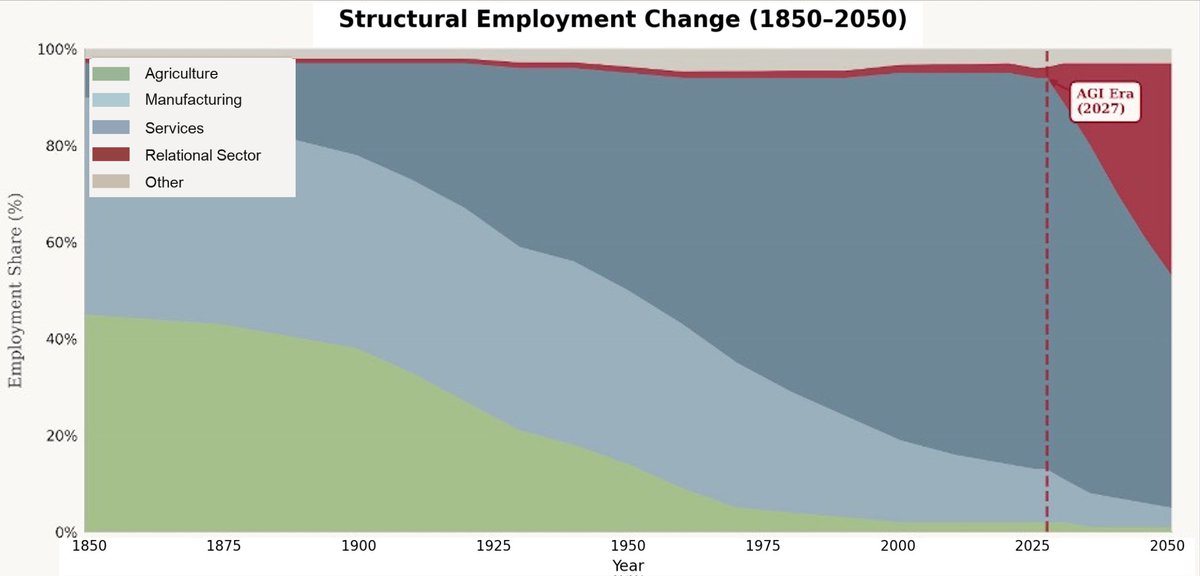
New essay on the economics of structural change and the post-commodity future of work.
1. Almost any question about the impact of advanced AI on the economy needs to start at the same place: what is still scarce? Answer that, and the analysis becomes pretty straightforward. This essay explores what becomes scarce if AI really can replicate most of what humans do in production, and what this mean for the future of jobs.
2. My conjecture, working through the economics: labor reallocates across sectors, and the sector it reallocates to has properties that keep labor a meaningful share of the economy. Ultimately this is about the structure of demand itself. For this, we have to go back to Girard, Augustine and Rousseau: once people's base needs are met, their preferences shift to comparative motives (e.g., status, exclusivity, social desirability). This motive is inherently non-satiated.
4. The key paper is Comin, Lashkari, and Mestieri (Econometrica 2021). As people get richer, they don't buy proportionally more of everything. They shift spending toward sectors with higher income elasticity. They estimate income effects account for 75%+ of observed structural change.
5. The ironic consequence: the sector that gets automated becomes a smaller share of the economy, not a larger one. Agriculture got massively more productive and its share of employment collapsed. Manufacturing too. The "stagnant" sectors absorb the spending and the jobs.
6. So the question is: which sectors have high income elasticity in a post-AGI world? I argue it's what I call the relational sector. Categories where the human isn't just an input into production, it is part of the value.
7. Why does the relational sector have high income elasticity? Because human desire has a mimetic, relational dimension. We don't just want things for their intrinsic properties. We want what others want, and we want it more when others can't have it. Girard, Rousseau, Augustine, and Hobbes all saw this.
8. In work with Kristóf Madarász, we showed this experimentally: WTP roughly doubles when a random subset of others is excluded from the good. And in new work with Graelin Mandel, AI involvement kills the premium. Human-made art gains 44% from exclusivity; AI-made art only 21%.
9. This all comes together for the core argument. The sector that absorbs spending as AI makes commodity production cheap is one where human provenance is part of the value, and demand for it grows faster than income. Exactly the profile that keeps labor meaningful.
10. To be clear about the claim: I'm NOT saying aggregate labor share must rise. It may fall. The claim is about sectoral composition, i.e., where expenditure and employment go once commodities get cheap, and the fact that the sector that will absorb reallocated labor maps to a substantial component of human preferences and desire.
11. If you're interested in the formal model, a linked companion technical note works out all the economics.
Read the essay here: https://t.co/NcjVgn2o8g
This looks like a must-read!
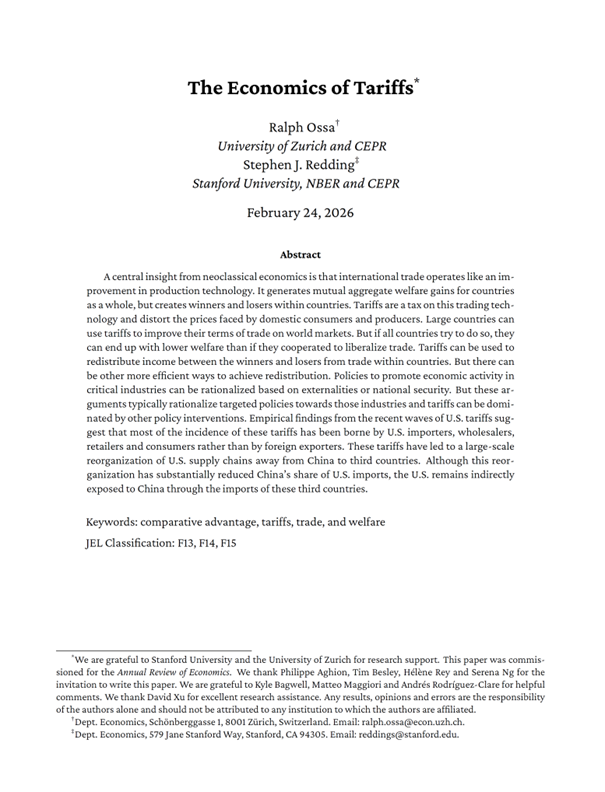
"The Economics of Tariffs" by Ralph Ossa and Stephen J. Redding.
"A central insight from neoclassical economics is that international trade operates like an improvement in production technology. It generates mutual aggregate welfare gains for countries as a whole, but creates winners and losers within countries. Tariffs are a tax on this trading technology and distort the prices faced by domestic consumers and producers. Large countries can use tariffs to improve their terms of trade on world markets. But if all countries try to do so, they can end up with lower welfare than if they cooperated to liberalize trade. ...Empirical findings from the recent waves of U.S. tariffs suggest that most of the incidence of these tariffs has been borne by U.S. importers, wholesalers, retailers and consumers rather than by foreign exporters. These tariffs have led to a large-scale reorganization of U.S. supply chains away from China to third countries. Although this reorganization has substantially reduced China’s share of U.S. imports, the U.S. remains indirectly exposed to China through the imports of these third countries."
https://t.co/J9vW8Rtwpn
@datirachida@PSG_inside A quel prix? Le PSG a offert 40 millions (a peine plus que Lens pour son stade...), soit 800e du m2 a Paris 16... Le stade en vaut 300. Le but etait juste de faire porter le chapeau a la mairie. En vous engageant vous risquez d inciter le PSG a faire une 2eme offre ridicule.
Between 1974 and 2014, only 0.1% of publications in the top 50 economics journals were replication studies.
That's 40 years. Thousands of papers. Almost none replicated.
We've built careers on findings no one has verified.
When economists finally replicate studies, 40-67% fail depending on the study.
Federal Reserve (2015): Only 49% of 67 papers from top journals successfully replicated — even with the original authors' help.
Most papers? Never checked at all.
Here's the worst part: Papers that don't replicate get cited MORE than papers that do.
And after a failed replication is published, only 12% of subsequent citations mention it.
The profession rewards interesting findings, not true ones.
Remember Reinhart-Rogoff (2010)? "Debt above 90% GDP kills growth."
Herndon, Ash & Pollin found a spreadsheet error. Results didn't hold. But by then, it had shaped austerity policy across Europe and the US.
How many other canonical papers have Excel errors?
We replicate recent papers, but canonical findings from the 1970s-90s? Nobody touches them. Too famous. Too foundational.
The older the paper, the less scrutiny it gets. Yet these are the studies we cite most.
Maybe we should replicate backwards.
Start with the most-cited papers from 1975-2000. See what holds up.
https://t.co/AjpGF2Mrv9
@anup_malani And how many of those few papers successfully replicated are valid with different time periods or datasets? How many papers bother with SUTVA? https://t.co/Q6A3pY0HHq
Maybe journals should publish more theory, more structural estimation, and more long run historical studies.
Donc ras le bol en plus tres peu de trains tres chers donc on prend la voiture vive les trajets responsables. Les tgv Paris-Lille sont plus confortables coutent souvent moins chers et durent 1h distance equivalente@udupc14 @train_nomad@SNCFVoyageurs#SNCF 3/3
A 56€ on est ballottes, sac entre vos jambes, des valises nous tombent dessus et peut etre un changement. Si Caen Cherbourg en car le trajet annonce 4h14 dure 6 heures. Pour remboursement il faut passer par la sncf pas de reponse. @udupc14@train_nomad@SNCFVoyageurs#SNCF 2/3
Il y a 10 ans Paris-Cherbourg direct de 3h Prems: €20 a toute heure. On rangeait son sac au dessus du siege, de la place pour toutes les valises, bp de places handicap. Aujh meme quand le caen-cherbourg est en car (surprise)... 56€ @udupc14@train_nomad@SNCFVoyageurs#SNCF