CEO of Haitu Tech. Founder of 海国图智 Intellisia Institute, an independent think tank on international affairs in China. Professor at Jinan University, China.
How does a social science professor become a tech company CEO??? We now have a tech company with a focus on how LLMs can change our academic life and society. For an interview, please view here: https://t.co/XTaHZiymTa
China will take part in the selection of the next UN secretary-general in a responsible and constructive manner, and will work to promote the United Nations to revitalize its authority and vitality, and to better adapt to the new circumstances and better cope with new challenges. Read more: https://t.co/augE3xMwKf
🇨🇳 China Mission – Day 6 | The future of the automotive industry is being decided now.
The biggest lesson from the past days in China: the real competition in the automotive sector is no longer about the powertrain.
While Europe is still debating combustion engines, EVs, and hydrogen, the US and China are already competing for the technologies that will define the future of mobility: software, data, AI, and digital ecosystems built around the smart car.
The car of the future is no longer just a means of transportation. It is becoming part of a connected digital ecosystem that provides services, generates data, and creates new sources of value.
Europe must be honest with itself. Strategic mistakes have been made in parts of the automotive industry, but policymakers also bear responsibility. Too often, decisions were taken without a sufficient understanding of technological developments.
Europe needs manufacturers that think beyond the vehicle itself and build complete technology and platform ecosystems. Companies such as Tesla and Xpeng demonstrate what this model can look like.
The key question is no longer which technology shaped the past. The key question is who will build the digital ecosystems of the future and whether Europe wants to lead or merely watch from the sidelines.
China creates the worlds largest national park system - by a mile.
The national park idea was invented in Yellowstone in the US. Now China will make a national park system three times the American. Of course there is no competion - its wonderful that both China and the US inspire the world to protect Mother Earth.
I am reporting from Qinghai - the park at the source of three massive rivers - a park as large as England or Uganda.
China now has 109 car brands. These are at all price points. Of course, many will eventually fall by the wayside. But some of these will become global successes. The global auto industry seems to be in for a real churn. Signal to short the European auto majors?
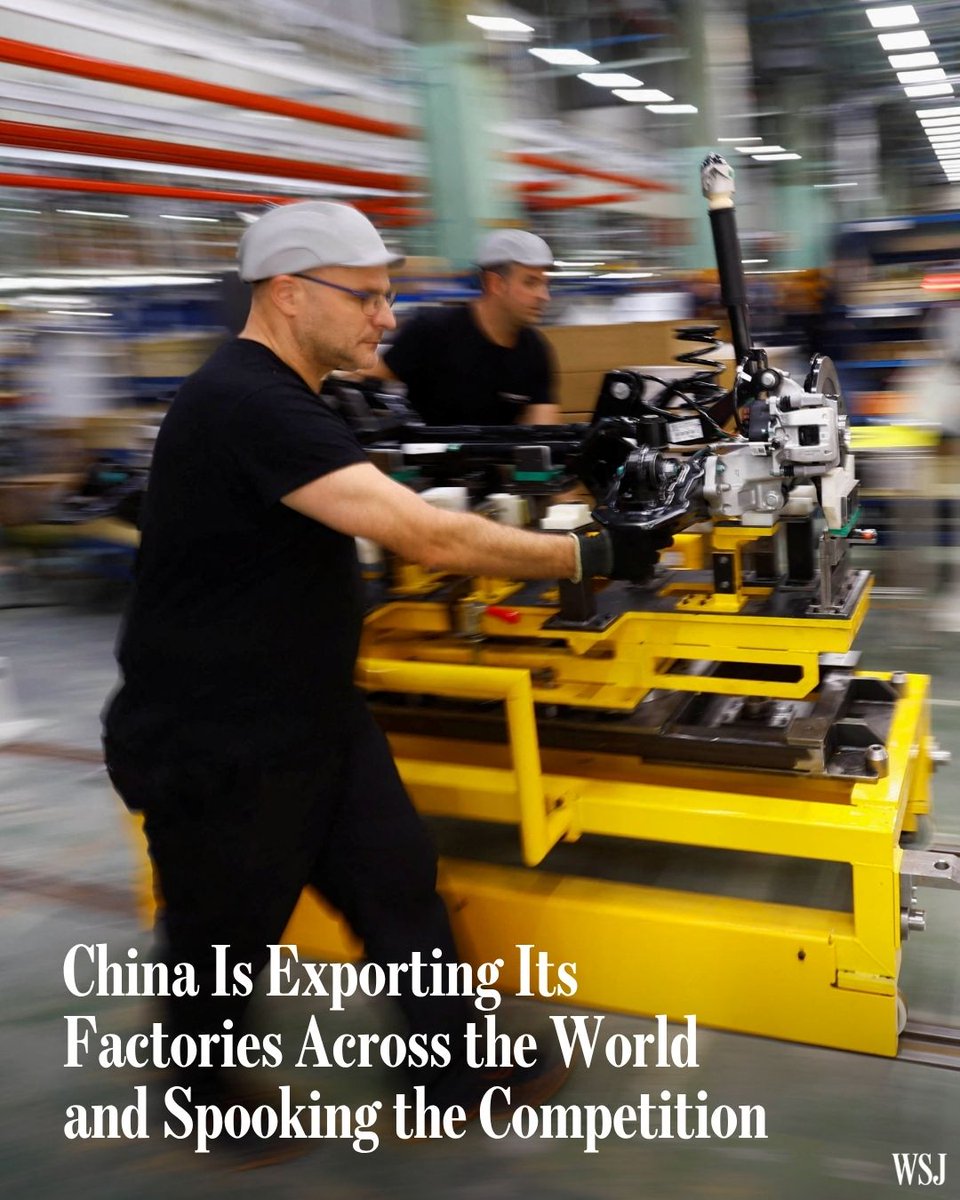
“Made in China” is becoming “made by China”—all over the world. Faced with higher Western tariffs and weak demand at home, many Chinese factories are moving abroad, making everything from appliances to cars everywhere from North America to Eastern Europe. https://t.co/ZhiI0CqQAZ
The 1980s was the crucial crossroads in China’s rise. China averted the USSR’s fate, escaped shock therapy and set out on a historically unprecedented path, carved out by drawing on its own statecraft tradition and lessons from experiences around the world.
The CCP is more like a VC fund than a traditional central planner.
Arthur Kroeber argues this is how China has succeeded, gaining massive dominance in industrial manufacturing, and sidestepping the traditional failure modes of centrally planned economies.
The CCP supports broad sectors rather than single nationalised firms, and encourages ruthless competition in those sectors.
Even though the CCP knows that competition will cause state-supported firms to fail, it believes that a few winners will make up for the failures.
The Future of Microchips Just Changed Forever! 🤯
I'm in Shanghai attending the International Symposium on Circuits and Systems, one of the most important semiconductor events of the year 💻
Bloomberg, Wall Street Journal, Forbes are all in attendance and this morning the President of Huawei Semiconductor He Tingbo gave the opening keynote speech announcing a major development for China 🇨🇳
Huawei has developed a new pathway to develop microchips and will be able to achieve a transistor density that is equivalent to 1.4 nanometers by 2031 🚀
Jensen Huang, Nvidia's CEO was recently in China and admitted the US government has given the future of China's microchip industry to Huawei and Huawei is wasting no time in mapping out the future of the industry
Read more about this from Huawei directly 👇
https://t.co/gu4oFb3rF5
Also read the latest media reports 👇
🔵 Reuters: https://t.co/qVVCJzKGr0
🔵 SCMP: https://t.co/VwSnTJq685
🔵 Bloomberg: https://t.co/bMQFARNcPn
The trajectory of Trump posts is changing:
Yesterday: Optimism about a deal
5 hours ago: Neutral, no rush for a deal
Now: Back to military threats
This is the “trap” unfolding before our eyes
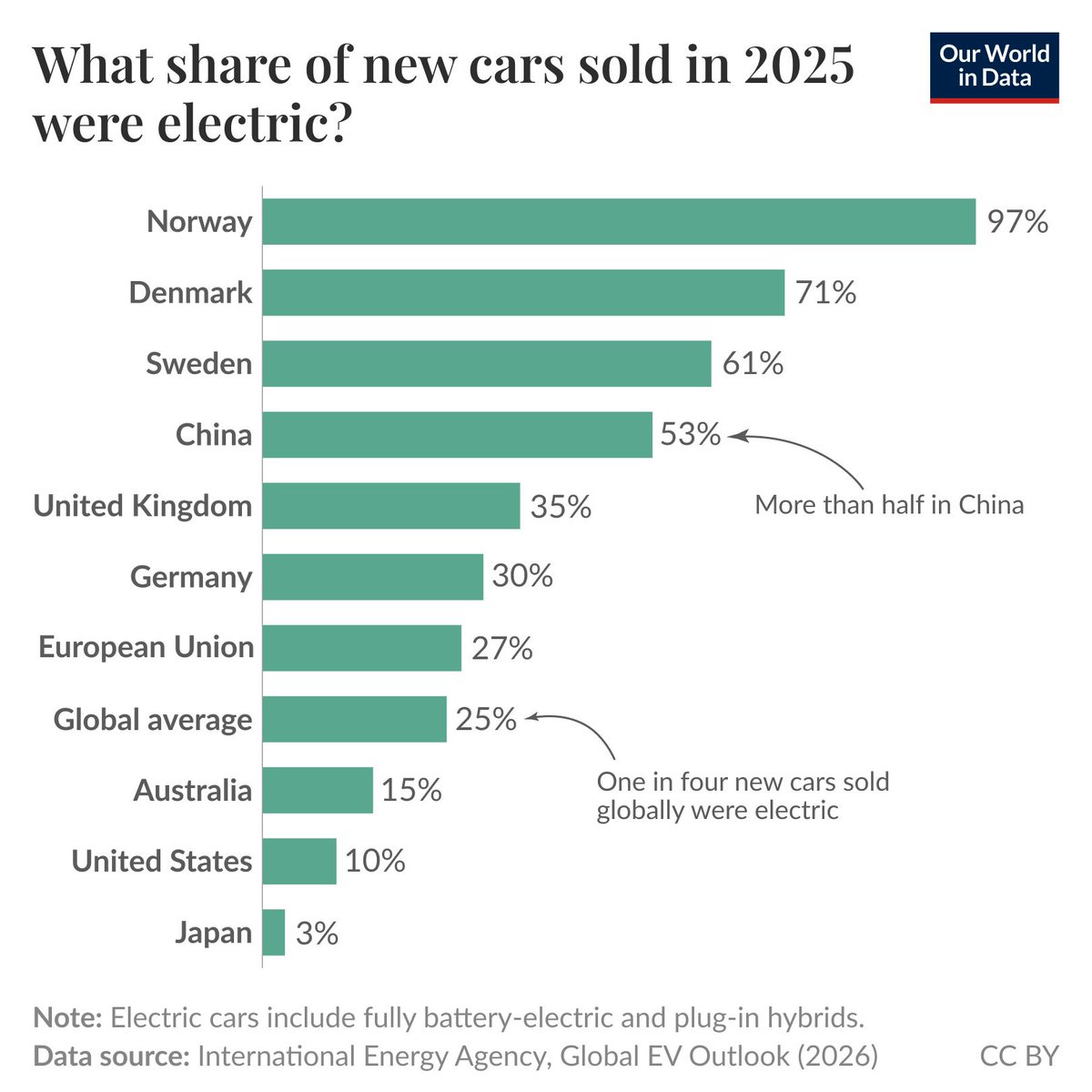
One in four cars sold in 2025 was electric.
The International Energy Agency (IEA) just published its latest annual Global EV Outlook. It provides estimates for electric vehicle sales in 2025.
One in four (25%) cars sold in 2025 were electric, more than double the share from just four years earlier.
But there are large differences in adoption rates across the world. This chart shows new sales shares by country. In Norway, almost every new car is an electric one. In China, more than half are, while in the United States, it’s just 10%.
These figures include fully electric vehicles and plug-in hybrids. You can find this data broken down by vehicle type in this chart.
(This Data Insight was written by @_HannahRitchie.)
Solar alone is now around 10–11% of China’s electricity generation depending on season/month, with #wind + #solar together already pushing above 25% in some periods. And it’s still scaling insanely fast.
Nuclear is the seasoning. #Renewables & #BESS storage are the main course.