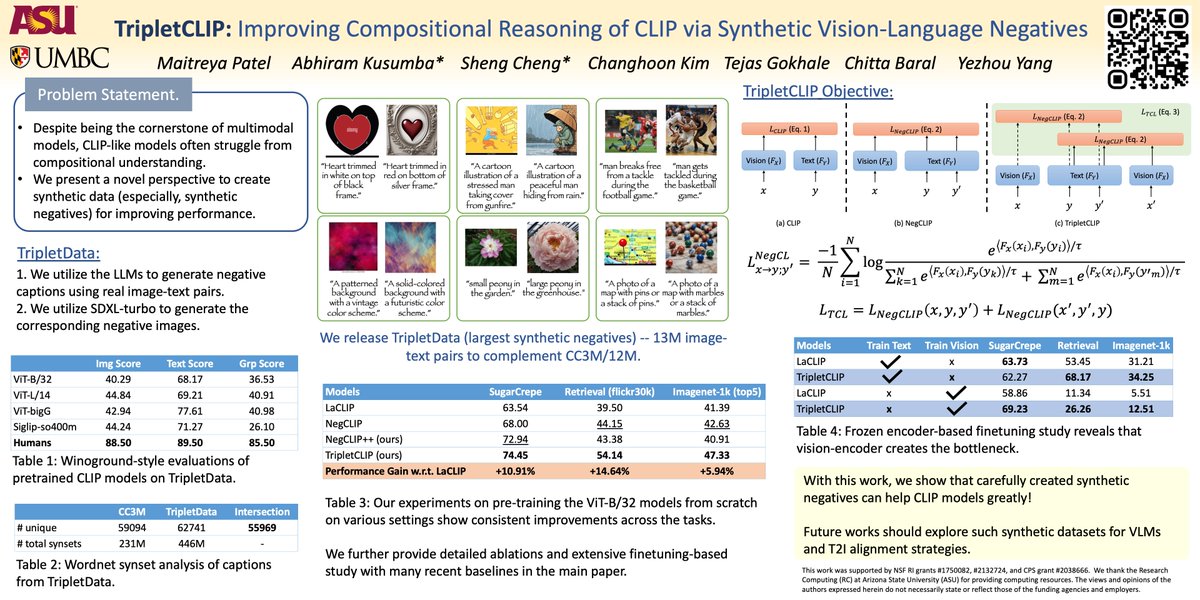
📢📢 We are presenting our paper on improving the compositionality of CLIP models today at #NeurIPS2024.
⏰11 a.m. -- 2 p.m. (today)
📍(East Exhibit Hall A-C # 2109)
Find me and my collaborators (@a_kusumba, @chengshengcs, @cbaral, and @prof_yz) to chat & learn more! 🚀
Thrilled to announce that our work has been accepted to #NeurIPS2024! Super excited to share our research with the community and be part of such an incredible conference.
Thanks a lot, as always.
@patelmaitreya@chengshengcs@prof_yz
📢📢 We will have our third talk by Deqian Kong from @uclastat for the GenAI seminar series this Friday, talking about the latent space generative model.
Date: 15th March
Time: 1-2pm MST
Location: BYENG 361 @SCAI_ASU
Register here to attend virtually: https://t.co/AIokhxD6el
📣📣 We will have our second invited talk by @huanwangx for the GenAI seminar series this Friday.
Date: 9th Feb
Time: 2-3pm MST
Location: BYENG 361 @SCAI_ASU
Register here to attend virtually: https://t.co/T36gdaaWUR
🚨🚨We are hosting "Frontier Topics in Generative AI" Seminar Series at @ASU .
This series delves into the cutting-edge of GenAI, exploring key areas like large-language models, text-to-image, video generation, and more.
We have our first speaker this week.
Don't miss this chance to dive deep into the foundational research driving the GenAI.
If you want to attend, please register through the link: https://t.co/0qVXB1cbYL
See you there!
🚨 New Paper Alert 🚨
Unleash the full potential of T2I prior models in resource efficient way with 𝑬𝘾𝑳𝙄𝑷𝙎𝑬! 🌟
𝑬𝘾𝑳𝙄𝑷𝙎𝑬 redefines efficiency for the T2I priors from unCLIP family:
✅ 33M params
✅ <5M data
A small step towards efficient T2I models. 🧵
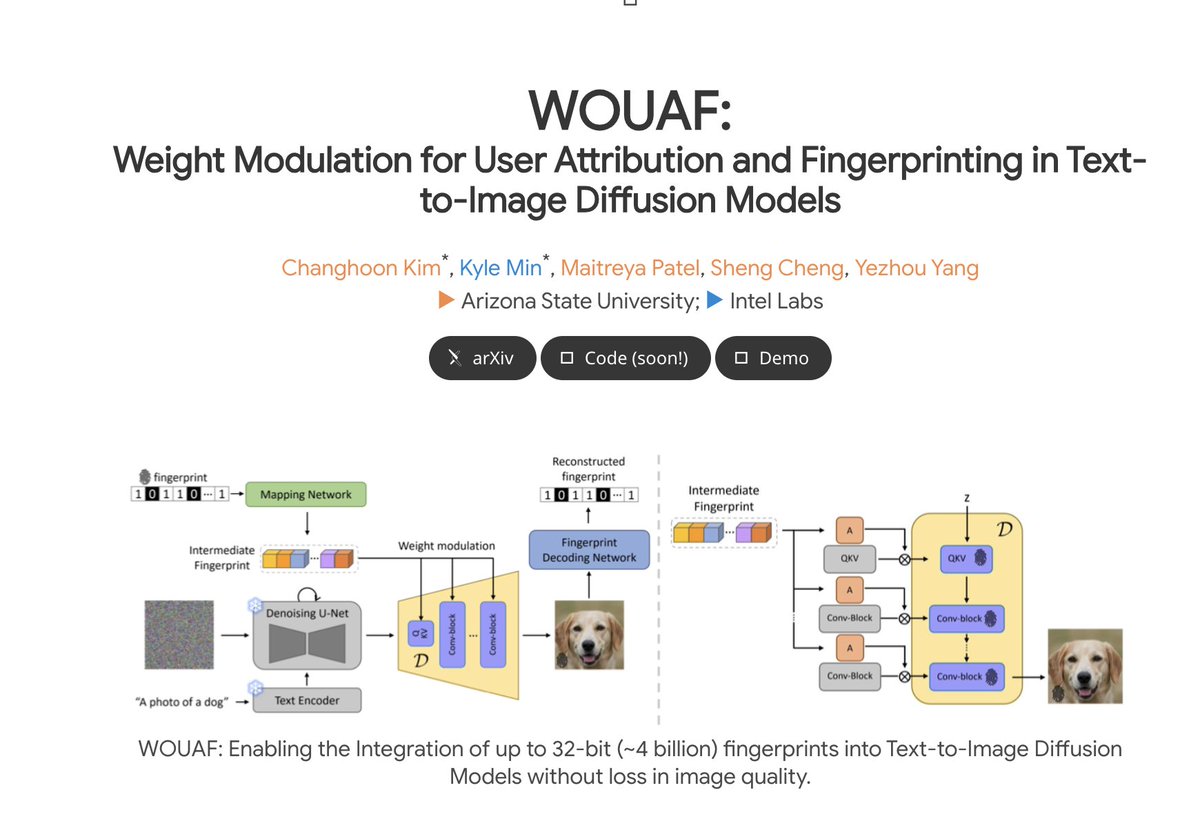
WOUAF:Weight Modulation for User Attribution and Fingerprinting in Text-to-Image Diffusion Models
paper page: https://t.co/88wJJpsPsI
demo: https://t.co/uc6Mhs7IPt
The rapid advancement of generative models, facilitating the creation of hyper-realistic images from textual descriptions, has concurrently escalated critical societal concerns such as misinformation. Traditional fake detection mechanisms, although providing some mitigation, fall short in attributing responsibility for the malicious use of synthetic images. This paper introduces a novel approach to model fingerprinting that assigns responsibility for the generated images, thereby serving as a potential countermeasure to model misuse. Our method modifies generative models based on each user's unique digital fingerprint, imprinting a unique identifier onto the resultant content that can be traced back to the user. This approach, incorporating fine-tuning into Text-to-Image (T2I) tasks using the Stable Diffusion Model, demonstrates near-perfect attribution accuracy with a minimal impact on output quality. We rigorously scrutinize our method's secrecy under two distinct scenarios: one where a malicious user attempts to detect the fingerprint, and another where a user possesses a comprehensive understanding of our method. We also evaluate the robustness of our approach against various image post-processing manipulations typically executed by end-users. Through extensive evaluation of the Stable Diffusion models, our method presents a promising and novel avenue for accountable model distribution and responsible use.
Adversarial learning
+ Bayesian CNNs = ⬆️single-source domain generalization tasks.
Joint work with Sheng Cheng, @trgokhale, and from @ApgAsu
ArXiv: https://t.co/rVQEnR5dFi
To 📢 @ICCVConference
PS: I still think this paper could be with just three sentences... 🤠